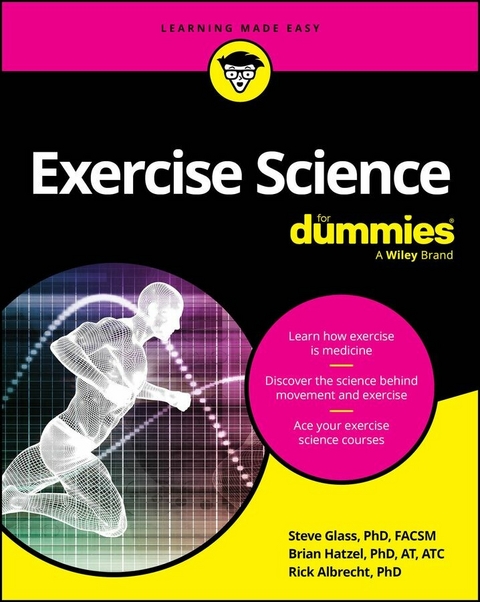
Exercise Science For Dummies (eBook)
500 Seiten
For Dummies (Verlag)
978-1-394-32390-6 (ISBN)
A comprehensive guide to the science of movement
Exercise Science For Dummies covers must-know information about the how and why to body movement. This useful primer covers content found in a typical introduction course in this topic area-which includes the likes of exercise physiology, biomechanics, and more. With current and helpful guidance, this book includes information on wearable technology, fitness programming across the lifespan, exercise as medicine, and the 101 on human performance, including prevention and care of injuries.
With Exercise Science For Dummies, you'll:
- Discover the science behind movement and exercise
- Know the powerful connection between the mind and body
- Understand exercise as a form of medicine
- Explore fitness across the lifespan
Exercise Science For Dummies is a great guide for kinesiology and exercise science majors, coaches and personal trainers, athletes, and anyone who would like to know more about movement.
Steve Glass, PhD, is a professor of exercise physiology at Grand Valley State University (GVSU) with more than 30 years' experience teaching and developing courses in exercise prescription, sports medicine, and cardiac rehabilitation.
Brian Hatzel, PhD, AT, ATC, is a professor in the Physical Therapy and Athletic Training Department at GVSU with more than 20 years' experience as an athletic training clinician and educator, having taught courses in athletic training, kinesiology, biomechanics, and injury assessment.
Rick Albrecht, PhD, is a professor emeritus in the Department of Movement Science at GVSU.
A comprehensive guide to the science of movement Exercise Science For Dummies covers must-know information about the how and why to body movement. This useful primer covers content found in a typical introduction course in this topic area which includes the likes of exercise physiology, biomechanics, and more. With current and helpful guidance, this book includes information on wearable technology, fitness programming across the lifespan, exercise as medicine, and the 101 on human performance, including prevention and care of injuries. With Exercise Science For Dummies, you'll: Discover the science behind movement and exercise Know the powerful connection between the mind and body Understand exercise as a form of medicine Explore fitness across the lifespan Exercise Science For Dummies is a great guide for kinesiology and exercise science majors, coaches and personal trainers, athletes, and anyone who would like to know more about movement.
Chapter 1
Introducing Exercise Science
IN THIS CHAPTER
Identifying the fields within exercise science
Grasping the concept of a systems approach to the control of the body
Studying the many aspects of exercise
Evaluating whether a career in exercise science is a good fit for you
The human body was made to move. Your health depends on it, your survival is supported through it, and your ability to engage and interact with the world requires it. Exercise science is the science behind exercise, how the body adapts to exercise, and using exercise as therapy to improve the body’s condition.
Because the human body is complex, the study of exercise and exercise itself is complex as well. In this chapter, we offer a quick overview of the science, the field, and the options available to you as a student — official or not — of exercise science.
Getting Familiar with Key Areas of Study
Exercise science grew out of the areas of physiology, medicine, and physical education. It has only been around as a field since the 1970s, and it’s connected to many disciplines that examine the human body at rest, during motion, and as it adapts and changes because of exercise and physical activity.
Forming the foundation of exercise science
Before you can understand how the body moves and adapts to exercise, you must understand the human body at rest. These basics — knowing important biological processes, explaining the function of the body’s structural components and its systems, knowing the chemical reactions that occur in the body, being familiar with principles governing matter in motion, and so on — give you a working knowledge of the human body and how it works.
Here’s a quick rundown of the subjects you need to know before you get into exercise science, arranged in a way to give you a glimpse of how the body works:
- Biology: Learning about living organisms and what makes them tick sets you on the right path. Biology helps you understand the structure and function of cells, their growth and development, and how they come together to form complex life-forms.
-
Anatomy: When you understand how organisms function at the level of the cell, you can then begin to understand how humans (and animals) are constructed. Understanding anatomy gives you the blueprint of a species. Anatomical study ranges from the structure of the very small (cells and tissues) to the very large (the hip-bone-connected-to-the-thigh-bone kind of info).
If you want to learn how to train someone to increase muscle growth or bone strength, you really need to know how the muscles and bones are constructed.
- Physiology: With a firm understanding of cellular processes (biology) and how the body is put together (anatomy), you can start to examine how cells, tissues, and organs work together in a living body. Physiology examines the functions of the living tissues of the body. Whereas anatomy teaches you how the heart is constructed, physiology shows you how the heart works in relation to the lungs and the muscles and reveals its purpose throughout the body. By studying human physiology, you begin to see that the different structures of the body are designed for specific functions that, altogether, keep the entire body functioning while at rest
- Chemistry: Humans are made of matter and require energy to live. Because the body is constructed of atoms, and energy is exchanged through the interaction of various atoms, molecules, and enzymes, you need a basic understanding of chemistry. This knowledge helps you understand what goes on in the body during exercise. After you know the basics of chemistry, you can then focus more closely on the chemistry of the human body.
- Biochemistry: Biochemistry gives you a more in-depth understanding about how the body makes energy from the food eaten and how it uses that energy to keep the cells alive.
- Physics: Bodies are always in motion, even when they seem to be sitting still. Therefore, understanding matter in motion — the realm of physics — is essential to the study of exercise science. Physics helps you understand the relationship between energy and force, levers (like joints!), center of gravity, and acceleration.
- Psychology: You can’t fully understand exercise and movement unless you also understand the brain and human behavior! Not only do you need to know the anatomy and basic physiology of the functioning areas of the brain, but you also must understand that people learn new things, how people handle stress, and how people prepare themselves mentally for peak performance. Psychology also delves into how emotions influence the body and behaviors.
Getting serious: Focusing on the fields specific to exercise science
Sometimes, the hardest part of starting a career in exercise science is deciding which field to focus on! Your interest may gravitate toward the microscopic: the actions of cells and organ systems and how they function during exercise. Or, maybe you prefer to focus on the way the body performs during exercise and generates forces, or how the body heals through physical training. Maybe you want to blend exercise and nutrition as a means of preventing disease There is a field for all interests within the study of exercise science. We cover some of the primary fields in the following sections.
Biomechanics
Exercise and movement involve forces, levers, balance, and acceleration. Starting with a foundation in mathematics and physics, biomechanics studies the mechanics of exercise and physical movement. Exercise can be as simple as lifting a weight or as complex as walking (gait) or doing a high jump. Biomechanics uses technologies that can measure forces (through force platforms) and the activation of muscles (through electromyography), and it often uses video to analyze all the aspects of body exercise. (Part 3 delves deeply into the biomechanics of exercise.)
Exercise physiology
Exercise physiology is all about the body in motion. As a field, exercise physiology is often associated with a job in a clinical setting (like cardiac rehabilitation) or sports medicine (working with athletes). Understanding how the systems of the body (for example, muscular or cardiovascular) behave during exercise and how they adapt because of exercise training is a major part of exercise physiology. (For detailed information on exercise physiology, head to Part 2).
Exercise is used as a tool to change the body, as well as to better understand how the body functions. For this reason, exercise physiology is a key component of the many careers and fields that use exercise as a way to improve the body. (You can discover a number of these fields in Chapter 18.)
Fitness and wellness
Cardiovascular disease and cancer are the leading killers of men and women in America. Research has shown a strong link between these conditions and physical inactivity and poor nutrition. Chapter 2 introduces today’s view of exercise as a key therapy for health and well-being.
Exercise is Medicine (www.exerciseismedicine.org) is an initiative across the medical and exercise science disciplines. It takes advantage of modern medicine while using exercise to build the foundation of fitness that can lead to many years of health. Fitness and wellness professionals, along with doctors, use exercise and physical activity as part of a comprehensive approach to reduce the incidence of cancer, heart disease, and many other common health challenges. Exercise, body fat reduction, and dietary improvements go a long way toward putting people on a path to health. (Chapter 17 delves into the link between physical inactivity and health problems related to obesity.)
Graduate-level health professions
Having a strong background in exercise science means that you have the knowledge of how exercise can change the systems of the body. You also gain hands-on skills in assessment of the body — things like measuring fitness, body composition, and blood pressure and performing a bunch of cool tests for both athletes and those with chronic diseases. These skill sets are what graduate programs in athletic training, physical therapy, occupational therapy, physician assistant, public health, and more advanced exercise physiology studies are looking for. Exercise science is an excellent degree for a range of bachelor’s degree-level careers, as well as a way to be competitively prepared for graduate degree programs in the health professions.
Rehabilitation therapy
Injuries can happen for a variety of reasons: perhaps from a exercise that isn’t performed correctly (you lift something wrong, for example), an accident (you fall on an arm), or some underlying health issue (a problem exists with your heart or lungs, for example).
Understanding how the body heals and the interaction between exercise and the healing process is an area of study that spans a number of career fields. These fields often combine medical knowledge with exercise physiology, biomechanics, and even sports psychology. Studies for this field may focus on cardiac rehabilitation, physical therapy, respiratory therapy, occupational therapy, physician assistant studies, athletic training and therapeutic...
| Erscheint lt. Verlag | 8.4.2025 |
|---|---|
| Sprache | englisch |
| Themenwelt | Medizin / Pharmazie ► Medizinische Fachgebiete ► Chirurgie |
| Schlagworte | Biomechanics • Clinical kinesiology • Conditioning • Exercise as medicine • Exercise Physiology • Exercise Science • Fitness • into to exercise science • intro to kinesiology • Kinesiology • medical terminology • motion analysis • Motor Control • muscle anatomy • Rehabilitation Therapy • science of movement • sports and exercise physiology • Strength • Wellness |
| ISBN-10 | 1-394-32390-5 / 1394323905 |
| ISBN-13 | 978-1-394-32390-6 / 9781394323906 |
| Informationen gemäß Produktsicherheitsverordnung (GPSR) | |
| Haben Sie eine Frage zum Produkt? |
 EPUB (Adobe DRM)
Kopierschutz: Adobe-DRM
Adobe-DRM ist ein Kopierschutz, der das eBook vor Mißbrauch schützen soll. Dabei wird das eBook bereits beim Download auf Ihre persönliche Adobe-ID autorisiert. Lesen können Sie das eBook dann nur auf den Geräten, welche ebenfalls auf Ihre Adobe-ID registriert sind.
Details zum Adobe-DRM
Dateiformat: EPUB (Electronic Publication)
EPUB ist ein offener Standard für eBooks und eignet sich besonders zur Darstellung von Belletristik und Sachbüchern. Der Fließtext wird dynamisch an die Display- und Schriftgröße angepasst. Auch für mobile Lesegeräte ist EPUB daher gut geeignet.
Systemvoraussetzungen:
PC/Mac: Mit einem PC oder Mac können Sie dieses eBook lesen. Sie benötigen eine
eReader: Dieses eBook kann mit (fast) allen eBook-Readern gelesen werden. Mit dem amazon-Kindle ist es aber nicht kompatibel.
Smartphone/Tablet: Egal ob Apple oder Android, dieses eBook können Sie lesen. Sie benötigen eine
Geräteliste und zusätzliche Hinweise
Buying eBooks from abroad
For tax law reasons we can sell eBooks just within Germany and Switzerland. Regrettably we cannot fulfill eBook-orders from other countries.
aus dem Bereich