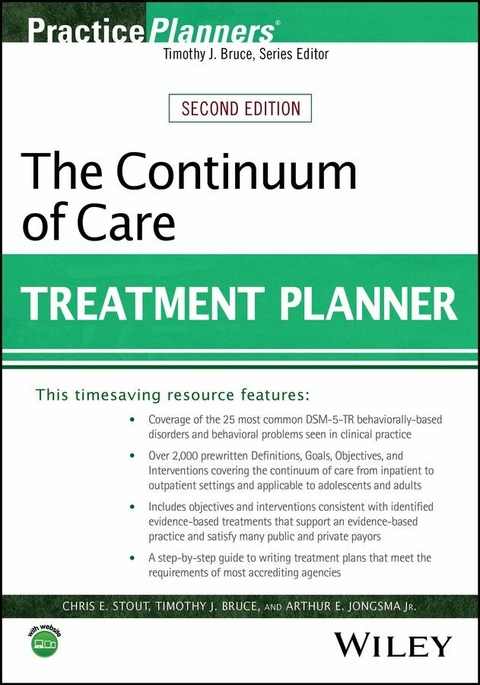
The Continuum of Care Treatment Planner (eBook)
709 Seiten
Wiley (Verlag)
978-1-394-27347-8 (ISBN)

Create customized formal treatment plans with over 1,000 professional goal and intervention statements
The Continuum of Care Treatment Planner offers clinicians a timesaving, evidence-based guide that helps to clarify, simplify, and accelerate the process of planning treatments for adults and adolescents. The authors provide a thorough introduction to treatment planning, along with the elements necessary to quickly and easily develop formal, customizable treatment plans. Treatment planning statements satisfy the demands of HMOs, managed-care companies, third-party payers, and state and federal agencies.This planner provides treatment planning components foranxiety, bipolar disorder, depression, eating disorders, posttraumatic stress disorder, substance use disorders, and beyond. Following the user-friendly format that has made the Treatment Planners series so popular, this book smooths the planning process so you can spend less time on paperwork and more time with clients.
- Get definitions, treatment goals and objectives, therapeutic interventions, and DSM-5 diagnoses for mental disorders in adults and adolescents
- Employover 1,000 polished goals and intervention statements as components of provider-approved treatment plans
- Use workbook space to record customized goals, objectives, and interventions
- Access a sample plan that meets all requirements of third-party payers and accrediting agencies,including the JCAHO
This updated edition of The Continuum of Care Treatment Planner is a valuable resource for psychologists, therapists, counselors, social workers, psychiatrists, and other mental health professionals who work with adult and adolescent clients.
CHRIS E. STOUT, PsyD, is a licensed clinical psychologist and Founding Director of the Center for Global Initiatives. He served as the first Chief of Psychology for the State of Illinois, President of the Illinois Psychological Association, is a Life Member of the American Psychological Association and Fellow in three Divisions. He was formerly a Clinical Full Professor in the College of Medicine, University of Illinois, Chicago, and on the faculty of Northwestern University's Feinberg School of Medicine.
TIMOTHY J. BRUCE, PH.D, is Professor Emeritus of the Department of Psychiatry and Behavioral Medicine at the University of Illinois College of Medicine.
ARTHUR E. JONGSMA, JR., PH.D, created the bestselling Practice Planners series. He has provided professional mental health services to both inpatient and outpatient clients for approximately 50 years. He was the Founder and Director of Psychological Consultants, a group private practice in Michigan, for 25 years.
Create customized formal treatment plans with over 1,000 professional goal and intervention statements The Continuum of Care Treatment Planner offers clinicians a timesaving, evidence-based guide that helps to clarify, simplify, and accelerate the process of planning treatments for adults and adolescents. The authors provide a thorough introduction to treatment planning, along with the elements necessary to quickly and easily develop formal, customizable treatment plans. Treatment planning statements satisfy the demands of HMOs, managed-care companies, third-party payers, and state and federal agencies.This planner provides treatment planning components foranxiety, bipolar disorder, depression, eating disorders, posttraumatic stress disorder, substance use disorders, and beyond. Following the user-friendly format that has made the Treatment Planners series so popular, this book smooths the planning process so you can spend less time on paperwork and more time with clients. Get definitions, treatment goals and objectives, therapeutic interventions, and DSM-5 diagnoses for mental disorders in adults and adolescents Employover 1,000 polished goals and intervention statements as components of provider-approved treatment plans Use workbook space to record customized goals, objectives, and interventions Access a sample plan that meets all requirements of third-party payers and accrediting agencies,including the JCAHO This updated edition of The Continuum of Care Treatment Planner is a valuable resource for psychologists, therapists, counselors, social workers, psychiatrists, and other mental health professionals who work with adult and adolescent clients.
INTRODUCTION
ABOUT PRACTICEPLANNERS® TREATMENT PLANNERS
Pressure from third‐party payers, accrediting agencies, and other outside parties has increased the need for clinicians to quickly produce effective, high‐quality treatment plans. Treatment Planners provide all the elements necessary to quickly and easily develop formal treatment plans that satisfy the needs of most third‐party payers and state and federal review agencies.
Each Treatment Planner:
- Saves you hours of time‐consuming paperwork.
- Offers the freedom to develop customized treatment plans.
- Includes over 1,000 clear statements describing the behavioral manifestations of each relational problem and provides long‐term goals, short‐term objectives, and clinically tested treatment options.
- Has an easy‐to‐use reference format that helps locate treatment plan components by behavioral problem or Diagnostic and Statistical Manual of Mental Disorders, 5th Edition (DSM‐5™) diagnosis.
As with the rest of the books in the PracticePlanners® series, our aim is to clarify, simplify, and accelerate the treatment planning process, so you spend less time on paperwork and more time with your clients.
ABOUT THIS SECOND EDITION OF THE CONTINUUM OF CARE TREATMENT PLANNER
This second edition of the Continuum of Care Treatment Planner has been improved in many ways:
- Updated with new Objectives and Interventions consistent with identified evidence‐based practices
- An expanded and updated list of self‐help books in the Bibliotherapy Suggestions (Appendix A)
- A new appendix of Professional Resources including recommended books, chapters, manuals, and other “how‐to” clinical resources (Appendix B)
- A new appendix with Objectives and Interventions reflecting principles of the Recovery Model of mental health care (Appendix C)
- A new alphabetical appendix of sources for assessment instruments, measures, and inventories used in mental health care (Appendix D)
- An online appendix of references to empirical work supporting the evidence‐based content found in this Planner
- More suggested homework assignments integrated into the Interventions
- Addition of new chapters on Attention‐Deficit/Hyperactivity Disorder in adults, Bipolar Disorder, Opioid Use Disorder, Posttraumatic Stress Disorder (PTSD), Schizophrenia Spectrum Disorders, Substance Use, and chapters for adolescent clients including Bipolar Disorder, Conduct Disorder, Eating Disorder, Opioid Use Disorder, PTSD, Schizophrenia Spectrum, and Substance Use Disorders
- Integrated DSM‐5 diagnostic labels and codes into the Diagnostic Suggestions section of each chapter
Evidence‐based practice (EBP) is steadily becoming the standard of care in mental health care as it has in medical health care. Professional organizations such as the American Psychological Association, National Association of Social Workers, and the American Psychiatric Association, as well as consumer organizations such the National Alliance on Mental Illness have all endorsed the use of EBP. In some practice settings, EBP is becoming mandated. Some third‐party payers require the use of EBP for reimbursement. The call for evidence and accountability is being increasingly sounded. So, what is EBP and how is its use facilitated by this Planner?
Borrowing from the Institute of Medicine's definition (Institute of Medicine, 2001), the American Psychological Association (APA) has defined EBP as “the integration of the best available research with clinical expertise in the context of patient characteristics, culture, and preferences” (APA Presidential Task Force on Evidence‐Based Practice, 2006). Consistent with this definition, we have identified those psychological treatments with the best available supporting evidence, added Objectives and Interventions consistent with them in the pertinent chapters, and indicated these with this symbol: . As most practitioners know, research has shown that although these treatment methods may have demonstrated efficacy, factors such as the individual psychologist (e.g., Wampold, 2001), the treatment relationship (e.g., Norcross, 2019), and the client (e.g., Bohart & Tallman, 1999) are also vital contributors to optimizing a client's response to psychotherapy. As noted by the APA, “Comprehensive evidence‐based practice will consider all of these determinants and their optimal combinations.” (APA Presidential Task Force on Evidence‐Based Practice, 2006, p. 275). For more information and instruction on constructing evidence‐based psychotherapy treatment plans, see our 12 DVD‐based training videos titled Evidence‐Based Psychotherapy Treatment Planning (Jongsma & Bruce, 2010–2012).
The sources we used to identify the evidence‐based treatments integrated into this Planner are multiple and, we believe, high quality. They include rigorous meta‐analyses, current critical, expert reviews, as well as evidence‐based practice guideline recommendations. Examples of specific sources include the Cochrane Collaboration reviews; the work of the Society of Clinical Psychology identifying research‐supported psychological treatments; evidence‐based treatment reviews (e.g., David et al., 2018; Nathan & Gorman, 2015), as well as critical analyses of the process through which evidence‐based practice is defined (e.g., Dimidjian, 2019; Norcross et al., 2017). EBP guidelines informing the selection process include those from the American Psychological Association, American Psychiatric Association, the National Institute for Health and Clinical Excellence in the United Kingdom, and the National Institute on Drug Abuse, to name a few.
Although sources may vary slightly in the criteria they use for judging levels of empirical support, we favored those that use more rigorous criteria, typically requiring demonstration of efficacy through randomized controlled trials or clinical replication series, good experimental methodology, and independent replication. Our approach was to evaluate these various sources and include those treatments supported by the highest level of evidence and for which there was consensus across most of these sources. For any chapter in which EBP is indicated, references to the sources used to identify them can be found online at www.wiley.com/go/stout/continuumTP2e. In addition to these references to empirical support, we have also included a Professional Resources appendix. Clinical resources are books, manuals, and other resources for clinicians that describe the details of the application, or the “how to,” of the treatment approaches described in a chapter. To maintain the consistency and integrity of the evidence‐based content in the PracticePlanners Series, some of the evidence‐based content in this Planner is adapted from other Planners in the series, including the sixth editions of the Adult and Adolescent Treatment Planners. Although this does build some redundancy across treatment planners in the series that provide this content, we felt that the convenience of having it readily available in each planner supersedes other, more resource‐consuming, options for accessing it.
We recognize that there is debate regarding EBP among mental health professionals who are not always in agreement regarding the best treatment, what factors contribute to good outcomes, or even what constitutes “evidence.” We also recognize that some practitioners are skeptical about changing their practice based on psychotherapy research. Our intent in this book is to accommodate these differences by providing a range of treatment plan options, including those consistent with the “best available research” (APA Presidential Task Force on Evidence‐Based Practice, 2006), those reflecting common clinical practices of experienced clinicians (that may not have been subjected to study), and some that reflect promising emerging approaches. Our intent is to allow users of this planner an array of options so they can construct what they believe to be the best plan for their particular client.
More recently, psychotherapy research is moving toward trying to identify evidence‐based principles of psychotherapeutic change that cut across the various individual psychotherapies that have largely been the focus of outcome research. An example of this call to identify these principles is seen in Goldfried (2019), in which he advances the following principles:
- Promoting client expectation and motivation that therapy can help
- Establishing an optimal therapeutic alliance
- Facilitating client awareness of the factors associated with their difficulties
- Encouraging the client to engage in corrective experiences
- Emphasizing ongoing reality testing in the client's life
Although many endorse this effort, at the time of this writing it is still in progress. Consequently, our approach to identifying objectives and interventions consistent with evidence‐based practices reflects what has been done from the “principles” approach as well as the previous and continuing research examining and demonstrating the...
| Erscheint lt. Verlag | 3.4.2025 |
|---|---|
| Reihe/Serie | PracticePlanners |
| Sprache | englisch |
| Themenwelt | Geisteswissenschaften ► Psychologie |
| Medizin / Pharmazie ► Medizinische Fachgebiete ► Psychiatrie / Psychotherapie | |
| ISBN-10 | 1-394-27347-9 / 1394273479 |
| ISBN-13 | 978-1-394-27347-8 / 9781394273478 |
| Informationen gemäß Produktsicherheitsverordnung (GPSR) | |
| Haben Sie eine Frage zum Produkt? |
 EPUB (Adobe DRM)
Kopierschutz: Adobe-DRM
Adobe-DRM ist ein Kopierschutz, der das eBook vor Mißbrauch schützen soll. Dabei wird das eBook bereits beim Download auf Ihre persönliche Adobe-ID autorisiert. Lesen können Sie das eBook dann nur auf den Geräten, welche ebenfalls auf Ihre Adobe-ID registriert sind.
Details zum Adobe-DRM
Dateiformat: EPUB (Electronic Publication)
EPUB ist ein offener Standard für eBooks und eignet sich besonders zur Darstellung von Belletristik und Sachbüchern. Der Fließtext wird dynamisch an die Display- und Schriftgröße angepasst. Auch für mobile Lesegeräte ist EPUB daher gut geeignet.
Systemvoraussetzungen:
PC/Mac: Mit einem PC oder Mac können Sie dieses eBook lesen. Sie benötigen eine
eReader: Dieses eBook kann mit (fast) allen eBook-Readern gelesen werden. Mit dem amazon-Kindle ist es aber nicht kompatibel.
Smartphone/Tablet: Egal ob Apple oder Android, dieses eBook können Sie lesen. Sie benötigen eine
Geräteliste und zusätzliche Hinweise
Buying eBooks from abroad
For tax law reasons we can sell eBooks just within Germany and Switzerland. Regrettably we cannot fulfill eBook-orders from other countries.
aus dem Bereich