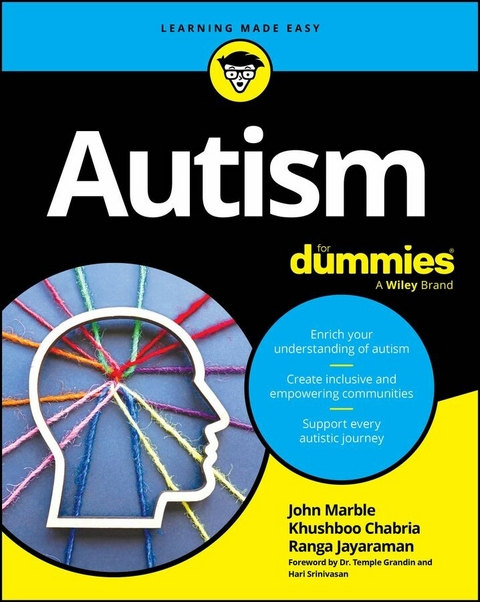
Autism For Dummies (eBook)
581 Seiten
For Dummies (Verlag)
978-1-394-30101-0 (ISBN)
Embrace neurodiversity and foster understanding
Autism For Dummies is a comprehensive guide exploring the full spectrum of autism experiences. This essential resource deepens understanding for self-advocates, parents, educators, and professionals, fostering respect and acceptance for all individuals on the autism spectrum. Covering the basics of autism, including the latest research and diagnostic criteria, the book offers insights into neurological diversity. It acknowledges the vastly different abilities and support needs among autistic individuals, portraying these experiences with depth and empathy.
The book addresses families' and caregivers' experiences, offering candid testimonials and practical advice on advocating for resources, fostering supportive communities, and ensuring the best outcomes for their children. Autism For Dummies bridges polarized views within the autism community, highlighting self-advocates' calls for independence and parents' need for comprehensive support.
Through respectful dialogue and shared stories, the book encourages an enlightened approach to support and acceptance and provides practical strategies for inclusion, covering tools for communities, schools, and workplaces to become more accommodating and empowering.
The book:
- Explains the varied support needs of autistic individuals, from extensive daily support to minimal assistance
- Offers strategies for caregivers supporting children and adults with autism
- Includes candid testimonials and practical advice from real families on how to advocate for appropriate resources and foster supportive environments
- Provides tools for inclusive communities, schools, and workplaces
With its compassionate and inclusive approach, Autism For Dummies educates and inspires broader understanding and acceptance, calling on readers to help create a society where every autistic individual can thrive.
John Marble is the founder of Pivot Neurodiversity and a trainer with Neurodiversity Pathways.
Khushboo Chabria is a neurodiversity specialist and career coach at Neurodiversity Pathways.
Ranga Jayaraman is Director of Neurodiversity Pathways.
All three are authors of Neurodiversity For Dummies.
Embrace neurodiversity and foster understanding Autism For Dummies is a comprehensive guide exploring the full spectrum of autism experiences. This essential resource deepens understanding for self-advocates, parents, educators, and professionals, fostering respect and acceptance for all individuals on the autism spectrum. Covering the basics of autism, including the latest research and diagnostic criteria, the book offers insights into neurological diversity. It acknowledges the vastly different abilities and support needs among autistic individuals, portraying these experiences with depth and empathy. The book addresses families' and caregivers' experiences, offering candid testimonials and practical advice on advocating for resources, fostering supportive communities, and ensuring the best outcomes for their children. Autism For Dummies bridges polarized views within the autism community, highlighting self-advocates' calls for independence and parents' need for comprehensive support. Through respectful dialogue and shared stories, the book encourages an enlightened approach to support and acceptance and provides practical strategies for inclusion, covering tools for communities, schools, and workplaces to become more accommodating and empowering. The book: Explains the varied support needs of autistic individuals, from extensive daily support to minimal assistance Offers strategies for caregivers supporting children and adults with autism Includes candid testimonials and practical advice from real families on how to advocate for appropriate resources and foster supportive environments Provides tools for inclusive communities, schools, and workplaces With its compassionate and inclusive approach, Autism For Dummies educates and inspires broader understanding and acceptance, calling on readers to help create a society where every autistic individual can thrive.
Chapter 1
What Is Autism?
IN THIS CHAPTER
Exploring current understanding
Getting to know the autistic person
Examining how autism develops
Changing how we talk about autism
Autism is a natural way of thinking, experiencing the world, and connecting with others. It’s not a disease or a flaw — it’s just one of the many ways brains work. Autistic people often think, communicate, socialize, and respond to their surroundings in unique and meaningful ways.
Autism lasts a lifetime — you’re born with it and live with it through every stage of life. While an autistic person may face challenges, they also have amazing strengths, fresh ideas, and talents. No two autistic people are the same — just like no two other people are — but there are common experiences many autistic people share. Understanding what makes autistic people unique and what connects their experiences helps us support them better.
Science has taught us that autism isn’t something to “fix” or “cure.” It’s part of who a person is — and that’s a good thing! We’ve moved away from harmful approaches that tried to change autistic people into someone they’re not. Now, the focus is on understanding, accepting, and supporting autistic people with tools and resources that help them live happy, meaningful lives.
In this chapter, we explore the modern understanding of autism, the science behind it, and how autism shapes an individual. To fully understand autism, you need to know about neurodiversity — how variations in the human brain like autism, ADHD, and dyslexia are natural parts of human life.
Understanding Neurodiversity
For much of history, people assumed all brains worked the same way, and differences were seen as defects. This mindset led to harmful practices like forced institutionalization, discrimination, and attempts to “fix” those who didn’t conform. Entire groups were misunderstood and excluded, causing significant harm.
Thankfully, we’ve come a long way. We now understand that every brain is unique, like fingerprints, and that diverse ways of thinking are essential for a thriving society (see Chapter 2). These differences help us innovate and find solutions for problems — solutions not possible if everyone thought the same way.
“The world needs a neurodiverse workforce to help solve some of the big problems of our time,” wrote Virgin Group founder Richard Branson in a 2024 LinkedIn post. Branson, an advocate for neurodiversity, highlights how his dyslexic brain processes information uniquely, benefiting his ventures and society. He makes it clear: “neurodiversity should be embraced.”
Branson’s insight underscores that recognizing neurodiversity doesn’t just help individuals who think differently. It helps all of us.
Neurodiversity acknowledges both the challenges and strengths of different brain types. Both are normal parts of being human.
Organizing brains into neurotypes
Each of our brains is unique; we all process information and interact with the world differently. To make sense of this diversity, we categorize brains into groups, known as neurotypes.
Neurotypes are labels for clusters of brains that typically process information or respond to stimuli in similar ways. Examples include autism, ADHD, and dyslexia. These categories help us better understand the incredible variety of human brains.
Everyone has a neurotype — including you! People with brains that function like most others have a neurotypical neurotype, whereas those with different thinking styles — such as autism, ADHD, or dyslexia — have neurodivergent neurotypes. At least 20 percent of people are neurodivergent, which means these differences aren’t uncommon.
Neither neurotypical nor neurodivergent neurotypes are “broken”; they simply reflect different ways of experiencing and understanding the world.
Understanding autism as a neurotype
Autism is one of many neurotypes. Although every autistic person is different, they share many commonalities in their ways of thinking and experiencing the world, which shapes many aspects of their lives, including sensory processing, communication, socialization, and problem-solving. (See Chapter 4 for more.)
Autistic people have a neurotype that can’t — and shouldn’t — be “fixed.” Embracing this fact shifts the focus from trying to change autistic people to understanding what everyone — including autistic people — needs to thrive.
Expanding Our Understanding of Autism
Autism has been recognized for decades, but our understanding has grown significantly in recent years. Let’s explore the ways scientific perspectives have shifted, the latest statistics, and the positive sign of progress indicated by the rising number of autism diagnoses.
Our evolving knowledge
Not long ago, autism was deeply misunderstood. It was thought to be rare and defined by rigid, stereotypical behaviors, often described in terms of “deficits” rather than acknowledging strengths and individuality. Early researchers focused on a narrow demographic, recognizing only a limited set of traits, which excluded many autistic people from being identified.
Families faced harmful blame, with myths like the “refrigerator mother” theory accusing parents of causing autism by being cold or unloving. These beliefs fueled stigma, isolation, and prejudice for autistic individuals and their families.
“Autism became a source of shame and stigma,” author Steve Silberman said at a 2015 TED conference. “And two generations were shipped off to institutions ‘for their own good.’”
Actor Daryl Hannah was nearly one of them. When she was diagnosed with autism as a child, doctors recommended institutionalizing her, but her mother refused and supported her at home. That decision allowed Hannah to grow up and star in iconic films like Blade Runner, Splash, Steel Magnolias, and Kill Bill.
Today, we know better. Autism isn’t rare and doesn’t fit a single mold. (No human does.) Every autistic person’s experiences, challenges, and strengths are unique.
Shifts in perspective and diagnosis
The way autism is diagnosed today reflects significant progress. Diagnoses now account for the wide variety of ways autism can present, recognizing a broader spectrum of traits and experiences. This shift allows more individuals to be identified and supported. (To discover more about the diagnostic process, turn to Chapter 3.)
Our current understanding of statistics
Worldwide, studies suggest that at least 1 percent to 2 percent of people are autistic, with U.S. statistics estimating about 1 in 36 individuals. But what truly matters isn’t the exact number; it’s how we use our understanding of autism to create a world where everyone can thrive.
These figures represent real people: neighbors, coworkers, family members, and friends. Recognizing autism’s diversity helps us build a society that supports and values autistic individuals.
Increasing diagnostic rates?
If you’ve heard that autism diagnoses are rising, you might wonder what that means. Is autism becoming more common? The short answer is no. The rise in diagnoses reflects improved diagnostic tools, expanded criteria, and greater awareness.
In the past, many autistic people — especially women and people of color — were overlooked due to outdated stereotypes. Today’s rising diagnostic rates signal progress, helping us recognize and support those who were previously excluded.
“I feel Black autistic women are just now being embraced because more Black women are starting to be diagnosed,” said children’s author Ayanna Davis in a 2024 interview with Learn from Autistic People. “For so long, Black women were being misdiagnosed, late diagnosed, or not diagnosed at all. As diagnoses become more common, I feel society will become more accepting.”
Autism isn’t “increasing”; our understanding is simply catching up. Rising diagnostic rates are a sign of progress, showing that more people — especially those once overlooked — are finally getting the recognition and support they need.
Being an Autistic Person
Every autistic person is, first and foremost, an individual. Autism is a part of who they are, but it is not all they are. Like anyone else, autistic people have preferences, talents, and experiences. Recognizing their individuality is crucial for making meaningful connections and providing the right support.
A lifelong experience
Autism isn’t something people outgrow — it’s a lifelong experience that shapes development, identity, and opportunities. From childhood to older adulthood, autistic individuals face unique challenges and triumphs at every stage of life.
Shortly after John, from our author team, turned 40, he joined a meditation session with a dozen other autistic people. After sitting quietly together, the group shared lunch and discussed life’s challenges. John, who was grappling with his...
| Erscheint lt. Verlag | 31.3.2025 |
|---|---|
| Vorwort | Temple Grandin, Hari Srinivasan |
| Sprache | englisch |
| Themenwelt | Sachbuch/Ratgeber ► Gesundheit / Leben / Psychologie |
| Medizin / Pharmazie ► Allgemeines / Lexika | |
| Schlagworte | am I autistic? • autism diagnosis • autism inclusion • autism needs • autism resources • Autism Spectrum • Child Autism • do I have autism? • Hari Srinivasan • living with autism • neurodevelopmental conditions • neurodiversity • Temple Grandin • Understanding Autism • What is autism? • what is the autism spectrum? |
| ISBN-10 | 1-394-30101-4 / 1394301014 |
| ISBN-13 | 978-1-394-30101-0 / 9781394301010 |
| Informationen gemäß Produktsicherheitsverordnung (GPSR) | |
| Haben Sie eine Frage zum Produkt? |
 EPUB (Adobe DRM)
Kopierschutz: Adobe-DRM
Adobe-DRM ist ein Kopierschutz, der das eBook vor Mißbrauch schützen soll. Dabei wird das eBook bereits beim Download auf Ihre persönliche Adobe-ID autorisiert. Lesen können Sie das eBook dann nur auf den Geräten, welche ebenfalls auf Ihre Adobe-ID registriert sind.
Details zum Adobe-DRM
Dateiformat: EPUB (Electronic Publication)
EPUB ist ein offener Standard für eBooks und eignet sich besonders zur Darstellung von Belletristik und Sachbüchern. Der Fließtext wird dynamisch an die Display- und Schriftgröße angepasst. Auch für mobile Lesegeräte ist EPUB daher gut geeignet.
Systemvoraussetzungen:
PC/Mac: Mit einem PC oder Mac können Sie dieses eBook lesen. Sie benötigen eine
eReader: Dieses eBook kann mit (fast) allen eBook-Readern gelesen werden. Mit dem amazon-Kindle ist es aber nicht kompatibel.
Smartphone/Tablet: Egal ob Apple oder Android, dieses eBook können Sie lesen. Sie benötigen eine
Geräteliste und zusätzliche Hinweise
Buying eBooks from abroad
For tax law reasons we can sell eBooks just within Germany and Switzerland. Regrettably we cannot fulfill eBook-orders from other countries.
aus dem Bereich