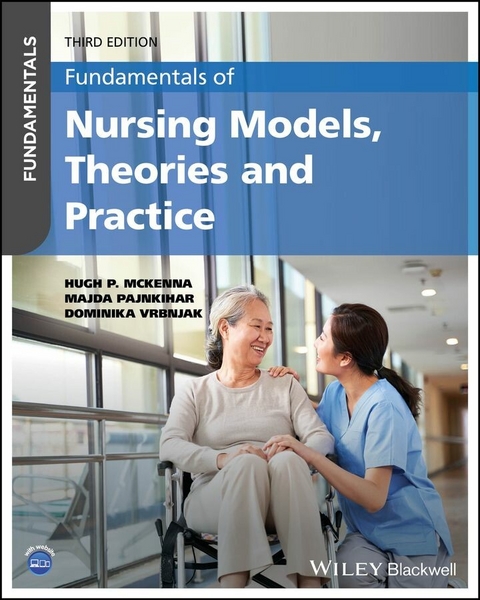
Fundamentals of Nursing Models, Theories and Practice (eBook)
542 Seiten
Wiley-Blackwell (Verlag)
978-1-394-19276-2 (ISBN)
Fundamentals of Nursing Models, Theories and Practice
THIRD EDITION
Introduces different nursing theories and their relevance to everyday nursing practice
Nursing theory and nursing models are key elements of any modern nursing course. Understanding both the conceptual and practical aspects of nursing is vital to assessing, planning, and implementing consistent and seamless patient care.
Fundamentals of Nursing Models, Theories and Practice is a concise, easily accessible introduction to the development, application, and evaluation of various nursing theories. This highly anticipated new edition guides readers through each step of a theory-generating journey, from identifying phenomena in clinical practice, to forming concepts and propositions, to constructing a new theory. Incorporating the most recent research and up-to-date references throughout, the third edition covers a broader range of nursing theories to guide and improve patient care.
- Examines the relationship between nursing theory, clinical practice, and nursing roles
- Discusses 12 different criteria that readers can use to select the appropriate theory
- Outlines the different ways that nurses learn and impart knowledge
- Describes various methodological approaches used by researchers to generate or test nursing theory
- Demonstrates how the validity of a theory is determined through rigorous and systematic analysis and evaluation
Fundamentals of Nursing Models, Theories and Practice is a must-have book for all pre-registration nursing students and newly qualified nurses.
Hugh P. Mckenna, CBE, PhD, BSc (Hons), RMN, RGN, RNT, DipN (Lond), AdvDipEd, FFN, FRCSI, FEANS, FRCN, FAAN, MAE, MEASA, Emeritus Professor, Ulster University, UK.
Majda Pajnkihar, PhD, RN, FAAN, FEANS, Professor, Senior Research Fellow, Head of Institute of Nursing Care, Head of the Doctoral Study Program Nursing Care, Faculty of Health Sciences, University of Maribor, Slovenia.
Dominika Vrbnjak, PhD, RN, Associate Professor, Faculty of Health Sciences, University of Maribor, Slovenia.
CHAPTER 1
The Case for Nursing Theory
Outline of Content
This chapter covers the following: the case for theory; the argument that all intentional and rational actions, including nursing actions, by definition, must have an underlying theory; an initial definition of theory; and how theory and practice become integrated into nursing praxis.
Learning Outcomes
At the end of this chapter, you should be able to:
- Understand what nursing theory is
- Define theory
- Understand the construction/development of a theory
- Discuss the relationship between nursing theory and science
- Evaluate the relationship between nursing theory and practice
- Know the limitations of nursing theory
- Understand the importance of nursing theory for contemporary nursing
Introduction
In the realm of nursing, understanding and defining the construction and function, as well as limitations, of nursing theory is crucial for both education and practice. Before nursing students and registered nurses recognise the content and function of theory, they often ask themselves questions such as the following. What are nursing theories? Why study them? What has this got to do with nursing? How can something so theoretical and abstract be valuable to a practical field like nursing? Nursing theories provide a structured framework that guides clinical decision‐making, patient care and educational curriculums. Theory presents a description of the practice of nursing in mental images. However, recognising the limitations of these theories is essential to adapt and apply them effectively in diverse healthcare settings.
This book will help to answer these questions. Theories exist everywhere in society. There are numerous theories of the family, of the spread of fake news on social media, of how electric vehicles impact the environment, of how cancer cells multiply, of potential effects of artificial intelligence on the job market and of theories about climate change. And perhaps what you, as a student, are familiar with, because you encounter and experience the educational process on a daily basis, are theories about education. The world is full of theories, some tested as accurate, some untested and some speculative. It is no surprise, then, that there are theories of nursing. But what do theories do? In essence, they are simply used to describe, explain or predict phenomena (see Reflective Exercise 1.1). This will be explored in detail later.
Reflective Exercise 1.1
Theory
Write down or discuss with other people two different theories for one of the following:
- origins of the COVID‐19 outbreak
- the rise of TikTok as a social media phenomenon
- climate change
- newborn babies smiling when spoken to
Consider if there is a basis of truth in any of these theories.
Now, none of the theories that you outlined for any of the topics in Reflective Exercise 1.1 may be true. In fact, they may be erroneous or downright preposterous. The point is that we all use theories to explain what goes on in our lives or in the world. But if you wanted to, you could probably test or find out whether your theories are true. Later on in this chapter, we will outline what theories are made of and how they are formed.
In many ways, theories are like maps. Maps are used to give us directions or to help us find our way in a complicated landscape or terrain. Maps often make simple what is a very complex picture. At their best, nursing theories also give us directions, instructions and information on how to design integrated care as to how to best care for patients or give us a broad picture of nursing care. But why have we got so many nursing theories? If you take any large city, there are many maps. For instance, in London, there are street maps, underground maps, electricity supply maps, Ordinance Survey maps and so on. Consider the London Underground or Paris Metro maps – they are simple and easy to follow but they do not look anything like the complex reality of the underground networks they represent. In other words, they make a complex system understandable.
Similarly, nursing can be highly complex, and we need different theories to help us understand what is going on. A theory that can be used in emergency care may not be of much use in mental health care, and a theory that can be used to help nurses in a busy surgical ward may be of little use in community care. In addition, the different theories attempt to highlight different phenomena that occur in practice and thus emphasise approaches to patient care such as equal partner‐like relationships, caring, adaptation or self‐care.
Nursing theories can provide frameworks for practice, and in many clinical settings, they have been used in the assessment of patients' needs. For instance, one of the most popular nursing theories in the United Kingdom was designed by three nurses who worked at Edinburgh University – Nancy Roper, Winifred Logan and Alison Tierney. They based their theory on the work of an American nurse called Virginia Henderson. Her theory outlined how nurses should be focused on encouraging patients to be independent in certain activities of daily living (ADLs), such as sleeping, eating and mobilising. Roper et al. (1983) took this a step further by identifying 12 ADLs. They stressed that the nurses' role was to prevent people from having problems with these ADLs. If this could not be achieved, nurses should help the patients be independent in the ADLs. If this was not possible, then nurses should give the patient and/or the patient's family the knowledge and skills to cope with their dependence on the ADLs. Many clinical nurses use the ADL theory to assess patients. They simply see how independent the patient is for each ADL and then focus their care on those for which the patient is dependent.
Therefore, theory can help us to carry out an individual patient's care and can contribute to better observations and recognition of specific patient needs, be they physical, psychosocial, emotional or spiritual. Nursing theories are often derived from practice. In other words, nursing theorists have constructed their theories based on what they have experienced when working with patients and their families, and by observing and describing phenomena in practice. Understanding the basic elements of a theory and its role and taking a critical view of it can help develop a body of knowledge that nurses need for everyday practice, education and research.
In this book, we want to highlight the need for and use of nursing theory and its function. This first chapter will introduce you to new words and ideas. You can read it in short bursts instead of tackling it all in one go. However, once you have mastered this first chapter, the rest of the book will be relatively easy to understand and, believe it or not, enjoyable and intellectually engaging. Several aspects of nursing theory are discussed in later chapters, and when reading those, dipping back into this first chapter will be helpful. Have a look at Reflective Exercise 1.2.
Reflective Exercise 1.2
Terminology
When you get involved in a new subject, you often have to learn new words to understand the topic. If you are a nursing student, you have had to learn many new anatomical or psychological words and phrases. Also, think of all the new words you would have to learn to take on any of the following hobbies:
- streaming
- gaming
- music
- fitness/wellness
See how many more you can think of. People accept learning new terms as part of understanding something in which they have an interest. The same is true in nursing theory.
The Necessity and Meaning of Theory
While it is true that some may argue that theories in nursing are only of concern to nursing academics and not always applicable in the practical world, we firmly stand by a different perspective. We believe there is no such thing as nursing without theory because there is no such thing as atheoretical nursing. Nursing is theory in action and every nursing act finds its basis in some theory. Thus, the theory is not abstract and reserved for academics but an integral part of the very essence of nursing. For instance, if a nurse is talking to a patient, they may be using communication theory. At its simplest, a communication theory would include a speaker, a listener, a message and understanding between the speaker and the listener. Similarly, if the nurse is putting a dressing on a patient, they may be using a theory of asepsis from the field of microbiology. Nurses might not always think about these theories by name or even say they are not using them. But behind what they do, there is usually a purpose or a reason, which often links back to a theory. Fawcett (2022) explained that theories are typically thought of as formulations that are not relevant for practice, which is the source of the so‐called theory–practice gap.
When providing care to a patient, we are doing something in a purposeful manner – every action we take has a purpose. While doing it, we seek to understand, uncover meaning and determine how we should act based on our understanding. This process is essentially what we mean by ‘theorising' or ‘theory...
| Erscheint lt. Verlag | 26.3.2025 |
|---|---|
| Reihe/Serie | Fundamentals |
| Mitarbeit |
Herausgeber (Serie): Ian Peate |
| Sprache | englisch |
| Themenwelt | Medizin / Pharmazie ► Pflege |
| Schlagworte | nursing models guide • nursing models in practice • nursing models intro • nursing models reference • nursing models textbook • nursing theory guide • nursing theory in practice • nursing theory intro • nursing theory reference • nursing theory textbook |
| ISBN-10 | 1-394-19276-2 / 1394192762 |
| ISBN-13 | 978-1-394-19276-2 / 9781394192762 |
| Informationen gemäß Produktsicherheitsverordnung (GPSR) | |
| Haben Sie eine Frage zum Produkt? |
 EPUB (Adobe DRM)
Kopierschutz: Adobe-DRM
Adobe-DRM ist ein Kopierschutz, der das eBook vor Mißbrauch schützen soll. Dabei wird das eBook bereits beim Download auf Ihre persönliche Adobe-ID autorisiert. Lesen können Sie das eBook dann nur auf den Geräten, welche ebenfalls auf Ihre Adobe-ID registriert sind.
Details zum Adobe-DRM
Dateiformat: EPUB (Electronic Publication)
EPUB ist ein offener Standard für eBooks und eignet sich besonders zur Darstellung von Belletristik und Sachbüchern. Der Fließtext wird dynamisch an die Display- und Schriftgröße angepasst. Auch für mobile Lesegeräte ist EPUB daher gut geeignet.
Systemvoraussetzungen:
PC/Mac: Mit einem PC oder Mac können Sie dieses eBook lesen. Sie benötigen eine
eReader: Dieses eBook kann mit (fast) allen eBook-Readern gelesen werden. Mit dem amazon-Kindle ist es aber nicht kompatibel.
Smartphone/Tablet: Egal ob Apple oder Android, dieses eBook können Sie lesen. Sie benötigen eine
Geräteliste und zusätzliche Hinweise
Buying eBooks from abroad
For tax law reasons we can sell eBooks just within Germany and Switzerland. Regrettably we cannot fulfill eBook-orders from other countries.
aus dem Bereich