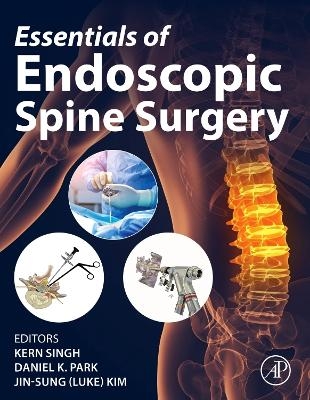
Essentials of Endoscopic Spine Surgery
Academic Press Inc (Verlag)
978-0-443-36628-4 (ISBN)
Kern Singh, MD, is a Professor and Vice-Chair of Orthopaedic Surgery at Rush University Medical Center in Chicago, Illinois. He is also the Co-Director of the Minimally Invasive Spine Institute and Founder & President of the Minimally Invasive Spine Surgery Study Group. Dr. Singh has contributed over 500 articles, 250 book chapters, and has authored over 15 textbooks in spine surgery. His international reputation is well known, and he frequently has visiting surgeons from the US and around the world to learn about the newest advancements in outpatient, minimally invasive, and endoscopic spine surgeries. He has lectured all over the world, sharing his expertise and pioneering techniques globally. Dr. Singh’s commitment to education and collaboration has made him an esteemed mentor and speaker at national spine conferences, where his groundbreaking research has earned several awards. Dr. Singh has also developed innovative surgical instruments that are widely adopted by spine surgeons worldwide. Beyond his clinical and academic contributions, Dr. Singh is dedicated to improving patient outcomes and expanding access to state-of-the-art spinal care through research, education, and surgical excellence. Daniel K. Park, MD is a Professor of Orthopedics at Corewell Health-Oakland University School of Medicine. He graduated from Duke University School of Medicine, RUSH University Orthopedic Surgery Residency, and Emory University Spine Fellowship. He currently specializes in minimally invasive surgery and motion preservation. He has published over 90 peer-reviewed articles and has presented numerous abstracts at international meetings. Dr Park's journey into endoscopic spine surgery began in 2018, and he was one of the first surgeons in the United States to perform biportal endoscopic spine surgery. Seeing the benefits of this technique, he has lectured across America as well as internationally, teaching fellow surgeons how to adopt this technique into their practice. He currently works with various industry partners to make advancements in surgical endoscopic tools. He is the co-founder of World UBE Society-America, a society dedicated to the advancement of biportal endoscopic spine surgery. Professor Jin-Sung Kim (a.k.a. Luke SpineWalker) is a board-certified neurosurgeon and is highly active in international spine societies. He specializes in minimally invasive, navigation-guided, and endoscopic spine surgery, and is currently a Professor of Neurosurgery at Seoul St. Mary’s Hospital, the Catholic University of Korea. Internationally recognized as a pioneer in his field, he serves as the Deputy Editor of Neurospine, the official journal of major Asian spine societies, and the Global Spine Journal, the official journal of AOSpine. Both journals are among the most highly cited in spine surgery. He has served as International Director of the Society for Minimally Invasive Spine Surgery (SMISS) since 2018. He has also held major positions in North American Spine Society (NASS), serving on the Minimally Invasive Procedures Committee, Governance Committee, and International Strategic Growth Committee (ISGC), as well as on the AOSpine MIS Task Force during the same period. Through these roles, he has made significant contributions to the global advancement of minimally invasive spine surgery (MIS) and endoscopic techniques. These appointments reflect his recognized expertise and leadership in the global spine surgery community.
Section 1: Foundations of endoscopic spine surgery
1. History and evolution of endoscopic spine surgery
2. Classification of complexity of endoscopic spine procedures
3. Practical and applied anatomy for endoscopic spine surgery
4. Radiological investigations and surgical planning in endoscopic spine surgery
5. The paradigm shift from open spine surgery to endoscopic surgery
Section 2: Endoscopic instruments and technology
6. Overview of instruments in endoscopic spine surgery
7. The role of navigation in endoscopic spine surgery
8. Role of robotics in endoscopic spine surgery
9. Imaging techniques (O-arm, intraoperative CT, augmented reality)
10. Use of fluoroscopy in endoscopic spine surgery
Section 3: Cervical spine endoscopy
11. Uniportal posterior cervical endoscopic foraminotomy and laminectomy for foraminal stenosis or disc herniation
12. Uniportal posterior cervical endoscopic decompression for cervical spinal stenosis
13. Unilateral biportal endoscopic (UBE) posterior cervical foraminotomy for spondylosis
14. Unilateral biportal endoscopic (UBE) posterior cervical decompression for cervical spondylotic myelopathy (CSM)
15. Unilateral biportal endoscopic (UBE) posterior cervical laminoplasty for multilevel stenosis
Section 4: Thoracic spine endoscopy
16. Uniportal transforaminal discectomy for thoracic disc herniation
17. Uniportal transforaminal approach for calcified intracanal thoracic disc herniations
18. Biportal endoscopic decompression for thoracic myelopathy
Section 5: Lumbar spine endoscopy
19. Lumbar endoscopic spine surgery: Where are we?
20. Uniportal basic: transforaminal endoscopic lumbar discectomy
21. Uniportal intermediate: Transforaminalendoscopic lumbar foraminotomy and lateral recess decompression
22. Uniportal basics: Endoscopic extraforaminal lumbar discectomy (EELD)
23. Uniportal intermediate: the transforaminal endoscopic approach for foraminal/extraforaminal stenosis at L5-S1
24. The biportal endoscopic approach for foraminal/extraforaminal stenosis at L5-S1
25. Uniportal intermediate: transforaminal endoscopic trans-Kambin lumbar interbody fusion
26. Uniportal advanced: Transforaminal endoscopic posterolateral lumbar interbody fusion with 3D printing cages
27. Uniportal: Interlaminar endoscopic lumbar discectomy
28. Uniportal basic: Interlaminar endoscopic lumbar lateral recess decompression
29. Uniportal intermediate: Interlaminar endoscopic unilateral endoscopic bilateral decompression
30. Uniportal advanced: Interlaminar endoscopic contralateral approaches for lateral recess and foraminal pathology of the lumbar spine
31. Basic unilateral biportal endoscopic lumbar discectomy (UBE): The paramedian approach for lumbar discectomy
32. Basic UBE: The paraspinal approach for foraminal and extraforaminal lumbar disc herniation and stenosis
33. Unilateral biportal endoscopy for far-out syndrome in the lumbosacral junction
34. Unilateral biportal endoscopic lateral recess decompression
35. Unilateral biportal endoscopic unilateral laminotomy and bilateral decompression
36. Unilateral biportal endoscopic contralateral sublaminar approach for lateral recess and foraminal pathology
37. Lumbar multilevel spinal stenosis decompression with unilateral biportal endoscopy
38. Revision surgery: UBE for discectomy
39. Revision surgery: UBE for suboptimal decompression
40. Revision surgery: Unilateral Biportal Endoscopy (UBE) lumbar interbody fusion
41. Unilateral biportal endoscopic transforaminal lumbar interbody fusion via posterior approach
42. Unilateral biportal endoscopic transforaminal lumbar interbody fusion (UBE—TLIF) far lateral approach with large cage insertion
43. Endoscopic radiofrequency ablation of medial branch for chronic back pain
44. Endoscopic procedures for chronic SIJ pain
Section 6: Advanced endoscopic techniques
45. Robotic-assisted endoscopic procedures
46. Endoscopic treatment of spinal masses
47. Uniportal endoscopic revision spine surgery
48. The role of spinal endoscopy (uniportal and biportal) in degenerative scoliosis
49. The role of spinal endoscopy (uniportal and biportal) in degenerative spondylolisthesis
50. Endoscopic treatment of pars fractures
51. The role of endoscopy in management of spondylodiscitis
Section 7: Managing complications and postoperative care
52. Common complications in endoscopic spine surgery
53. Postoperative care and rehabilitation
54. Long-term outcomes and patient satisfaction of endoscopic spine surgery
55. Unique complications in endoscopic spine surgery
56. Fluid dynamics and pressure control in endoscopic spine surgery
Section 8: Future directions in endoscopic spine surgery
57. Innovations, emerging technologies, predictions, and future research
58. Training and credentialing for endoscopic spine surgery
59. The role of artificial intelligence and robots in spine research and surgery
| Erscheinungsdatum | 23.12.2025 |
|---|---|
| Verlagsort | San Diego |
| Sprache | englisch |
| Maße | 216 x 276 mm |
| Gewicht | 450 g |
| Themenwelt | Medizinische Fachgebiete ► Chirurgie ► Neurochirurgie |
| Naturwissenschaften ► Biologie | |
| ISBN-10 | 0-443-36628-4 / 0443366284 |
| ISBN-13 | 978-0-443-36628-4 / 9780443366284 |
| Zustand | Neuware |
| Informationen gemäß Produktsicherheitsverordnung (GPSR) | |
| Haben Sie eine Frage zum Produkt? |
aus dem Bereich