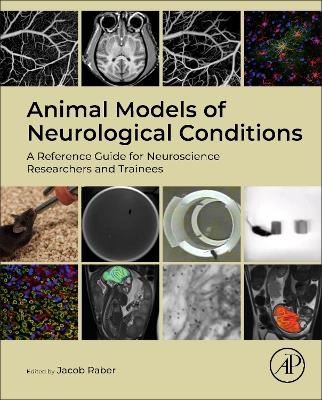
Animal Models of Neurological Conditions
Academic Press Inc (Verlag)
978-0-443-29090-9 (ISBN)
This is an invaluable resource for neuroscience researchers, trainees, and healthcare professionals.
Jacob Raber, PhD received his BS in Chemistry and MS in Pharmacochemistry from the Free University of Amsterdam, his PhD in Molecular Genetics and Virology from the Weizmann Institute of Science, and further training under Floyd Bloom at the Scripps Research Institute, La Jolla, and Lennart Mucke at the Gladstone Institutes and UCSF. In 2001 he was recruited to Oregon Health & Science University (OHSU) in Portland, Oregon and currently serves as a professor in the Departments of Behavioral Neuroscience, Neurology, Psychiatry, and Radiation Medicine, an affiliate scientist in the division of Neuroscience at the ONPRC, and a Courtesy Professor in the College of Pharmacy at Oregon State University. He was an Ellison Medical Foundation New Scholar in Aging from 2002-2006. Dr Raber’s research is devoted to characterizing effects of environmental and genetic factors on brain function, identifying of affected pathways, and developing treatments to antagonize detrimental effects.
Section 1: Animal models of alcohol and drugs of abuse
1. Mouse behavioral models of alcohol and drug hedonic effects
2. Nonhuman primate models of fetal alcohol spectrum disorders
Section 2: Posttraumatic stress disorder animal models
3. Rodent models of posttraumatic stress disorder
Section 3: Animal models of traumatic brain injury
4. Mouse models of traumatic brain injury
Section 4: Animal models of ischemic and vascular conditions
5. Sheep model of hypoxia to the developing brain
6. Animal models of ischemic and hemorrhagic stroke
7. Animal models of depression: a novel preclinical framework for post-myocardial infarction depression
Section 5: Animal models of mild cognitive impairment
8. Nonhuman primate model of mild cognitive impairment
Section 6: Parkinson’s disease animal models
9. MPTP progressive model of Parkinson’s disease: changes in basal ganglia circuitry and restorative treatment strategies
Section 7: Alzheimer’s disease mouse models
10. Mouse models of Alzheimer’s disease pathology
11. Mouse models of apolipoprotein E
Section 8: Western Pacific ALS/PDC mouse models
12. Animals models of Western Pacific amyotrophic lateral sclerosis and Parkinsonism-dementia complex
Section 9: Second-hand cigarette smoke rodent models
13. Animal models of second-hand cigarette smoke (SHS) exposure in neurodevelopmental disorders and neurodegenerative disease
Section 10: Multiple sclerosis animal models
14. Nonhuman primate models of multiple sclerosis: advantages over rodent models for preclinical studies
Section 11: Hepatitis mouse models
15. Animal models of hepatitis
| Erscheinungsdatum | 22.11.2025 |
|---|---|
| Verlagsort | San Diego |
| Sprache | englisch |
| Maße | 152 x 229 mm |
| Gewicht | 450 g |
| Themenwelt | Medizin / Pharmazie ► Medizinische Fachgebiete ► Neurologie |
| Naturwissenschaften ► Biologie ► Humanbiologie | |
| Naturwissenschaften ► Biologie ► Zoologie | |
| ISBN-10 | 0-443-29090-3 / 0443290903 |
| ISBN-13 | 978-0-443-29090-9 / 9780443290909 |
| Zustand | Neuware |
| Informationen gemäß Produktsicherheitsverordnung (GPSR) | |
| Haben Sie eine Frage zum Produkt? |
aus dem Bereich