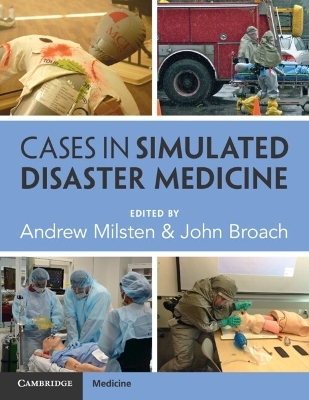
Cases in Simulated Disaster Medicine
Cambridge University Press (Verlag)
978-1-009-27901-7 (ISBN)
- Noch nicht erschienen (ca. Januar 2026)
- Versandkostenfrei
- Auch auf Rechnung
- Artikel merken
Bring life to your curriculum with this comprehensive, yet versatile book that explores core disaster medicine principles through vivid emergency medicine cases. Each case has been crafted to suit a wide range of learners – from novice to practitioner. The ready-to-teach cases are scalable and customizable to any learning environment, from low-resource teaching settings to high-fidelity simulation labs. Covering the basics of simulation to advanced disaster response strategies, cases cover natural and human-made disasters, including pandemics, building collapses, mass gathering medicine, and blast injuries, providing hands-on learning opportunities that can be used to enhance understanding and retention. Each case follows a standard structure including teaching objectives, discussion points, a timeline, and critical actions. With a mix of scenarios and flexible application, this resource will ensure every learner is prepared with the knowledge and skills necessary to navigate complexities associated with real-world emergencies while learning core disaster medicine principles.
Dr Andrew Milsten is a professor of emergency medicine at the University of Massachusetts Chan Medical School and completed the University of Maryland Emergency Medical Services (EMS) & Disaster Medicine fellowship in 2000, after finishing the Emergency Medicine residency at Lincoln Hospital (NYC). While in Maryland, he served as the Ravens' (National Football League team) stadium event Medical Director. Dr Milsten is currently the University of Massachusetts Disaster Medicine Fellowship Program Director. He is an advocate for disaster medicine as a boarded specialty through the American College of Emergency Physicians and continues to conduct research on disasters as well as event medicine topics. Dr Milsten teaches disaster medicine to medical students, residents, and fellows. He has responded to international disasters as a member of the Massachusetts-2 Disaster Medical Assistance Team (DMAT). Dr John Broach is an associate professor of emergency medicine at the University of Massachusetts Chan Medical School. He is the Division Director for EMS and Disaster Medicine at the University of Massachusetts Memorial Medical Center, has deployed to disasters domestically and internationally, and is a member of Massachusetts-2 DMAT through the National Disaster Medical System. He served as Medical Director of the UMass Memorial Medical Center DCU Center Field Hospital during the COVID-19 pandemic and has published and presented extensively on disaster medicine and EMS topics.
List of Contributors; Section 1. Introductory Chapters: 1. Introduction to simulation Cassandra Mackey and Jennifer Carey; 2. Disaster simulation: The best way to prepare for the worst David Ruby; 3. Simulation debriefing Jorge Yarzebski and Jordan Hitchens; Section 2. Geophysical Natural Disasters: Case 1. Options for delayed extraction following an earthquake Michael Weiner and C. Clare Charbonnet; Case 2. Covered in oil: HAZMAT injuries after a refinery collapse Liam Porter; Case 3. Crisis in Indonesia: Navigating volcanic eruptions, ash clouds, and lightning storm injuries Natalie Moore and Lauren Bacon; Case 4. Inhalational injuries after Mount Kilauea erupts Natalie Moore, Lauren Bacon and Andrew Milsten; Case 5. Emergency care in volcanic disasters: A case study of volcanic burn management after the Whakaari/White Island eruption Colleen M. Donovan, Emerson Franke, Paul Baker and Michelle B. Locke; Case 6. Tsunami survivor with fever and jaundice: Pediatric patient in a refugee clinic Alexander Hart; Case 7. Severe smoke inhalation and asthma exacerbation after a tsunami-induced fire Alexander Hart; Case 8. Tsunami-related pulmonary complications: Respiratory distress in an internally displaced person Jonathan Gammel; Section 3. Meteorological Natural Disasters: Case 9. Delayed blunt trauma sustained during debris removal after hurricane Morgan Ritz and Romeo Fairley; Case 10. Sheltering in the storm: Delayed extrication of an elderly man after a southern US hurricane Michael Weiner; Case 11. 'I Lost My Medications': Primary care interruption after a hurricane Liam Porter; Case 12. Tornado bloodbath: Addressing major trauma from a chainsaw complicated by anticoagulation in a rural emergency setting Ameer F. Ibrahim; Case 13. Tornado chasing gone wrong: Managing patients with impaled objects in the emergency department Ameer F. Ibrahim; Case 14. Tornado in the farmland: Multisystem trauma response in rural Alabama Guy Carmelli; Case 15. Stranded in the heat: Severe hyperthermia and multisystem organ failure Jonathan Gammel; Case 16. Out cold: Hypothermia from environmental exposure in a winter storm Daniel Saltzman; Case 17 An invisible killer: Carbon monoxide toxicity from gasoline generator use during a winter storm Daniel Saltzman; Section 4. Hydrological Natural Disasters: Case 18. Helping turns hazardous: Blunt trauma and respiratory distress during flash flood rescue Morgan Ritz and Romeo Fairley; Case 19. Trapped by the flood: Rescue of an elderly man after 24 hours Guy Carmelli; Case 20. Disaster strikes twice: Managing a dog bite injury in a posthurricane rescue Jennifer E. Geller and Colleen M. Donovan; Case 21. When rescuers become patients: A cold immersion injury scenario from the DMAT field hospital Colleen M. Donovan and Lekha Reddy; Section 5. Climatological Natural Disasters: Case 22. Wildfire chaos: A case of trauma and smoke inhalation from late evacuation Jonathan Gammel; Section 6. Biological Natural Disasters: Case 23. Critical management of Ebola virus disease in the emergency department Matthew Carlisle; Case 24. From cabin cleanup to critical care: Managing hantavirus infection Matthew Carlisle; Case 25. Medical response in crisis: Pediatric diarrhea and shock in refugee camps Matthew A. Tovar and James P. Phillips; Case 26. Resource management during a pandemic surge in a small hospital Christopher Hayden; Section 7. Technological Disasters: Case 27. Medical management of chlorine gas exposure following a freight train derailment Colleen M. Donovan, Mary G. Mcgoldrick and Denise Fernandez; Case 28. Treating life-threatening injuries with limited resources while at sea Cody Johnson; Case 29. Outbreak at sea: Managing acute gastroenteritis on a cruise ship Cody Johnson; Case 30. Illness on the high seas: Navigating a gastrointestinal outbreak 50 miles from shore Rashed Al Remeithi and Nata
| Erscheint lt. Verlag | 31.1.2026 |
|---|---|
| Zusatzinfo | Worked examples or Exercises |
| Verlagsort | Cambridge |
| Sprache | englisch |
| Themenwelt | Medizin / Pharmazie ► Gesundheitsfachberufe ► Rettungsassistent / -sanitäter |
| Medizin / Pharmazie ► Medizinische Fachgebiete ► Intensivmedizin | |
| Medizin / Pharmazie ► Medizinische Fachgebiete ► Notfallmedizin | |
| Medizin / Pharmazie ► Pflege | |
| ISBN-10 | 1-009-27901-7 / 1009279017 |
| ISBN-13 | 978-1-009-27901-7 / 9781009279017 |
| Zustand | Neuware |
| Informationen gemäß Produktsicherheitsverordnung (GPSR) | |
| Haben Sie eine Frage zum Produkt? |
aus dem Bereich