


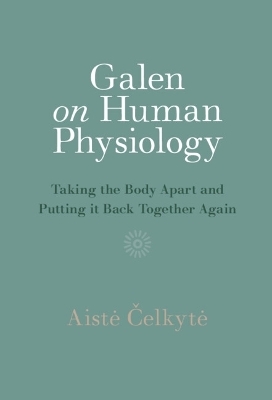
Galen on Human Physiology
Taking the Body Apart and Putting it Back Together Again
Seiten
2025
Cambridge University Press (Verlag)
978-1-009-43581-9 (ISBN)
Cambridge University Press (Verlag)
978-1-009-43581-9 (ISBN)
Galen of Pergamum, 'the prince of medicine', plays a significant role in the history of medicine, philosophy, and cultural history. This book presents a study of his physiology, looking both at Galen's solutions to a number of puzzles concerning human bodily functions, and at his theorisation of human nature.
Galen of Pergamum, known as 'the prince of medicine', is an important figure not only for the history of medicine but also for ancient philosophy, history of ideas and cultural history. In this book, Aistė Čelkytė explores Galenic physiology and examines how this highly influential figure theorised the unity of the multi-part, ever-moving and ever-changing human body. She approaches this question by first studying how Galen 'takes the body apart', that is, the different divisions of the body into parts that he proposes, and then how he 'puts it back together', that is, his use of philosophical tools to posit the vital unity among these parts. She then looks at Galen's theorisation of human nature, his understanding of parthood, the hierarchies between the parts that underpin vital functions, the 'mechanisms' that make the body one, and Galen's understanding of the body as a multifaceted but unified whole.
Galen of Pergamum, known as 'the prince of medicine', is an important figure not only for the history of medicine but also for ancient philosophy, history of ideas and cultural history. In this book, Aistė Čelkytė explores Galenic physiology and examines how this highly influential figure theorised the unity of the multi-part, ever-moving and ever-changing human body. She approaches this question by first studying how Galen 'takes the body apart', that is, the different divisions of the body into parts that he proposes, and then how he 'puts it back together', that is, his use of philosophical tools to posit the vital unity among these parts. She then looks at Galen's theorisation of human nature, his understanding of parthood, the hierarchies between the parts that underpin vital functions, the 'mechanisms' that make the body one, and Galen's understanding of the body as a multifaceted but unified whole.
Aistė Čelkytė is a Postdoctoral Fellow at the Centre for the Arts in Society (LUCAS) at Leiden University and a researcher at Vilnius University. She is the author of The Stoic Theory of Beauty (2020).
Introduction; 1. Galen on parts: taking the body apart; 2. Nutrition, growth, and vegetative capacities; 3. Respiration and transpiration: the cardiac system and pneumatology; 4. Perception and voluntary motion: the nervous systems; 5. Tripartition: putting the body back together; Conclusions; References; General index; Index locorum.
| Erscheinungsdatum | 23.09.2025 |
|---|---|
| Zusatzinfo | Worked examples or Exercises |
| Verlagsort | Cambridge |
| Sprache | englisch |
| Gewicht | 500 g |
| Themenwelt | Geisteswissenschaften ► Philosophie ► Philosophie Altertum / Antike |
| Studium ► 1. Studienabschnitt (Vorklinik) ► Physiologie | |
| Studium ► Querschnittsbereiche ► Geschichte / Ethik der Medizin | |
| ISBN-10 | 1-009-43581-7 / 1009435817 |
| ISBN-13 | 978-1-009-43581-9 / 9781009435819 |
| Zustand | Neuware |
| Informationen gemäß Produktsicherheitsverordnung (GPSR) | |
| Haben Sie eine Frage zum Produkt? |
Mehr entdecken
aus dem Bereich

aus dem Bereich


