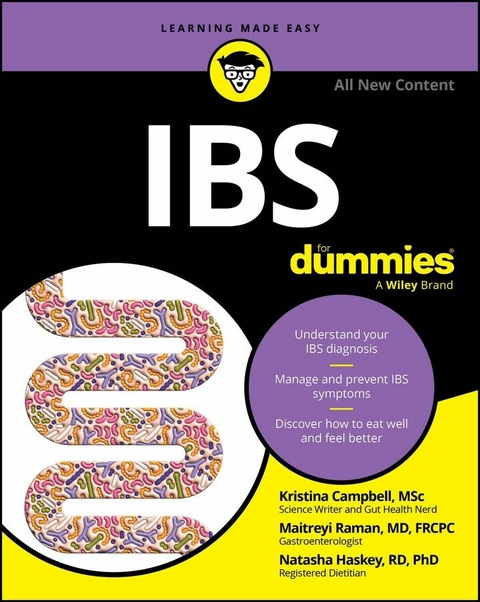
IBS For Dummies (eBook)
440 Seiten
For Dummies (Verlag)
978-1-394-28946-2 (ISBN)
Get trustworthy answers to all your questions about irritable bowel syndrome
IBS For Dummies is a much-needed resource that covers all aspects of this common gastrointestinal disorder, from a basic understanding of how the digestive tract works to managing the difficult and often unpredictable symptoms that come with the condition. This essential guide also gives those with IBS and IBS-like symptoms key tips on how to adapt their lifestyle and live life to the fullest. Packed with up-to-date scientific information, IBS For Dummies takes you through the different subtypes of IBS and their symptoms, covers treatment options, and provides helpful tips in a clear and approachable way. The compassionate Dummies approach makes coping with IBS easier, so you won't be held back by your symptoms.
- Discover the role of the gut microbiome and the gut-brain axis in IBS
- Learn how you can get an IBS diagnosis and find the treatment that works for you
- Find IBS-friendly recipes, current research findings, and new management options
If you or someone you love has been diagnosed with IBS-or struggles with IBS symptoms without a diagnosis-this book will help you uncover new avenues for relief. Healthcare professionals looking to educate patients will also love this approachable reference.
Kristina Campbell, MSc, is the author of The Well-Fed Microbiome Cookbook and Gut Health For Dummies.
Maitreyi Raman, MD, FRCPC, is a gastroenterologist, nutrition specialist, and associate professor at the University of Calgary.
Natasha Haskey, RD, PhD, is a registered dietitian and a researcher at the University of British Columbia, Okanagan.
Get trustworthy answers to all your questions about irritable bowel syndrome IBS For Dummies is a much-needed resource that covers all aspects of this common gastrointestinal disorder, from a basic understanding of how the digestive tract works to managing the difficult and often unpredictable symptoms that come with the condition. This essential guide also gives those with IBS and IBS-like symptoms key tips on how to adapt their lifestyle and live life to the fullest. Packed with up-to-date scientific information, IBS For Dummies takes you through the different subtypes of IBS and their symptoms, covers treatment options, and provides helpful tips in a clear and approachable way. The compassionate Dummies approach makes coping with IBS easier, so you won't be held back by your symptoms. Discover the role of the gut microbiome and the gut-brain axis in IBS Learn how you can get an IBS diagnosis and find the treatment that works for you Find IBS-friendly recipes, current research findings, and new management options If you or someone you love has been diagnosed with IBS or struggles with IBS symptoms without a diagnosis this book will help you uncover new avenues for relief. Healthcare professionals looking to educate patients will also love this approachable reference.
Chapter 1
A Road Map to Success with IBS
IN THIS CHAPTER
Understanding IBS as a disorder of gut-brain interaction
Delving into why IBS diagnosis is important and how the diagnostic process works
Discovering science-backed approaches to managing IBS
Coping with IBS in special situations
Under normal circumstances, the brain and the digestive tract (or gut) are good buddies. They send messages back and forth all day long — sharing the minutiae of what you’re eating and your emotional state, giving thumbs-up emojis when everything’s going well and warning each other when they sense trouble.
But in someone with irritable bowel syndrome (IBS), the communication between the gut and the brain is much more chaotic. The gut may send a very routine message that a sip of coffee is incoming, and the brain responds with an all-out emergency alarm, sending signals to speed up the muscle contractions in the gut and prepare for a bowel movement. Or the gut may sense a small, normal bubble of air and kick up the drama, telling the brain to activate its pain centers. In fact, different sensations in the gut all day long may be interpreted as signals to activate pain-sensitive regions of the brain.
IBS (not to be confused with inflammatory bowel disease, or IBD) is a disorder of gut-brain interaction (DGBI), which involves disruption in the normal two-way communication that should proceed seamlessly between the gut and the brain.
This chapter is an overview of what IBS is, why it’s important to receive a diagnosis, and how to manage IBS using a holistic approach that encompasses your diet and other aspects of your lifestyle.
Comprehending IBS
Over the past 200 years, doctors and scientists have gradually come to understand more about the pattern of symptoms that characterizes IBS and how the symptoms arise. IBS was previously known as a functional disorder (with no known physical cause), but now it’s better understood as a DGBI.
Discovering what defines IBS
IBS is best perceived as a cluster of digestive symptoms that indicate faulty gut-brain communication. Individuals with IBS may have very different underlying factors contributing to these symptoms.
No physical damage to the digestive tract is observed in IBS. As outlined in Chapter 2, the defining features of IBS are as follows:
- Abdominal pain that’s related to bowel movements.
- Abnormal bowel movements, either more or less often than normal for you, or with a different appearance than usual; the bowel movements may be loose and watery or hard and lumpy.
Outside of these core symptoms, people with IBS often experience other gastrointestinal (GI) symptoms such as bloating, distension, intestinal gas, and burping.
Although IBS is not a life-threatening condition, it can have an outsize effect on your quality of life. Proper diagnosis is essential, and treatment should be approached with seriousness and determination.
Pinpointing who tends to get IBS and why
In the United States, researchers estimate that around 6 percent of adults have a diagnosis of IBS and about 15 percent live with IBS-like symptoms. Rates of IBS are different in various countries around the world and tend to change over time.
Chapter 3 covers various risk factors that increase someone’s chance of developing IBS.
Although the root cause of IBS is complex, the following biological changes are sometimes seen (inconsistently) in people with IBS:
- Abnormal GI motility: Motility is how quickly food and fluids move through the digestive tract with the help of gut muscles. Motility disruptions can result in diarrhea (if too fast) or constipation (if too slow).
- Increased sensitivity to pain or discomfort in the digestive tract: In people with IBS, scientists have found increased sensitivity to pain, and/or activation of the brain’s pain centers in response to normal, non-painful gut stimuli.
- A more permeable gut barrier: The gut barrier usually seals off the digestive tract from the rest of the body while retaining spaces between cells that can open up to let in essential nutrients and water. Some people with IBS have a more permeable (or leaky) gut barrier, leading to symptoms that include abdominal pain.
- Dysregulation (abnormal cell activity) of the immune system: Even though IBS is not associated with abnormal clinical measures of inflammation, some people with IBS have different patterns of immune cell activation than people without IBS.
- Pelvic floor dysfunction: Some cases of IBS are associated with pelvic floor muscles not working properly, contributing to diarrhea or constipation.
- Difficulty digesting or absorbing some carbohydrates: Some people with IBS show disrupted chemistry in the small intestine, which causes certain carbohydrates to be poorly absorbed and leads to the production of gases and water to result in diarrhea. Others may lack the enzymes (chemicals) to break down specific carbohydrates such as the lactose in dairy products, causing digestive symptoms.
- Changes in the community of gut microbes: Studies have found differences in the types and amounts of microorganisms in the digestive tracts of people with IBS, compared with healthy people. These microorganisms help regulate the immune system and other body functions such as motility, so their disruption may cause gut symptoms.
Understanding how the gut-brain axis works
IBS is characterized by a breakdown in the functioning of the gut-brain axis, the two-way communication channel that extends between the digestive tract and the brain. Chapter 4 delves into the components of the gut-brain axis and how they work together.
The main parts of your digestive tract, from top to bottom, are:
- Oral cavity (mouth)
- Esophagus
- Stomach
- Small intestine
- Large intestine
Other organs, such as the liver and pancreas, also make important contributions to digestion. However, the digestive tract itself maintains a stable environment by managing two main functions: digestion and absorption (letting things in) along with defense (keeping things out). It manages these functions with the help of several other important but lesser-known systems: the gut’s own nervous system, called the enteric nervous system (ENS); gut microorganisms; the immune system; and the enteroendocrine system.
The main channels of two-way communication between the gut and the brain are:
- Nerve activation: ENS neurons interact with the vagus nerve, which is the main superhighway for gut-brain messages.
- Immune signals: Immune cells from the gut can release signals that reach the brain.
- Hormone and other molecule signals: Various hormones and other molecules (called metabolites) produced in the gut can activate ENS neurons and convey messages to the brain. These molecules may also circulate in the blood and reach targets in the brain.
Some of these modes of communication are disrupted in IBS.
Navigating a Diagnosis of IBS
If you have IBS-like symptoms, seeking an official IBS diagnosis is important because it allows you to rule out closely related conditions that require very different treatments. Chapters 5 and 6 correct the record on the misunderstandings around IBS diagnosis.
Getting diagnosed
Diagnosis by a medical professional is a critical first step in taking charge of your IBS. Other conditions — such as celiac disease, colorectal cancer, endometriosis, IBD, small intestinal bacterial overgrowth, and thyroid disorders — may look similar to IBS but require very different treatments, so they should be ruled out before proceeding. Chapter 5 walks through the typical process of IBS diagnosis.
No single test positively confirms that you have IBS, so diagnosis involves two phases:
- Confirming symptoms that fit the IBS pattern
- Ruling out other conditions that may account for the symptoms
The diagnosis may be confirmed only after the symptoms occur for six months or more.
When seeking a diagnosis, keeping a written log is the best way to track your symptoms in the days and weeks before your doctor’s appointment.
A medical history is usually the first step in IBS diagnosis. Then, after your doctor conducts a physical examination, some or all of the following tests may be carried out:
- Cross-sectional imaging (such as an abdominal ultrasound)
- Blood tests
- Stool tests
- Endoscopic evaluations
After this information is collected, the doctor puts the pieces together and determines whether an IBS diagnosis is appropriate. During the process of diagnosis, be cautious about implementing dietary changes prematurely because they can negatively affect some test results.
Knowing what to expect after diagnosis
Receiving a diagnosis of IBS can leave you wondering “What’s next?” You may feel relieved to know the name of your condition, overwhelmed by the thought of starting to change your lifestyle, and many other emotions. As Chapter 6 explains, after diagnosis you begin a personal emotional journey as you embrace a new way of understanding your...
| Erscheint lt. Verlag | 17.3.2025 |
|---|---|
| Sprache | englisch |
| Themenwelt | Medizin / Pharmazie ► Allgemeines / Lexika |
| Medizin / Pharmazie ► Medizinische Fachgebiete ► Innere Medizin | |
| Schlagworte | books about ibs • Gut inflammation • Gut microbiome • IBS • IBS book • ibs solution • ibs supplements • ibs support • IBS treatment • irritable bowel • irritable bowel book • Irritable bowel syndrome • irritable bowel syndrome book • Low FODMAP • natural ibs • probiotics ibs |
| ISBN-10 | 1-394-28946-4 / 1394289464 |
| ISBN-13 | 978-1-394-28946-2 / 9781394289462 |
| Informationen gemäß Produktsicherheitsverordnung (GPSR) | |
| Haben Sie eine Frage zum Produkt? |
 EPUB (Adobe DRM)
Kopierschutz: Adobe-DRM
Adobe-DRM ist ein Kopierschutz, der das eBook vor Mißbrauch schützen soll. Dabei wird das eBook bereits beim Download auf Ihre persönliche Adobe-ID autorisiert. Lesen können Sie das eBook dann nur auf den Geräten, welche ebenfalls auf Ihre Adobe-ID registriert sind.
Details zum Adobe-DRM
Dateiformat: EPUB (Electronic Publication)
EPUB ist ein offener Standard für eBooks und eignet sich besonders zur Darstellung von Belletristik und Sachbüchern. Der Fließtext wird dynamisch an die Display- und Schriftgröße angepasst. Auch für mobile Lesegeräte ist EPUB daher gut geeignet.
Systemvoraussetzungen:
PC/Mac: Mit einem PC oder Mac können Sie dieses eBook lesen. Sie benötigen eine
eReader: Dieses eBook kann mit (fast) allen eBook-Readern gelesen werden. Mit dem amazon-Kindle ist es aber nicht kompatibel.
Smartphone/Tablet: Egal ob Apple oder Android, dieses eBook können Sie lesen. Sie benötigen eine
Geräteliste und zusätzliche Hinweise
Buying eBooks from abroad
For tax law reasons we can sell eBooks just within Germany and Switzerland. Regrettably we cannot fulfill eBook-orders from other countries.
aus dem Bereich