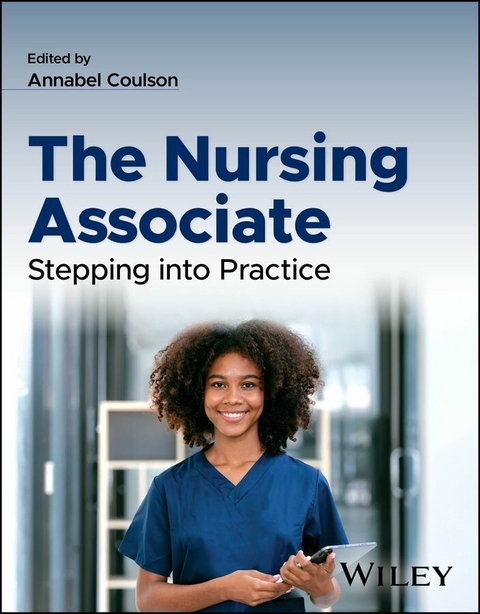
The Nursing Associate (eBook)
351 Seiten
Wiley (Verlag)
978-1-119-69858-6 (ISBN)
A complete guide to the challenges and opportunities of the nursing associate role, and its potential to improve patient outcomes
The Nursing Associate: Stepping into Practice provides essential insights into the important, emerging role of the nursing associate within clinical practice, the importance of professional development, and the core skills and competencies outlined by the Nursing and Midwifery Council (NMC, 2018). This book carefully considers how these skills align with the NMC Standards for Nurse Education and the Future Nurse expectations, and where appropriate, outlines their relationship directly to the Standards of Proficiency. Each chapter includes further reading to enable the reader to expand their understanding in relation to their own experiences and practice needs.
The Nursing Associate includes information on:
- The importance of decision-making, evidence-based practice, and professionalism as a nursing associate
- Approaches to ensuring a person-centred mindset during admission and the provision of safe and effective care
- Effective communication skills aimed at supporting individuality, gaining trust, and ensuring the patient voice is recognised
- The relevance of duty of care, candour, equality and diversity, and how the three concepts interlink
- The transition into becoming a registrant, covering changes in responsibility and accountability level as well as new skill development
The Nursing Associate is an essential read for all current and aspiring nursing associates seeking to understand their role, maximise their effectiveness in team support and patient outcomes, and taking the next step in their careers.
Annabel Coulson, Practice Learning Lead and Programme Leader for FdSc Nursing Associate, University Hospitals of Leicester, UK.
1
Understanding Your Apprenticeship
Annabel Coulson
University Hospitals of Leicester NHS Trust, Leicester, UK
Introduction
You might associate apprenticeships with young people at the start of their careers as an opportunity to gain employment. However, the growing breadth and level of apprenticeships mean that they are popular for anyone considering a career change or further development within a career framework. The Nursing Associate (NA) Apprenticeship (Institute of Apprenticeships Standard ST0827) also enables individuals who have had initial careers as healthcare assistants or healthcare support workers to expand their careers to NMC registration. Some employers will offer opportunities for those who are new to care, or have limited care experience, to enter employment as an apprentice to complete the NA Programme and progress within their nursing careers.
Postregistration opportunities for NAs will also be discussed in this chapter; as a NA there is potential for further development within your role or towards Level 1 registration as a Registered Nurse (RN) by undertaking a further Level 6 Apprenticeship.
This chapter will support you to understand both your responsibility and your employer's responsibility as an apprentice studying towards your NA registration.
Aims of This Chapter
This chapter is relevant to both students and registrants and will be of value to those supporting students in practice.
This chapter aims to:
- provide an overview of the history of nursing education using an apprenticeship model
- explore the benefits and risks of the apprenticeship as an educational concept
- understand the needs of apprentice NAs within the workplace; from this point the apprentice NA will be termed ‘student’
- to develop an awareness of some of the challenges that face students and how these may be overcome.
It is recognised that not all students will enter the NA role via the apprenticeship route. This chapter aims to provide those of you completing an apprenticeship with a greater level of understanding of your responsibility and the responsibility of your employer in supporting your development. While this chapter does not link directly to the NMC Standards of Proficiency for NAs, it does discuss the knowledge, skills and behaviours that are assessed as part of the Institute of Apprenticeships Standard (ST0827) and you will see how closely aligned these are to the NMC Standards of Proficiency (NMC 2018a).
The History of Nurse Education and the Apprenticeship Model
Learning how nurse education has evolved will enable you to develop an understanding of some of the challenges and opportunities associated with an apprenticeship model, either during your educational programme or when supporting others. Nurse education has a long history of using an apprenticeship model of delivery and various reports have either promoted the benefits or highlighted the challenges of this model. This section will briefly explore the history of nurse education in the context of apprenticeship delivery to provide a background which will help you to consider how to utilise the apprenticeship model effectively. This is a very brief overview and further reading has been provided at the end of the chapter.
In 1860, Florence Nightingale established the Nightingale Training School for Nurses at St Thomas's Hospital in a bid to create a skilled nursing workforce. The training of nurses, termed ‘probationers’, aimed to ensure that nurses were knowledgeable and skilled and held the welfare of the patient at the centre of their care. Nurses needed to demonstrate compassion and a genuine interest in the needs of the individual. To develop these skills and attributes, Nightingale believed that training should take place in hospitals and be provided by suitably trained ward sisters and matrons. She advocated for standardised training for all nurses and a syllabus was developed with medical staff and senior nurses to ensure that all probationers at St Thomas's had the required knowledge, skills and behaviours for the delivery of compassionate, person‐centred care. You will see many of these early expectations mirrored in the expectations of the apprenticeship standard for NAs and within the NMC Code (NMC 2018b).
Training was delivered using a practical, ‘hands‐on’ approach which maintained the vocational importance of nursing; the role of the ward sister was integral in ensuring that probationers were provided with the knowledge and opportunity to practise under supervision before they could be deemed to be suitably trained. Nurse probationers were provided with their training free of charge and were given a small wage and for this, they were expected to work long hours, study and maintain a level of conduct befitting the nurse role. Developments in nurse education continued based on an apprenticeship model of learning and practical application and this model was seen as best practice by consultants, ward sisters and matrons.
In 1919, the Nurses' Registration Act and the foundation of the General Nursing Council resulted in a legal requirement for the standardisation of nurse training, leading to a national training syllabus and examination. To be entered onto the nursing register, an individual had to successfully complete the standard training and assessment and be deemed of good character.
Nurse education and the need to ensure a supply of suitably trained nurses were discussed and debated over the next 50 years; demand for nurses was influenced by global events such as the lasting effects of the First World War and the increased need for hospital care because of the Second World War. Shortages of nurses has been, and continues to be, debated in terms of ensuring that healthcare has access to the right number of suitably skilled staff able to respond to changes in demand and advances in technology and medical science. The NHS Workforce Plan (2023) identified the need for the correct mix of staff to provide effective and compassionate care while also ensuring highly skilled practitioners who are able to meet the increasing complexity of care needs.
Any discussion relating to the education of nurses must include a balance between ensuring the education needs of those seeking a career in nursing and the needs of those employing a nursing workforce. The apprenticeship model of educating nurses remained popular with senior medical and nursing teams when in the 1960s concerns were identified around the status of students and the priority given to their learning. Advocates for the apprenticeship model recognised the importance of practical skill development and feared that by prioritising academia, this would be lost. At the same time there was a concern that students' learning was being compromised in favour of tasks that could be done by non‐registered staff. Students identified that they were working long hours with limited time for study and because of staff shortages, they were not getting the support to practise their new skills. While there were reports suggesting that significant change was needed in nurse education, this change did not start to happen for a long time.
The Briggs Report in 1972 recommended that nurse education be more closely aligned to a university in a bid to protect student status and increase the professional identity of nursing. While it was not until much later that nursing finally moved towards a university‐based education, the Briggs Report was responsible for initiating the most significant shift in nurse education since Nightingale (Briggs 1972). Briggs recommended that there should be a single tier of nurse, the RN, as there was a lack of appropriate definition between the RN and Enrolled Nurse (EN) and often this resulted in ENs assuming roles that should be limited to the RN. The development and subsequent demise of the EN are discussed in relation to the new NA role in Chapter 2. You might find further reading of the Briggs Report interesting in relation to the development of the NA role.
In 1992, nurse education moved to a university and was delivered by lecturers and nurse academics; student status was maintained throughout the period of the programme, resulting in the immediate loss of the student workforce. Considerable debate around how nursing programmes prepare students for the demands of healthcare has existed ever since, with calls to increase the amount of time student nurses spend as part of the workforce. The supernumerary status of nursing students continues to be maintained and it could be viewed that the NA apprenticeship offers the opportunity to have the ‘best of both worlds’. The lessons learnt from early apprenticeship models and the transition to university‐based education will be discussed in greater detail throughout this chapter.
The NA role was developed to bridge the gap between the HCA and the RN; you may be familiar with this concept but if you are not then you must ensure that you read the Shape of Caring Review (Willis 2015). Willis identified the challenges to nurse education and the intention that a role positioned between HCA and RN will provide improved patient care and create development opportunities for existing HCAs. Apprenticeship offers existing HCAs the ability to learn and gain registration while not restricting earning ability, providing an excellent opportunity for experienced HCAs to gain career progression.
What Is an...
| Erscheint lt. Verlag | 28.2.2025 |
|---|---|
| Sprache | englisch |
| Themenwelt | Medizin / Pharmazie ► Pflege |
| Schlagworte | Future Nurse expectations • healthcare career • NMC Standards for Nurse Education • Nursing and Midwifery Council • nursing associate career • nursing associate impact • nursing associate opportunities • nursing associate role |
| ISBN-10 | 1-119-69858-8 / 1119698588 |
| ISBN-13 | 978-1-119-69858-6 / 9781119698586 |
| Informationen gemäß Produktsicherheitsverordnung (GPSR) | |
| Haben Sie eine Frage zum Produkt? |
 EPUB (Adobe DRM)
Kopierschutz: Adobe-DRM
Adobe-DRM ist ein Kopierschutz, der das eBook vor Mißbrauch schützen soll. Dabei wird das eBook bereits beim Download auf Ihre persönliche Adobe-ID autorisiert. Lesen können Sie das eBook dann nur auf den Geräten, welche ebenfalls auf Ihre Adobe-ID registriert sind.
Details zum Adobe-DRM
Dateiformat: EPUB (Electronic Publication)
EPUB ist ein offener Standard für eBooks und eignet sich besonders zur Darstellung von Belletristik und Sachbüchern. Der Fließtext wird dynamisch an die Display- und Schriftgröße angepasst. Auch für mobile Lesegeräte ist EPUB daher gut geeignet.
Systemvoraussetzungen:
PC/Mac: Mit einem PC oder Mac können Sie dieses eBook lesen. Sie benötigen eine
eReader: Dieses eBook kann mit (fast) allen eBook-Readern gelesen werden. Mit dem amazon-Kindle ist es aber nicht kompatibel.
Smartphone/Tablet: Egal ob Apple oder Android, dieses eBook können Sie lesen. Sie benötigen eine
Geräteliste und zusätzliche Hinweise
Buying eBooks from abroad
For tax law reasons we can sell eBooks just within Germany and Switzerland. Regrettably we cannot fulfill eBook-orders from other countries.
aus dem Bereich