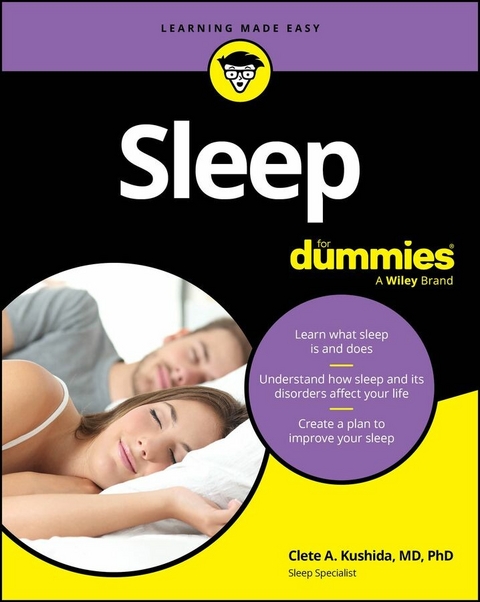
Sleep For Dummies (eBook)
437 Seiten
For Dummies (Verlag)
978-1-394-26235-9 (ISBN)
Improve your health, your productivity, and your relationships-with sleep!
In a world constantly on the move, it's not surprising that more and more people aren't sleeping as much as they'd like. Sleep For Dummies helps you understand the foundations of sleep and how it impacts our everyday lives. With easy-to-understand explanations and simple strategies you can start using today, this book will help you get the most out of your sleep hours. Get science-backed advice on how to get the sleep you need and explore how prioritizing your sleep health can supercharge your life, with this fun Dummies guide.
- Learn all about sleep cycles, circadian rhythms, dreams, and the effects of sleep deprivation on your body and brain
- Get the lowdown on sleep changes across the lifespan, plus sleep disorders like insomnia, sleep apnea, and beyond
- Find out how smartwatches and other wearable sleep technology can help improve your sleep quantity and quality
- Wake up each morning feeling refreshed, thanks to tips to optimize your sleep.
Around 62% of adults worldwide feel they don't sleep well. If you're in that group-or trying to avoid getting in-Sleep For Dummies is for you. This is also a great resource for parents who want to understand their children's sleep needs, shift workers, and anyone with sleep struggles. Look no farther for practical advice to help you get the Zs you need.
Clete A. Kushida, MD, PhD, is a sleep specialist, neurologist, professor, chief, and medical director at Stanford Sleep Medicine. He served as the inaugural president of the World Sleep Society, past president of the American Academy of Sleep Medicine, and founding president of the California Sleep Society. He has authored or edited more than 300 publications and is editor-in-chief of the journal Sleep Science and Practice.
Improve your health, your productivity, and your relationships with sleep! In a world constantly on the move, it's not surprising that more and more people aren't sleeping as much as they'd like. Sleep For Dummies helps you understand the foundations of sleep and how it impacts our everyday lives. With easy-to-understand explanations and simple strategies you can start using today, this book will help you get the most out of your sleep hours. Get science-backed advice on how to get the sleep you need and explore how prioritizing your sleep health can supercharge your life, with this fun Dummies guide. Learn all about sleep cycles, circadian rhythms, dreams, and the effects of sleep deprivation on your body and brain Get the lowdown on sleep changes across the lifespan, plus sleep disorders like insomnia, sleep apnea, and beyond Find out how smartwatches and other wearable sleep technology can help improve your sleep quantity and quality Wake up each morning feeling refreshed, thanks to tips to optimize your sleep. Around 62% of adults worldwide feel they don't sleep well. If you're in that group or trying to avoid getting in Sleep For Dummies is for you. This is also a great resource for parents who want to understand their children's sleep needs, shift workers, and anyone with sleep struggles. Look no farther for practical advice to help you get the Zs you need.
Chapter 1
Exploring Sleep’s Fundamental Nature
IN THIS CHAPTER
Uncovering the states and stages of sleep
Seeing how sleep needs shift and change over your lifetime
Digging into how sleep impacts all body systems
Seeking help for your sleep problems
Every night, billions of people close their eyes, surrendering to a state that has puzzled and fascinated scientists, philosophers, and poets alike for centuries: sleep. For something so universal, sleep remains one of the most complex and poorly understood processes of the human body. Sleep is not just a nightly shutdown; it involves a complex dance of chemical messengers from the brain that interact with biological rhythms. Sleep is a vital activity that underpins all bodily processes — from memory to immunity.
This book unravels the questions of sleep by diving into its science, challenges, and solutions. As someone who has dedicated decades to studying this field, I’ve witnessed firsthand the profound impacts of both healthy and disordered sleep. Whether you examine the devastating consequences of chronic sleep deprivation or the life-changing effects of a good night’s rest, one aspect is clear: Sleep matters. It matters for your health, your productivity, and your happiness.
Sleep’s role in people’s lives is more crucial now than ever. Modern life — with its constant barrage of screens, deadlines, and stress — has turned sleep into an elusive commodity. For many people, getting the recommended seven to nine hours of sleep feels like a distant dream that’s been replaced by exhaustion and caffeine-fueled mornings.
In this chapter, I walk you through the fundamentals of sleep — what it is, why it’s essential, and how it changes throughout our lives. I also touch on the fascinating world of sleep science, disorders, and optimization. This chapter helps you see sleep not as a passive downtime, but as a powerful tool for transformation.
Understanding the Composition of Sleep
Sleep may feel like a single continuous experience, but beneath the surface, sleep harbors an intricate symphony of biological activity. From the gentle transitions of light sleep to the vivid dreams of REM sleep, every stage plays a unique role in restoring your body and mind.
Stages and states of sleep
When you fall asleep, your brain doesn’t simply turn off. Instead, it moves through two distinct states: Non-Rapid Eye Movement (NREM) sleep and Rapid Eye Movement (REM) sleep.
NREM sleep forms the foundation of restorative sleep and dominates most of the sleep cycle. It consists of three stages that serve unique purposes and repeat in cycles throughout the night:
- Stage N1: This is the gateway to sleep — a light, transitional stage marked by slower brain waves (like theta waves at 5–7 Hz versus alpha waves at 8–12 Hz, which dominate the wake state). Your muscles relax and eye movements slow down. People often don’t realize they’re asleep during this stage.
- Stage N2: Often called intermediate sleep, this stage makes up 40 to 55 percent of your nightly rest. It features hallmark brain wave patterns — including sleep spindles and K-complexes — which help consolidate memories and suppress external stimuli.
- Stage N3: Also known as slow-wave sleep or deep sleep, this stage is essential for physical recovery. During the N3 stage, your body repairs tissues, clears brain toxins, and strengthens the immune system.
Turn to Chapter 2 for more information about each stage of NREM sleep.
After NREM, you enter the state of REM sleep, which occurs about 90 minutes after you fall asleep and recurs multiple times throughout the night. Each period of REM sleep grows longer. During REM, your brain activity mimics wakefulness, but your body remains in a state of temporary paralysis. During this sleep stage, the majority of your dreams occur, and experiencing it is critical for emotional regulation and memory consolidation.
Sleep specialists often refer to REM sleep as a state rather than a stage of sleep because it is so different from NREM stages of sleep.
Altogether, the states and stages of sleep form a roughly 90-minute cycle that repeats four to six times during an average night. Each cycle shifts in composition as the night progresses, with deep sleep (N3) dominating earlier cycles and REM sleep taking over later on. Visit Chapter 2 to read more about sleep stages and states.
While sleep stages are universal, the way people cycle through them can vary. For example,
- Genetics may play a role in determining your natural sleep tendencies, including whether you’re a morning lark or a night owl. See Chapters 7 and 8 for additional information on the role of genetics in sleep disorders.
- Lifestyle factors, such as exercise, diet, and stress levels, also influence how easily your body transitions through sleep stages. A sedentary lifestyle may contribute to lighter, more fragmented sleep, and consistent physical activity promotes deeper slow-wave sleep. See Chapter 6 for information about how your lifestyle and habits affect your sleep.
- Aging causes the way your body navigates through sleep stages to change naturally. Newborns need more sleep (of varying stages) than do older humans, who spend less time in deep sleep and more time in the lighter stages.
- External factors, such as medications, stress situations, sleep disorders, or the makeup of your sleep environment all have an effect on the quality and quantity of your sleep.
Sleep specialists and researchers don’t really know which sleep states and stages are most critical to overall health. But from certain studies on animals and humans, they know that deeper stages of sleep and REM sleep are particularly important, and that sleep deprivation for lighter stages of sleep does not have as substantial an effect.
And although sleep specialists can identify the stages and states of sleep, they don’t know why people sleep. But I do cover a few prevailing theories about the reason for sleep in Chapter 2.
Sleep components and characteristics
During sleep, your conscious mind takes a break, but your body and brain perform critical maintenance that supports your health and well-being. Sleep is marked by distinct neurophysiological and physical changes, all of which help restore your energy and optimize your body’s functions. I cover these aspects of sleep in detail in Chapter 4, but here’s a quick glance at them:
- Circadian system: Your sleep-wake cycle is largely controlled by your sleep drive and by your circadian sleep-wake rhythm, which follows a roughly 24-your cycle. One of the strongest influences on this rhythm is light. Exposure to light in the morning can allow you to wake up earlier, and evening light can delay the onset of sleep.
- Dreams: Most dreaming occurs during REM sleep, when the brain is highly active, particularly in the limbic system, which governs emotions. Dreams play a role in emotional processing, learning, and even simulating waking-life scenarios. Dreams also reflect the activity in regions of the brain associated with vision and emotion, which can make dreams richly sensory and often emotionally intense. Interestingly, dream recall happens primarily when you briefly wake during or after REM sleep, which is a natural part of nightly cycles. Flip to Chapter 5 for a breakdown of theories on dreaming.
-
Effects on body systems: During the transition from wakefulness to light sleep, your breathing changes as it switches from conscious control to an autonomic mechanism, and during REM sleep, your breathing becomes shallower and irregular. Similarly, other body systems react, including
- Your heart rate and blood pressure can fluctuate during REM sleep.
- Your digestive system undergoes a change, with gastric acid secretion peaking in the early morning hours, and during REM sleep, your digestion is generally more active.
- Growth hormone secretion surges during deep NREM sleep, promoting repair and growth of tissues.
- Body temperature varies during sleep, and during REM sleep, your body can’t regulate temperature as efficiently, leading to unpredictable swings in temperature.
Head to Chapter 3 for all of the ways sleep impacts your body.
- Differences due to sex: Women tend to sleep longer than men, and differences in EEG activity between women and men occur during the sleep stages. Additionally, sleep disturbances are common during pregnancy, postpartum, and menopause. Turn to Chapter 6 to discover more differences in sleep between men and women.
- Neurotransmitters: These chemical messengers play a role in regulating NREM and REM sleep. For example, GABA (gamma-aminobutyric acid) is an inhibitory neurotransmitter that slows down brain activity and helps induce sleep, and orexin (hypocretin) stabilizes wakefulness and prevents transitions to sleep.
- Racial and ethnic differences: Racial minorities are more likely to experience sleep disruptions and shorter sleep durations, and cultural practices vary among ethnic groups with respect to co-sleeping and napping. Turn to Chapter 6 for more details on how sleep...
| Erscheint lt. Verlag | 11.3.2025 |
|---|---|
| Sprache | englisch |
| Themenwelt | Sachbuch/Ratgeber ► Gesundheit / Leben / Psychologie |
| Medizin / Pharmazie ► Allgemeines / Lexika | |
| Schlagworte | baby sleep • better sleep • improve sleep • Insomnia • narcolepsy • Sleep • Sleep Apnea • sleep apnea dummies • sleep book • Sleep Disorders • sleep disorders dummies • sleep mask • sleep more • Sleep phases • Sleep quality • sleep science • sleep training |
| ISBN-10 | 1-394-26235-3 / 1394262353 |
| ISBN-13 | 978-1-394-26235-9 / 9781394262359 |
| Informationen gemäß Produktsicherheitsverordnung (GPSR) | |
| Haben Sie eine Frage zum Produkt? |
 EPUB (Adobe DRM)
Kopierschutz: Adobe-DRM
Adobe-DRM ist ein Kopierschutz, der das eBook vor Mißbrauch schützen soll. Dabei wird das eBook bereits beim Download auf Ihre persönliche Adobe-ID autorisiert. Lesen können Sie das eBook dann nur auf den Geräten, welche ebenfalls auf Ihre Adobe-ID registriert sind.
Details zum Adobe-DRM
Dateiformat: EPUB (Electronic Publication)
EPUB ist ein offener Standard für eBooks und eignet sich besonders zur Darstellung von Belletristik und Sachbüchern. Der Fließtext wird dynamisch an die Display- und Schriftgröße angepasst. Auch für mobile Lesegeräte ist EPUB daher gut geeignet.
Systemvoraussetzungen:
PC/Mac: Mit einem PC oder Mac können Sie dieses eBook lesen. Sie benötigen eine
eReader: Dieses eBook kann mit (fast) allen eBook-Readern gelesen werden. Mit dem amazon-Kindle ist es aber nicht kompatibel.
Smartphone/Tablet: Egal ob Apple oder Android, dieses eBook können Sie lesen. Sie benötigen eine
Geräteliste und zusätzliche Hinweise
Buying eBooks from abroad
For tax law reasons we can sell eBooks just within Germany and Switzerland. Regrettably we cannot fulfill eBook-orders from other countries.
aus dem Bereich