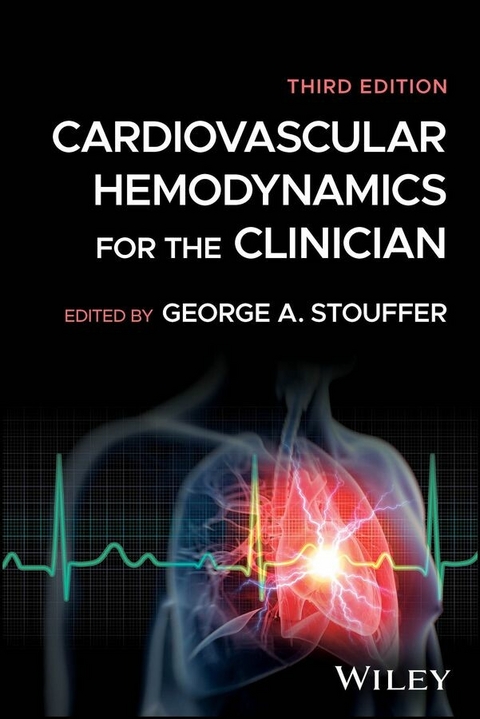
Cardiovascular Hemodynamics for the Clinician (eBook)
797 Seiten
Wiley (Verlag)
978-1-394-23934-4 (ISBN)
Concise, reliable, and useful handbook for understanding the practical application of hemodynamics in clinical medicine
Cardiovascular Hemodynamics for the Clinician, Third Edition is a concise, straightforward handbook to help practicing clinicians and physicians in training better understand and interpret hemodynamic data. This book contains useful and practical information that will be helpful in making specific diagnoses, determining prognosis, and guiding therapy. The text provides a basic overview of cardiac and circulatory physiology followed by detailed discussion of pathophysiological changes in various disease states.
Topics covered include the basics of hemodynamics, nuts and bolts of right heart catheterization, coronary artery disease, cardiomyopathies, cardiogenic shock, valvular heart disease, arrhythmias, mechanical circulatory support devices, and pericardial disease. Numerous pressure tracings and comprehensive information on other hemodynamic data including cardiac output, intracardiac shunts, and coronary hemodynamics are included throughout the book. The book has a large number of case examples which reinforce the text by demonstrating what is seen in daily practice.
New content for the third edition includes expanded discussion of transcatheter valves, ventricular assist devices, ECMO, assessment of coronary microvasculature, use of resting coronary indices to determine hemodynamic significance of atherosclerotic coronary artery disease, acute right heart strain in pulmonary embolus, and interventions for tricuspid and mitral valve disease.
Written by a group of highly qualified authors with significant academic and practitioner experience, Cardiovascular Hemodynamics for the Clinician, Third Edition includes information on specific sample topics including:
- Basics of hemodynamics
- Nuts and bolts of right heart catheterization and PA catheter placement, the atrial waveform, cardiac output, and detection, localization, and quantification of intracardiac shunts
- Hemodynamics of valvular disease including aortic and mitral stenosis and regurgitation, pulmonary valve disease, and tricuspid valve disease
- Hypertrophic and restrictive cardiomyopathy
- Acute and chronic heart failure
- Pericardial disease including constrictive pericarditis, effusive-constrictive pericarditis, and cardiac tamponade
- Cardiogenic shock
- Hemodynamics of mechanical circulatory support devices including ECHO, Impella, Tandem Heart, and intra-aortic balloon counterpulsation
- Coronary hemodynamics, fractional flow reserve, and coronary microvascular dysfunction
- Hemodynamics of right ventricular myocardial infarction
- Pulmonary hypertension
- Hemodynamics of arrhythmias and pacemakers
Cardiovascular Hemodynamics for the Clinician, Third Edition is an essential reference for cardiologists, intensivists, anesthesiologists, cardiovascular surgeons, advanced practice providers working in the ICU, Cath Lab or CV surgery service, medical and surgical residents, cardiology fellows, intensive care unit nurses, and cath lab nurses and techs.
George A. Stouffer, MD, is Ernest and Hazel Craige Distinguished Professor of Medicine and Chief, Division of Cardiology and Co-Director, McAllister Heart Institute, University of North Carolina.
Concise, reliable, and useful handbook for understanding the practical application of hemodynamics in clinical medicine Cardiovascular Hemodynamics for the Clinician, Third Edition is a concise, straightforward handbook to help practicing clinicians and physicians in training better understand and interpret hemodynamic data. This book contains useful and practical information that will be helpful in making specific diagnoses, determining prognosis, and guiding therapy. The text provides a basic overview of cardiac and circulatory physiology followed by detailed discussion of pathophysiological changes in various disease states. Topics covered include the basics of hemodynamics, nuts and bolts of right heart catheterization, coronary artery disease, cardiomyopathies, cardiogenic shock, valvular heart disease, arrhythmias, mechanical circulatory support devices, and pericardial disease. Numerous pressure tracings and comprehensive information on other hemodynamic data including cardiac output, intracardiac shunts, and coronary hemodynamics are included throughout the book. The book has a large number of case examples which reinforce the text by demonstrating what is seen in daily practice. New content for the third edition includes expanded discussion of transcatheter valves, ventricular assist devices, ECMO, assessment of coronary microvasculature, use of resting coronary indices to determine hemodynamic significance of atherosclerotic coronary artery disease, acute right heart strain in pulmonary embolus, and interventions for tricuspid and mitral valve disease. Written by a group of highly qualified authors with significant academic and practitioner experience, Cardiovascular Hemodynamics for the Clinician, Third Edition includes information on specific sample topics including: Basics of hemodynamicsNuts and bolts of right heart catheterization and PA catheter placement, the atrial waveform, cardiac output, and detection, localization, and quantification of intracardiac shuntsHemodynamics of valvular disease including aortic and mitral stenosis and regurgitation, pulmonary valve disease, and tricuspid valve diseaseHypertrophic and restrictive cardiomyopathyAcute and chronic heart failure Pericardial disease including constrictive pericarditis, effusive-constrictive pericarditis, and cardiac tamponadeCardiogenic shockHemodynamics of mechanical circulatory support devices including ECHO, Impella, Tandem Heart, and intra-aortic balloon counterpulsationCoronary hemodynamics, fractional flow reserve, and coronary microvascular dysfunctionHemodynamics of right ventricular myocardial infarctionPulmonary hypertensionHemodynamics of arrhythmias and pacemakers Cardiovascular Hemodynamics for the Clinician, Third Edition is an essential reference for cardiologists, intensivists, anesthesiologists, cardiovascular surgeons, advanced practice providers working in the ICU, Cath Lab or CV surgery service, medical and surgical residents, cardiology fellows, intensive care unit nurses, and cath lab nurses and techs.
CHAPTER 1
Introduction to basic hemodynamic principles
James E. Faber and George A. Stouffer
[This is a revision of a chapter written for the first two editions of this book by James E. Faber and George A. Stouffer]
Hemodynamics is concerned with the mechanical and physiologic properties controlling blood pressure and flow through the body. Although a full discussion of hemodynamic principles is beyond the scope of this book, we present an overview of ten basic principles that are helpful in understanding hemodynamics.
Energy in the bloodstream exists in three interchangeable forms: pressure arising from cardiac output and vascular elasticity, “hydrostatic” pressure from gravitational forces, and kinetic energy of blood flow
Energy of a fluid in a straight tube exists in three interchangeable forms: perpendicular pressure (force exerted on the walls of the tube perpendicular to flow; a form of potential energy), kinetic energy of the flowing fluid, and pressure due to gravitational forces. Perpendicular pressure is transferred to the blood and vessel wall by cardiac pump function and vascular elasticity and is a function of cardiac output and vascular resistance.
where V is velocity and ρ is density of blood (approximately 1060 kg/m3)
where g is the gravitational constant and h is the height of fluid above the point of interest.
Since pressure is the force applied per unit area of a surface, blood pressure is the summation of three components: lateral pressure, gravitational forces, and kinetic energy (also known as the impact pressure or the pressure required to cause flow to stop). Lateral pressure on the blood vessel, due to cardiac output, is the most important contributor to blood pressure. In blood vessels or in the heart, the transmural pressure (i.e., pressure across the vessel wall or ventricular chamber wall) is equal to the intravascular pressure minus the pressure outside the vessel. The intravascular pressure is responsible for transmural pressure (i.e., vessel distention) and for longitudinal transport of blood through the vessels.
Kinetic energy is greatest in the ascending aorta where velocity is highest, but even there it contributes less than 5 mm Hg of equivalent pressure. Gravitational forces are important in a standing person. Arterial pressure in the foot will exceed thoracic aortic pressure due to gravitational pull on a column of blood. Likewise, arterial pressure in the head will be less than thoracic aortic pressure. Similarly, gravitational forces are important in the venous system, since blood will pool in the legs when an individual is standing. Decreased ventricular filling pressure results in lower cardiac output and explains why a person will feel lightheaded if rising abruptly from a sitting or supine position. In contrast, gravity has a negligible effect on arterial or venous pressure when a person is lying flat. Gravitational pressure equals the height of a column of blood × the gravitational constant × the fluid density. To calculate hydrostatic pressure at the bedside (in mm Hg), measure the distance in millimeters between the points of interest, for example, heart and foot, and divide by 13 (mercury is 13 times denser than water).
Blood flow is a function of pressure gradient and resistance
One of the properties of a fluid is that it will flow from a region of higher pressure (e.g., the left ventricle) toward a region of lower pressure (e.g., the right atrium; Figure 1.1). In clinical practice, the patient is assumed to be supine (negating the gravitational component of pressure) and at rest. As already mentioned, the contribution of kinetic energy to blood pressure is negligible at normal cardiac outputs and thus blood flow is estimated using the pressure gradient and resistance.
The primary parameter used in clinical medicine to describe blood flow through the systemic circulation is cardiac output, which is the total volume of blood pumped by the left ventricle per unit of time (generally expressed in liters per minute (L/min)). To compare cardiac output among individuals of different sizes, the cardiac index (cardiac output divided by body surface area) is used. Normalization of cardiac output for body surface area is important, as it enables proper interpretation of data independent of the patient’s size (e.g., cardiac output will obviously differ widely between a 260‐pound man and a 100‐pound woman). Indexing to body surface area is also used for other measurements such as aortic valve area.
Figure 1.1 A simple hydraulic system demonstrating fluid flow from a high‐pressure reservoir to a low‐pressure reservoir. Note that the volume of flow can be affected by a focal resistance (i.e., the valve).
Cardiac output and index are generally measured using the Fick equation or via thermodilution techniques, which are discussed in Chapter 6.
The relationship between blood flow, resistance, and pressure can be determined using a modification of Ohm’s law for the flow of electrons in an electrical circuit:
where ΔP is the difference in pressure between proximal and distal points in the system and R is the hydraulic resistance to blood flow between the proximal and distal points.
A useful clinical equation based on Ohm’s law is:
Using this equation, we can calculate systemic vascular resistance by knowing cardiac output, CVP, and arterial pressure. MAP is the average arterial pressure over time and is generally estimated using the following formula:
This formula was developed for a heart rate of 60 beats per minute (bpm; at this heart rate, diastole is twice as long as systole) and becomes progressively more inaccurate as heart rate increases. In a patient in shock (i.e., low blood pressure and impaired tissue perfusion), measurement of CO and calculation of SVR can help identify the etiology (e.g., septic shock with high CO + low SVR or cardiogenic shock with low CO + high SVR).
In the mammalian circulation, resistance is greatest at the level of the arterioles. While the radius of a typical capillary (e.g., 2.5 μm) is smaller than the radius of the smallest arterioles (e.g., 4 μm), the number of capillaries greatly exceeds the number of arterioles, and thus the effective area is much larger. Also of importance is that arteriolar resistance can be regulated (capillaries have no smooth muscle and thus resistance cannot be regulated at that level; however, pericyte cells can constrict capillaries in certain specialized structures like the kidney’s glomerulus). This enables rapid changes in vascular resistance to maintain blood pressure (e.g. in hypovolemic shock) and also enables regulation of blood flow to various organs (i.e., autoregulation). A general principle to remember is that reduction of arteriolar resistance in a tissue decreases SVR, resulting in increased cardiac output while simultaneously decreasing pressure proximal to the arterioles and increasing pressure distal to the arterioles.
Resistance to flow can be estimated using Poiseuille’s law
Energy (and pressure) is lost as flowing blood encounters resistance to flow. Resistance to blood flow is a function of viscosity, vessel radius, and vessel length in a vessel without any focal obstruction (resistance to blood flow also occurs from focal obstruction such as seen with atherosclerotic disease of arteries). The relationship is known as Poiseuille’s law (sometimes referred to as the Poiseuille–Hagen law) and is described by the following equation:
or, since flow = difference in pressure/resistance:
Since radius is raised to the fourth power, its importance in determining resistance is paramount. A 20% increase in radius leads to a doubling in flow if all other variables are constant. Or, as another example, resistance is 16 times greater in a coronary artery with a diameter of 2 mm (e.g., a distal obtuse marginal) than in a coronary artery with a diameter of 4 mm (e.g., the proximal left anterior descending).
Viscosity is also important in determining resistance (commonly abbreviated as η, commonly expressed as Pascal‐seconds (Pa·s) (also known as Poiseuille units; it is the International System of Units unit for viscosity) or dynes per second per square centimeter (also known as poise units). It is difficult to measure directly and thus is commonly reported as relative to water. The viscosity of plasma is 1.7 × viscosity of water and the viscosity of blood is 3–4 × viscosity of water, the difference being due to red blood cells and thus hematocrit.
It is important to note that Poiseuille’s law only provides an approximation of resistance when used in blood vessels. The four important assumptions underlying the derivation of this equation are: (1) the viscosity of the fluid is unchanging over time or space; (2) the tube is rigid and cylindrical; (3) length of the tube greatly exceeds diameter; and (4) flow is steady, nonpulsatile, and nonturbulent. Many of these assumptions are violated when this equation is applied to blood flow in the body. Poiseuille’s law is important, however, as it indicates the variables that are the important determinants of resistance to...
| Erscheint lt. Verlag | 10.3.2025 |
|---|---|
| Sprache | englisch |
| Themenwelt | Medizin / Pharmazie ► Allgemeines / Lexika |
| Medizin / Pharmazie ► Medizinische Fachgebiete ► Innere Medizin | |
| Schlagworte | atherosclerotic disease • cardiac function • circulatory physiology • coronary microvasculature • ECMO • hemodynamic data • hemodynamic significance • resting coronary indices • TAVR • Tricuspid valve disease • Ventricular Assist Devices |
| ISBN-10 | 1-394-23934-3 / 1394239343 |
| ISBN-13 | 978-1-394-23934-4 / 9781394239344 |
| Informationen gemäß Produktsicherheitsverordnung (GPSR) | |
| Haben Sie eine Frage zum Produkt? |
 EPUB (Adobe DRM)
Kopierschutz: Adobe-DRM
Adobe-DRM ist ein Kopierschutz, der das eBook vor Mißbrauch schützen soll. Dabei wird das eBook bereits beim Download auf Ihre persönliche Adobe-ID autorisiert. Lesen können Sie das eBook dann nur auf den Geräten, welche ebenfalls auf Ihre Adobe-ID registriert sind.
Details zum Adobe-DRM
Dateiformat: EPUB (Electronic Publication)
EPUB ist ein offener Standard für eBooks und eignet sich besonders zur Darstellung von Belletristik und Sachbüchern. Der Fließtext wird dynamisch an die Display- und Schriftgröße angepasst. Auch für mobile Lesegeräte ist EPUB daher gut geeignet.
Systemvoraussetzungen:
PC/Mac: Mit einem PC oder Mac können Sie dieses eBook lesen. Sie benötigen eine
eReader: Dieses eBook kann mit (fast) allen eBook-Readern gelesen werden. Mit dem amazon-Kindle ist es aber nicht kompatibel.
Smartphone/Tablet: Egal ob Apple oder Android, dieses eBook können Sie lesen. Sie benötigen eine
Geräteliste und zusätzliche Hinweise
Buying eBooks from abroad
For tax law reasons we can sell eBooks just within Germany and Switzerland. Regrettably we cannot fulfill eBook-orders from other countries.
aus dem Bereich