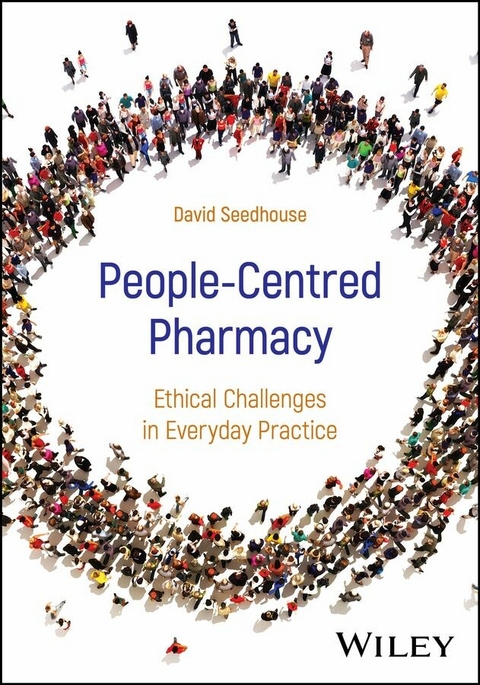
People-Centred Pharmacy (eBook)
360 Seiten
Wiley (Verlag)
978-1-394-21879-0 (ISBN)
Discover people-centred decision-making for pharmacists in this clear and practical volume
Pharmacy ethics and decision-making are a critical part of pharmaceutical care. Pharmacists are routinely faced with decisions that impact the immediate and long-term health of patients, and must exercise professional judgement when the best choices are uncertain.
Current guides to ethical decision-making in healthcare are generally written for doctors or nurses, overlooking the distinctive needs of pharmacy professionals in this crucial area of practice.
People-Centred Pharmacy: Ethical Challenges in Everyday Practice remedies this oversight with a down-to-earth discussion of the common ethical dilemmas pharmacists face. Offering a commonsense focus, the book articulates an approach to practical ethical reasoning that considers the interests of all involved, including the pharmacist. The result is an invaluable resource for pharmacists and those studying the subject.
Readers will also find:
- A text written in collaboration with pharmacy educators
- Concrete examples drawn from empirical research into pharmacy practice
- An interdisciplinary approach to the many dilemmas pharmacists face
People-Centred Pharmacy: Ethical Challenges in Everyday Practice is ideal for all pharmacy staff, as well as all students of pharmacy.
David Seedhouse is a widely read author and Honorary Professor of Deliberative Practice, Aston Pharmacy School, Birmingham, UK.
Discover people-centred decision-making for pharmacists in this clear and practical volume Pharmacy ethics and decision-making are a critical part of pharmaceutical care. Pharmacists are routinely faced with decisions that impact the immediate and long-term health of patients, and must exercise professional judgement when the best choices are uncertain. Current guides to ethical decision-making in healthcare are generally written for doctors or nurses, overlooking the distinctive needs of pharmacy professionals in this crucial area of practice. People-Centred Pharmacy: Ethical Challenges in Everyday Practice remedies this oversight with a down-to-earth discussion of the common ethical dilemmas pharmacists face. Offering a commonsense focus, the book articulates an approach to practical ethical reasoning that considers the interests of all involved, including the pharmacist. The result is an invaluable resource for pharmacists and those studying the subject. Readers will also find: A text written in collaboration with pharmacy educators Concrete examples drawn from empirical research into pharmacy practice An interdisciplinary approach to the many dilemmas pharmacists face People-Centred Pharmacy: Ethical Challenges in Everyday Practice is ideal for all pharmacy staff, as well as all students of pharmacy.
Introduction
The pharmacy profession is rapidly evolving from a predominantly technical, science‐based discipline into a patient‐focused service able to carry responsibilities previously assigned to primary care doctors, including independent prescribing [1].
This evolution is reflected in the nine standards the General Pharmaceutical Council (GPhC) expects pharmacists to demonstrate. The Council states that pharmacy professionals must:
- ‘provide person‐centred care
- work in partnership with others
- communicate effectively
- maintain, develop and use their professional knowledge and skills
- use professional judgement
- behave in a professional manner
- respect and maintain the person's confidentiality and privacy
- speak up when they have concerns or when things go wrong
- demonstrate leadership.’ [2]
Apart from Standard 4, each of these principles requires knowledge and skills beyond clinical expertise.
Because the standards are rarely examined in depth in the traditional pharmacy curriculum, we have collated a comprehensive set of examples under key headings to enable pharmacists to practise interpreting them in realistic situations. We initially chose ‘person‐centred care’ as our theoretical framework, since this is the GPhC's first Standard:
‘Every person is an individual with their own values, needs and concerns. Person‐centred care is delivered when pharmacy professionals understand what is important to the individual and then adapt the care to meet their needs – making the care of the person their first priority.’[2]
Other health professions have similar criteria. The General Medical Council (GMC), for example, says doctors should:
‘Treat patients as individuals and respect their dignity, respect patients' right to confidentiality, work in partnership with patients, respecting their right to reach decisions with doctors about their treatment and care, and work with colleagues in ways that best serve patients' interests.’ [3] (Guidance shortened.)
The Nursing and Midwifery Council (NMC) maintains that:
‘Being person‐centred means thinking about what makes each person unique, and doing everything you can to put their needs first.’ [4]
The official emphasis is firmly on the person. However, as the cases in this book demonstrate, there is more to best practice in pharmacy – and healthcare in general – than an exclusive focus on isolated individuals.
The GPhC's Standard 5 recognises this explicitly:
‘Pharmacy professionals must use their professional judgement
People expect pharmacy professionals to use their professional judgement so that they deliver safe and effective care. Professional judgement may include balancing the needs of individuals with the needs of society as a whole. It can also include managing complex legal and professional responsibilities and working with the person to understand and decide together what the right thing is for them – particularly if those responsibilities appear to conflict.’ [2]
SAFE CARE, LAW AND ETHICS
The Oxford Centre for Evidence‐Based Medicine lists harms and errors relating to medicines in the UK:
‘Numbers of patients affected by adverse drug reactions
- Accident & emergency visits, 2.5%
- Hospital admissions, 6.5%
- Inpatients, 15%
- Primary care visits, 25%
Reported rates of medication errors
- Prescribing error rate in hospitals, 7% of prescription items
- Prescribing errors rate in general practice, 5% of prescriptions of which 0.18% were severe errors; this implies 1.8 million serious prescribing errors each year
- Dispensing error rate in hospitals, 0.02–2.7% of dispensed medicines
- Dispensing error rates in community pharmacies, 0.01–3.32% dispensed medicines
- Medicine administration errors in hospital, 3–8%.’ [5]
These sobering statistics show how important it is for pharmacists to be clinically and scientifically vigilant. They should be at the forefront of every pharmacist's mind. However, as the cases in this book show, they are by no means the whole story of contemporary pharmacy decision‐making.
Many of the book's examples raise issues of law. However, legislation is not discussed in depth since it is more than adequately covered elsewhere; for example, in [6] and [7]. These texts offer comprehensive accounts of the law relating to pharmacy. They are reference books all pharmacists should have at hand.
Other useful textbooks discuss cases and legal principles in the wider healthcare setting:
- Principles of Medical Law, 4th edition, edited by Judith Laing and Jean McHale, Oxford University Press, 2017.
- Medical Law, Text, Cases and Materials, 5th edition, by Emily Jackson, Oxford University Press, 2019.
- Medical Law and Ethics, 8th edition, by Jonathan Herring, Oxford University Press, 2020.
Law is an essential consideration, but it is not always definitive. Where there is ethical uncertainty, insufficient guidance or conflicting legal rules, the pharmacist must use their professional judgement to decide.
Ethical insight is essential to the best human decision‐making. There is growing interest in its role in pharmacy, though the evidence base is currently smaller than that of other health disciplines:
‘Empirical ethics research is increasingly valued in bioethics and healthcare more generally, but there remain as yet under‐researched areas such as pharmacy, despite the increasingly visible attempts by the profession to embrace additional roles beyond the supply of medicines …’. [8]
From the research data that do exist, it is clear that most pharmacists are aware of ethical issues but rarely if ever use official codes and standards to deal with them:
‘… although most of the pharmacists were not conversant with the details of the Royal Pharmaceutical Society's Code of Ethics the examples of ethical dilemmas quoted could be classified and interpreted to demonstrate a knowledge of the basic ethical concepts and the wider legal, occupational, organisational and personal value sets which encompass ethics in the work place. Ethical dilemmas arose as a result of the pharmacist's role as supplier of prescription medicines, guardian of over‐the‐counter medicines and intermediary between patient and carer/doctor. Other dilemmas were related to the legal framework surrounding medicines as well as the organisational, occupational and personal values of the pharmacist.’ [9]
Pharmacists want to support their patients, and use ‘commonsense’ to do so:
‘The majority of pharmacists interviewed in NSW Australia practised within a theoretical framework of “best interests of the patient.” Pharmacists experienced dilemmas in practice involving a number of ethical principles. Pharmacists relied on common sense to circumvent such dilemmas and never referred to their professional code of ethics. There appeared to be a general lack of training, and a varying perception of difficulty with decision making, regarding ethical dilemmas encountered, depending on issues such as legal requirements, personal opinions or financial demands.’ [10]
A study in Saudi Arabia found that:
‘45.7% (of 850 community pharmacists) often discuss ethical issues with their patients, while only 2.1% never discuss it. 40.6% often record the ethical concern whereas only 1.9% of them never do so. 31.5% reported that patients initiate ethical issues … Most perceived ethical problems were: being asked for hormonal contraception, dispensing a drug for unreported indication (69.2%), dispensing dose of medicine for a child that is outside the SNF limits (68.9%), unwanted professional behaviour about controlled drugs (66.6%), a colleague insisting on unethical behaviour (65.0%), a colleague has done something unethical for the first time (64.7%), suspecting that a child is being abused (63.3%) prescribing on private scripts for suspected medications of possible abuse (60.7%) and terminally ill patient asks for a diagnosis or prognosis (52.9%).’ [11]
Pharmacy is replete with ethical issues and decision‐making dilemmas yet, compared to other healthcare professions, there is relatively little investigation and debate. This is certain to change as pharmacy is recognised as a frontline healthcare profession.
WHEN PEOPLE‐CENTRED CARE IS ESSENTIAL
Although trying to do the very best for individual patients is a core principle of healthcare, any therapeutic relationship involves more than one person: at the very least the carer (pharmacist) and the cared for (patient), and often several people at once.
Taking this into account, while acknowledging the significance of person‐centred healthcare, I have extended the focus to people‐centred care.
People‐centred care is essential where:
- the needs of more than one person must be considered;
- families wish or need to be included in the decision‐making process;
- cultural norms do not place the individual person centrally;
- it is unclear if the individual person has decision‐making...
| Erscheint lt. Verlag | 4.3.2025 |
|---|---|
| Sprache | englisch |
| Themenwelt | Medizin / Pharmazie ► Gesundheitsfachberufe |
| Medizin / Pharmazie ► Medizinische Fachgebiete | |
| Schlagworte | Compliance • cultural diversity in pharmacy • Healthcare Ethics • health reform • Patient-Centred Care • Patient choice • practical medical ethics • Public Health • third-party request in pharmacy • thoughtful healthcare • total health promotion |
| ISBN-10 | 1-394-21879-6 / 1394218796 |
| ISBN-13 | 978-1-394-21879-0 / 9781394218790 |
| Informationen gemäß Produktsicherheitsverordnung (GPSR) | |
| Haben Sie eine Frage zum Produkt? |
 EPUB (Adobe DRM)
Kopierschutz: Adobe-DRM
Adobe-DRM ist ein Kopierschutz, der das eBook vor Mißbrauch schützen soll. Dabei wird das eBook bereits beim Download auf Ihre persönliche Adobe-ID autorisiert. Lesen können Sie das eBook dann nur auf den Geräten, welche ebenfalls auf Ihre Adobe-ID registriert sind.
Details zum Adobe-DRM
Dateiformat: EPUB (Electronic Publication)
EPUB ist ein offener Standard für eBooks und eignet sich besonders zur Darstellung von Belletristik und Sachbüchern. Der Fließtext wird dynamisch an die Display- und Schriftgröße angepasst. Auch für mobile Lesegeräte ist EPUB daher gut geeignet.
Systemvoraussetzungen:
PC/Mac: Mit einem PC oder Mac können Sie dieses eBook lesen. Sie benötigen eine
eReader: Dieses eBook kann mit (fast) allen eBook-Readern gelesen werden. Mit dem amazon-Kindle ist es aber nicht kompatibel.
Smartphone/Tablet: Egal ob Apple oder Android, dieses eBook können Sie lesen. Sie benötigen eine
Geräteliste und zusätzliche Hinweise
Buying eBooks from abroad
For tax law reasons we can sell eBooks just within Germany and Switzerland. Regrettably we cannot fulfill eBook-orders from other countries.
aus dem Bereich