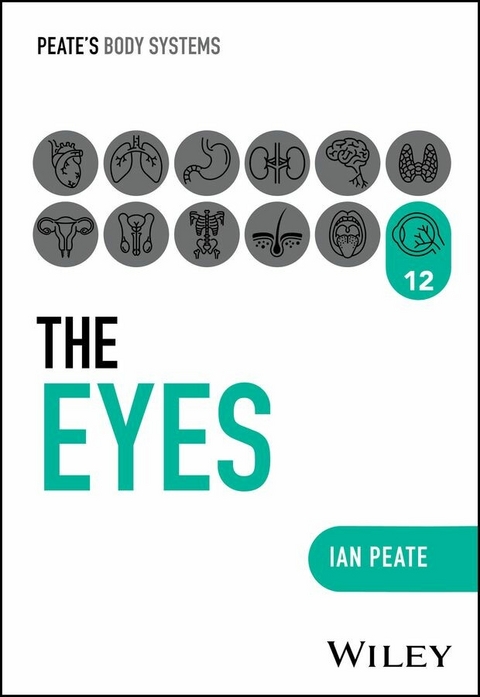
PEATE'S BODY SYSTEMS
THE EYES
A CONCISE, ILLUSTRATED, AND ACCESSIBLE GUIDE TO THE EYES
Each of the twelve volumes in Peate's Body Systems series is rooted in the belief that a deep and thorough understanding of the human body is essential for providing the highest standard of care. Offering clear, accessible and up-to-date information on different body systems, this series bridges the gap between complex scientific concepts and practical, everyday applications in health and care settings. This series makes for an invaluable resource for those committed to understanding the intricacies of human biology, physiology and the various systems that sustain life.
The Eyes is the perfect companion for students and newly registered practitioners across nursing and allied health fields with an interest in eye care, providing a comprehensive yet easy-to-digest guide for both academic and clinical application.
- Equips healthcare students and practitioners with the necessary information to provide safe and competent care
- Features colourful illustrations to aid comprehension, clarify complicated concepts, and render content more engaging and accessible
- Empowers readers to adapt to a rapidly evolving healthcare landscape, preparing them for the future of healthcare delivery
- Contains information necessary for effective patient care of those with glaucoma, cataract, macular degeneration, and other eye diseases and conditions
IAN PEATE is a Visiting Professor at Northumbria University, a Senior Clinical Fellow at the University of Hertfordshire, and a Professorial Fellow at the University of Roehampton. He is also the Editor-in-Chief of the British Journal of Nursing and the Consultant Editor of the Journal of Paramedic Practice and the International Journal of Advancing Practice.
Chapter 1
Anatomy and Physiology: The Eyes
The Sense of Sight
The sense of sight holds immense importance due to its multifaceted role in human life. It spans biological, psychological and social dimensions.
From a biological perspective, sight is essential for survival. It allows individuals to detect potential dangers in their environment, such as predators or hazardous conditions, enhancing their ability to avoid threats. Additionally, vision facilitates precise navigation and spatial orientation, enabling effective movement and coordination in complex surroundings.
In terms of information processing, vision provides access to complex visual data, including a wide range of colours, shapes and movements. This detailed information is vital for making informed decisions. The human visual system processes this data with remarkable speed and efficiency, which is particularly critical in scenarios that require quick responses, such as driving or playing sports.
Socially, sight plays a pivotal role in communication and interaction. A significant portion of human communication is non-verbal, relying on visual cues such as facial expressions, gestures and body language. These visual signals are essential for understanding and responding to others, thereby fostering social bonds and enhancing empathy. Eye contact and visual recognition are also key elements in forming and maintaining relationships within a community.
Sight is integral to learning and development. Visual aids such as books, diagrams and digital media are fundamental in educational settings, helping individuals to comprehend and retain information. Additionally, many skills are acquired and refined through visual observation and imitation, highlighting the importance of sight in personal and professional growth.
The artistic and cultural appreciation enabled by vision enriches human experience. The ability to see allows individuals to enjoy the beauty of art, nature and architecture, contributing to cultural and personal enrichment. Furthermore, visual perception stimulates creativity and innovation, impacting fields such as design, technology and the arts.
Economically and practically, vision is vital across numerous professions. Many jobs, from healthcare to engineering, depend heavily on visual skills for accuracy and efficiency. Visual inspections are crucial in various industries to ensure quality control and safety, directly influencing productivity and reducing risks.
The sense of sight is integral to human functioning and well-being. It enhances interaction with the environment, supports cognitive and social development and contributes to cultural and aesthetic experiences. The myriad ways in which sight underpins daily activities, professional tasks and overall quality of life underscore its profound importance and should not be underestimated. Table 1.1 provides an overview of the sense of sight.
Table 1.1 The sense of sight
| Biological function and survival | Detection of danger: Vision allows for the detection of potential threats in the environment, such as predators, hazardous terrain or other dangers, enhancing survival. Navigation and coordination: Sight enables precise navigation and spatial orientation; this facilitates movement and coordination in complex environments. |
| Information processing | Complex visual data: The human eye can perceive a vast range of colours, shapes and movements, providing detailed information about the surroundings. This data is key for making informed decisions. Speed and efficiency: Visual processing is highly efficient, allowing for the rapid interpretation of vast amounts of information. This efficiency is critical in tasks requiring quick responses, such as driving or sports. |
| Communication and social interaction | Non-verbal cues: A significant portion of human communication is non-verbal, relying on facial expressions, gestures and body language, all of which are then interpreted visually. Social bonding: Eye contact and visual recognition play important roles in forming and maintaining social bonds, enhancing empathy and fostering community. |
| Learning and development | Educational tools: Visual aids such as books, diagrams and digital media are essential tools in education, facilitating learning and comprehension. Skill acquisition: Many skills, from basic tasks to complex procedures, are learned and then refined through visual observation and imitation. Aesthetic and cultural appreciation: Art and nature: Sight allows individuals to appreciate the beauty of art, nature and architecture. This can enrich cultural and personal experiences. Creativity and innovation: Visual perception stimulates creativity and innovation, influencing fields such as design, technology and the arts. |
| Economic and practical implications | Occupational roles: Numerous professions, from healthcare to engineering, depend heavily on visual skills for accuracy and efficiency. Productivity and safety: In many industries, visual inspections ensure quality control and safety, impacting productivity and reducing risks. |
When vision fails or deteriorates, it significantly impacts various aspects of life, ranging from practical day-to-day activities to broader social and psychological well-being, and it can lead to a significant loss of independence. Navigating environments becomes difficult and often unsafe, resulting in increased dependence on others for transportation and movement. Daily activities that rely heavily on sight, such as reading, cooking and personal grooming, may become challenging, diminishing a person’s ability to perform these tasks independently.
Health and safety risks are also heightened with vision impairment. Poor vision increases the risk of falls, collisions and other accidents, both at home and in public spaces. Additionally, vision impairments can delay the detection of other health issues that have visible symptoms, complicating overall healthcare and leading to potentially severe consequences if not addressed promptly.
Visual impairment can contribute to cognitive decline, as it limits engagement in stimulating activities that are essential for maintaining cognitive function. Furthermore, vision loss can lead to depression, anxiety and social isolation due to the challenges and frustrations associated with decreased independence and reduced ability to engage in previously enjoyed activities.
Social implications are significant as well. Individuals with vision loss might withdraw from social activities due to embarrassment or logistical difficulties; this can lead to feelings of loneliness and isolation.
The economic and occupational impacts are considerable. Many jobs require good vision, and deterioration in eyesight can limit job opportunities or necessitate early retirement. Moreover, the financial burden associated with the cost of assistive devices, medical treatments and necessary home modifications can be substantial, placing a strain on individuals and families.
Educational barriers are another critical issue. For both children and adults, vision loss can thwart the ability to read, write and engage with educational materials, potentially impacting academic performance and lifelong learning.
Vision loss significantly affects the quality of life. Activities such as watching television, reading and enjoying nature become less accessible, diminishing overall enjoyment. While assistive technologies can help mitigate some challenges, they may not fully compensate for the loss of natural vision and can be expensive or difficult to use.
The deterioration or loss of vision has profound and far-reaching effects. It compromises independence, heightens health and safety risks, affects mental and emotional well-being and imposes significant social, economic and educational challenges (Clare 2020). Addressing these impacts requires a combination of medical intervention, assistive technologies and support systems to help individuals adapt and maintain their quality of life.
Those who offer care and support to people with a visual disturbance have a key role to play in helping to address the challenges that arise from vision loss or deterioration. To effectively manage these issues, a comprehensive approach involving prevention, early detection, treatment, rehabilitation and support services is essential.
Prevention and early detection are important steps. Regular eye examinations are vital for detecting vision issues early, especially in high-risk groups such as the elderly, those with diabetes and those with a family history of eye diseases. Public health education is equally important, as it informs people about the significance of eye health, the risks associated with vision loss and the benefits of protective measures such as wearing sunglasses, managing chronic conditions and avoiding smoking.
When it comes to medical and surgical interventions, those offering care and support should discuss appropriate treatments for conditions such as glaucoma, macular degeneration and diabetic retinopathy to slow their progression and manage symptoms. Surgical solutions, such as cataract surgery, can often restore vision and significantly improve the patients’ quality of life.
Addressing the psychological impact of vision loss is also essential. Counselling services can help patients cope with the emotional and psychological challenges, while...
| Erscheint lt. Verlag | 13.2.2025 |
|---|---|
| Reihe/Serie | Peate's Body Systems |
| Sprache | englisch |
| Themenwelt | Medizin / Pharmazie ► Medizinische Fachgebiete |
| Naturwissenschaften ► Biologie | |
| Schlagworte | eye anatomy and physiology • eye care illustrations • eye care nursing • eye care nursing book • eye care nursing illustrated • eye nursing • eye nursing book • eye system care nursing |
| ISBN-10 | 1-394-25269-2 / 1394252692 |
| ISBN-13 | 978-1-394-25269-5 / 9781394252695 |
| Informationen gemäß Produktsicherheitsverordnung (GPSR) | |
| Haben Sie eine Frage zum Produkt? |
 EPUB (Adobe DRM)
Kopierschutz: Adobe-DRM
Adobe-DRM ist ein Kopierschutz, der das eBook vor Mißbrauch schützen soll. Dabei wird das eBook bereits beim Download auf Ihre persönliche Adobe-ID autorisiert. Lesen können Sie das eBook dann nur auf den Geräten, welche ebenfalls auf Ihre Adobe-ID registriert sind.
Details zum Adobe-DRM
Dateiformat: EPUB (Electronic Publication)
EPUB ist ein offener Standard für eBooks und eignet sich besonders zur Darstellung von Belletristik und Sachbüchern. Der Fließtext wird dynamisch an die Display- und Schriftgröße angepasst. Auch für mobile Lesegeräte ist EPUB daher gut geeignet.
Systemvoraussetzungen:
PC/Mac: Mit einem PC oder Mac können Sie dieses eBook lesen. Sie benötigen eine
eReader: Dieses eBook kann mit (fast) allen eBook-Readern gelesen werden. Mit dem amazon-Kindle ist es aber nicht kompatibel.
Smartphone/Tablet: Egal ob Apple oder Android, dieses eBook können Sie lesen. Sie benötigen eine
Geräteliste und zusätzliche Hinweise
Buying eBooks from abroad
For tax law reasons we can sell eBooks just within Germany and Switzerland. Regrettably we cannot fulfill eBook-orders from other countries.
aus dem Bereich