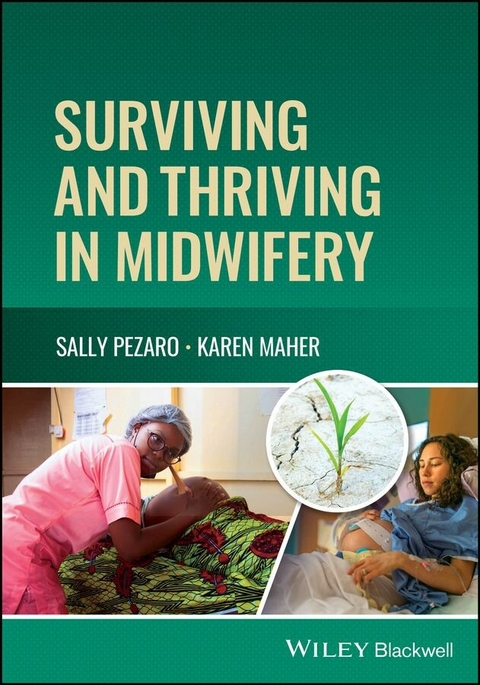
Surviving and Thriving in Midwifery (eBook)
354 Seiten
Wiley-Blackwell (Verlag)
978-1-119-88102-5 (ISBN)
A practical, evidence-based approach to psychological and professional well-being for midwives
Midwifery is an essential profession with a life-saving role in perinatal care. However, studies show that midwives experience remarkably high levels of work-related psychological distress, leading to equally high levels of attrition from the profession. If these issues are not addressed, the loss of qualified midwives may seriously impact the profession's ability to fight perinatal and infant mortality worldwide.
Surviving and Thriving in Midwifery offers a practical, evidence-based guide for midwives to achieve social, psychological, and professional success. Drawing upon extensive research as well as the personal experiences of midwives, the book invites readers to respond to a range of workplace challenges and develop robust strategies for coping, conflict resolution, and more. Thoroughly grounded in occupational psychology, it is a vital tool for any midwife looking to thrive in this critical profession.
Surviving and Thriving in Midwifery readers will also find:
- A global perspective on midwifery across the life course
- The author's personal journey through their own experience of losing their fitness to practice through ill health, before regaining it and achieving lasting success
- Detailed strategies for building psychological safety in midwifery teams, setting boundaries, and many more
Surviving and Thriving in Midwifery is ideal for aspiring, student, and qualified midwives worldwide.
Dr Sally Pezaro is an award winning Fellow of the Royal College of Midwives, a Senior Fellow of the Higher Education Academy, editorial board and consortium member and an academic researcher at Coventry University, UK.
Dr Karen Maher is a Chartered Psychologist and Academic in Organisational Psychology at Aston Business School, Aston University, UK. She is also a Fellow of the Higher Education Academy and former Chair of the Organisational Psychology Special Interest Group for the British Academy of Management.
A practical, evidence-based approach to psychological and professional well-being for midwives Midwifery is an essential profession with a life-saving role in perinatal care. However, studies show that midwives experience remarkably high levels of work-related psychological distress, leading to equally high levels of attrition from the profession. If these issues are not addressed, the loss of qualified midwives may seriously impact the profession s ability to fight perinatal and infant mortality worldwide. Surviving and Thriving in Midwifery offers a practical, evidence-based guide for midwives to achieve social, psychological, and professional success. Drawing upon extensive research as well as the personal experiences of midwives, the book invites readers to respond to a range of workplace challenges and develop robust strategies for coping, conflict resolution, and more. Thoroughly grounded in occupational psychology, it is a vital tool for any midwife looking to thrive in this critical profession. Surviving and Thriving in Midwifery readers will also find: A global perspective on midwifery across the life courseThe author s personal journey through their own experience of losing their fitness to practice through ill health, before regaining it and achieving lasting successDetailed strategies for building psychological safety in midwifery teams, setting boundaries, and many more Surviving and Thriving in Midwifery is ideal for aspiring, student, and qualified midwives worldwide.
CHAPTER 1
Introduction
INTRO TO CHAPTER
The Lancet Series on midwifery published in 2014 outlined the specific and vital role of midwives in the provision of high‐quality perinatal and newborn health and care around the world (ten Hoope‐Bender and Renfrew 2014). Nevertheless, there are global reports of midwifery workforce shortages linked to recruitment and retention issues. Moreover, the midwives currently in post are not always empowered to practise in the way they need or want to. Furthermore, some have limited autonomy and others require upskilling. These global challenges may not be solved in one book. Yet this book is needed to offer midwives a personalised toolkit from which to draw when they themselves need to survive and thrive in the face of challenges.
Due to their role in public health and reproductive services, empowered midwives also have the potential to contribute towards achieving the world's sustainable development goals (United Nations 2015). Yet we have highlighted how midwifery is often undervalued and underserved (Pezaro et al. 2022b). Where conventionally, professions are granted autonomy and social recognition for the services they provide, midwifery often lacks such status.
Nursing in comparison with midwifery has a robust history with widely revered figures, such as Clara Barton and Florence Nightingale. Although such figures have complex historical legacies, crucially those complexities derive from real life, serving to ground the identity of nursing. Thus, historical and reflective narratives of midwifery might similarly serve to ground the contemporary identity of midwifery.
Midwifery can be conflated with other professions (e.g. nursing), which challenges the creation of a distinctive professional identity and status. For midwives to be fully valued and play a crucial role in reducing global maternal and neonatal deaths, we argue their professional identity must be firmly instantiated.
History can tell us who we are, where we come from, and thus may guide us as to where we are going. Therefore, we start this book by introducing a historical narrative of midwifery, written by Professor Mary Fissell, as much of what is available on the history of midwifery is rooted in mythic or fictional characters such as Agnodike or Sairey Gamp. We then give an overview of the challenges faced within contemporary midwifery and explain what to expect from this book overall. As you read the historical narrative below, reflect on what we can learn about ourselves as midwives in terms of where we come from, who we are and where we may be going in future.
You may notice gender and culture wars apparent in this historical narrative, dressed up as Man versus Woman. It is important to reflect on how our history has shaped us as a profession, but at the same time avoid judging the past by present standards and ideals. We recognise the challenges midwifery faces in relation to gender inequalities and will address some of these issues later in the book. For now, we request, with whichever gender you identify (or not), you read the following with only a curiosity for how midwifery of the past was perceived.
CIRCUMSTANCES, WHICH NO MAN CAN BE A JUDGE OF: SARAH STONE AND THE IMPROVEMENT OF MIDWIFERY
Sarah Stone (c. 1680–1737) was really tired. The early eighteenth‐century Somerset midwife had travelled 10 miles on horseback over terrible roads to support a soap‐boiler's wife in childbirth, whose usual midwife could not be found. On the way there, a man ran up to her, and asked if they had seen another midwife, who, it turned out, was a further 8 miles away. After supporting the soap‐boiler's wife to birth her baby, Stone called in at the other woman's house and was told that they had found another midwife and the baby would be born in the quarter of an hour. So, Stone rode home. But it was not to be. Five hours later, the second husband came to Stone and begged her to return, saying her women feared the baby would never be born.
After her services had been refused earlier, she had to travel back to the same house on the same bad road. Once there, Stone demonstrated to her skills, ‘as soon as I Touched her, I was sensible of the reason of this poor Woman's being kept so long in distress’ (Stone 1737, p. 71). Her hands knew what was the matter; ‘touching’ was a newly coined technical term for manual examination (Giffard 1734, pp. 26, 44, 50, 53). Stone aided the woman to give birth quickly and concluded the case by saying ‘for ’tis an undoubted rule, If Pains do no good, they do a great deal of harm’ (Stone 1737, p. 73). Repeatedly, Stone abstracted such general rules from her daily practice, creating new knowledge and disseminating it in print. She wrote movingly about the pains birthing women suffered and criticised other midwives whose incompetence left women labouring for longer than necessary.
Stone's history contrasts with the narratives historians often tell about eighteenth‐century English midwifery (Wilson 1995). For it was in Stone's own lifetime that men began to assist with the birth of babies in England. The period is often portrayed as a turf battle between men, armed with the new technology of obstetrical forceps, and women who had long been the primary carers for pregnant and parturient women. Casting the eighteenth century in this way has caused us to overlook the work midwives did to make births safer; Stone is an excellent example of such pioneering work. In this essay, I will show how Stone sought to improve the practice of midwifery, and put her work in the larger context of enlightenment midwifery in Europe (Grundy 1995; Marland 1993).
We know about Stone's life and practice because she published a book of her cases in 1737; she was only the second midwife to publish in English. She was born around 1680, and married Samuel Stone in 1700; two of their children were baptised in the same Bridgwater parish over the next few years. Stone trained with her mother, who was a noted local midwife, and then served as her mother’s deputy for six years, basically in joint practice. Her mother died in 1708, and Stone embarked upon a solo practice (Bridgewater St Mary's Parish Records; 1682–1714). One of her biggest constraints was that noted above: the roads were terrible. Over the course of her career, Stone moved to Taunton, then Bristol, and finally London, where she died not long after the publication of her book. Her daughter, trained by Stone, worked in Bristol as a midwife.
Stone worked both as a regular midwife, with a list of clients who booked her in advance for their births, and as a consultant midwife, called in when things went wrong, as in the case described above (Woods and Galley 2014). Her caseload was staggering; she claims to have assisted as many as 300 births a year when she was in Somerset. Even half that number is astonishing, and indicates that much of her work was consultant, summoned in a crisis, possibly seeing a client for only a few hours. Her book was likely written in part as advertising when she moved to London. By then Samuel was dead, and she would have wanted to attract customers in the metropolis.
While self‐promotion may have been a factor, Stone's goal was to improve the standards of midwifery. She dedicated her book to the Queen, whom she described as ‘the Nursing‐mother’ of the nation; the book was intended to ‘prove instructive’ to female midwives, especially rural and lower‐class ones (Stone 1737, pp. vi, vii). By the 1730s, Stone had encountered the new breed of male midwife, and she was scathing about them, saying ‘that almost every young Man, who has served his Apprenticeship to a Barber‐Surgeon, immediately sets up for a Man‐Midwife’ (Stone 1737, p. xi). She repeatedly characterised man‐midwives as boyish and ignorant (Stone 1737, p. xiv). While Stone had attended anatomical dissections, she did not consider such training to be sufficient, ‘For dissecting the Dead, and being just and tender to the Living, are vastly different’ (Stone 1737, p. xiv). She staked a claim to women's particular expertise in midwifery, ‘there is a tender regard one Woman bears to another, and a natural Sympathy in those that have gone thro’ the Pangs of Childbearing’. Men lacked understanding because they had not given birth; those were ‘circumstances, which no man can be a judge of’ (Stone 1737, pp. xiv–xv). A combination of empathy and experience made a judicious midwife.
However, Stone was also very critical of female midwives who did not know enough to be skilled practitioners. In a difficult situation with a woman who had been in labour for four days already, Stone argued with the midwife who had been attending the woman. ‘I asked her Midwife the reason, Why she did not deliver her? She told me, Because God's time was not come: (a common saying amongst illiterate unskilful Midwives)’ Stone retorted dryly, ‘that it appeared to me to be God’s time then’. Stone described the mother as ‘to the eye of Reason, very near death’, but she managed to save her life (Stone 1737, pp. 44–45).
Another case demonstrated similar failings in rural midwifery care. A woman in Bishop's Lydeard went into labour on a Friday...
| Erscheint lt. Verlag | 11.2.2025 |
|---|---|
| Sprache | englisch |
| Themenwelt | Medizin / Pharmazie ► Pflege |
| Schlagworte | birth trauma services • clinical practice • Emotional Regulation • Evidence-based Medicine • evidence-based practice • gynecology • Gynecology and obstetrics • Maladaptive Coping • perinatal care • Personal development • prenatal care • shift work |
| ISBN-10 | 1-119-88102-1 / 1119881021 |
| ISBN-13 | 978-1-119-88102-5 / 9781119881025 |
| Informationen gemäß Produktsicherheitsverordnung (GPSR) | |
| Haben Sie eine Frage zum Produkt? |
 EPUB (Adobe DRM)
Kopierschutz: Adobe-DRM
Adobe-DRM ist ein Kopierschutz, der das eBook vor Mißbrauch schützen soll. Dabei wird das eBook bereits beim Download auf Ihre persönliche Adobe-ID autorisiert. Lesen können Sie das eBook dann nur auf den Geräten, welche ebenfalls auf Ihre Adobe-ID registriert sind.
Details zum Adobe-DRM
Dateiformat: EPUB (Electronic Publication)
EPUB ist ein offener Standard für eBooks und eignet sich besonders zur Darstellung von Belletristik und Sachbüchern. Der Fließtext wird dynamisch an die Display- und Schriftgröße angepasst. Auch für mobile Lesegeräte ist EPUB daher gut geeignet.
Systemvoraussetzungen:
PC/Mac: Mit einem PC oder Mac können Sie dieses eBook lesen. Sie benötigen eine
eReader: Dieses eBook kann mit (fast) allen eBook-Readern gelesen werden. Mit dem amazon-Kindle ist es aber nicht kompatibel.
Smartphone/Tablet: Egal ob Apple oder Android, dieses eBook können Sie lesen. Sie benötigen eine
Geräteliste und zusätzliche Hinweise
Buying eBooks from abroad
For tax law reasons we can sell eBooks just within Germany and Switzerland. Regrettably we cannot fulfill eBook-orders from other countries.
aus dem Bereich