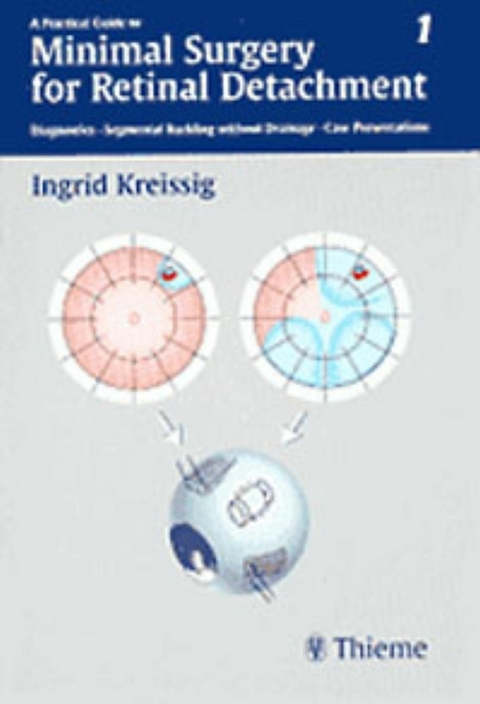
A Practical Guide to Minimal Surgery for Retinal Detachment, Vol. 1 (eBook)
Georg Thieme Verlag KG
978-3-13-257854-8 (ISBN)
Ingrid Kreissig
Ingrid Kreissig
2 Preoperative Examination
The success of minimal extraocular surgery in treating retinal detachment depends entirely on a meticulous and thorough pre-operative examination of the entire retina up to the ora serrata, and on precise documentation of the findings.
The essentials and the secret of success are:
– Finding the retinal break, or all of the breaks
– Limiting the surgery to the area of the break or breaks by providing a sufficient tamponade
– Only then achieving retinal reattachment
It is the primary operation that determines the future of an eye with a detachment… but here you only get what you invest.
This means:
–maximum preoperative diagnostics
– providing conditions for minimal surgery, with
–maximum success.
2.1 How to Find the Break or Breaks
First, the patient is examined with binocular indirect ophthalmoscopy. It is preferable for the patient to lie supine on a stretcher (Fig. 2.1a, b). This provides optimal conditions for determining the correct borders of the detachment, and allows the patient's head to be tilted to either side as needed.
The defined contours of the detachment indicate the area in which to carry out the search for the primary break.
What is a primary break?
The primary break is the break which alone will cause the configuration of the detachment.
Identifying the borders (superior and inferior) of a detachment is extremely important for indicating where to search for the primary retinal break. Of course, the entire retina up to the ora serrata has to be examined as well. To view the retina up to the ora, the periphery of the retina has to be indented through the lid, using a depressor.
Fig. 2.1a The patient is lying supine on the examination stretcher so that the borders of the detachment can be determined and the retina studied using indirect binocular ophthalmoscopy and depression. A drawing pad for precise documentation of fundus details is placed on the patient's chest.
Fig. 2.1b To test whether the borders of the detachment that have been identified are correct, the patient's head is rotated to either side. The retina is studied using various lenses (at different magnifications), with simultaneous depression via the lid to make it visible up to the ora serrata. Depression is carried out with a thimble or a curved depressor (see Fig. 2.3).
The next step is to examine the patient at the slit lamp (Fig. 2.2) using various contact lenses, together with indentation of the retinal periphery. Indentation is essential, as it allows a hole to be distinguished from a harmless retinal lesion. The slender and slightly curved Kreissig depressor (Fig. 2.3) is well suited for this purpose. When it is applied in the presence of a contact lens over the lid, it provides a dynamic examination of the anterior retina (Fig. 2.4).
How can the retinal hole be found in a pseudophakic eye?
In the presence of a secondary membrane, or precipitates on the surface of the intraocular lens, or through a pupil fixed in diameter at 4–5 mm.
The recently developed indirect wide-field contact lenses for small pupils by Mainster, Volk, and Lincoff (see below Fig. 4.2) provide viewing fields of 125°, 130°, and 140° (comparable to the field obtained in indirect ophthalmoscopy). The indirect lens provides enough light to overcome the interference of most lens or capsular opacities. With these lenses, and some experience on the part of the surgeon, it becomes possible to examine the retina anterior to the equator, and pinpoint holes can be detected [1].
Returning to the topic of how to detect all of the breaks preoperatively:
1. Use binocular indirect ophthalmoscopy, as well as:
2. Biomicroscopy with various contact lenses (the Goldmann lens for phakic and aphakic eyes, and the Mainster, Volk or Lincoff indirect contact lenses for pseudophakic eyes); the 2 techniques combined with depression of the anterior retina
3. Concentrate on searching for the primary retinal break, and apply the Rules of how to find the primary break [2–4].
These Rules rely on the contours of a detachment. This is why it is so important to define the correct borders of the detachment, with the patient supine on a stretcher. The Rules are based on the principle that a detachment first develops around the break, then progresses to the ora anterior to the break, then continues dependently and to the disk.
Fig. 2.2 After indirect ophthalmoscopy, the vitreous interface and the detachment are studied at the slit lamp using various contact lenses, again with simultaneous depression of the retinal periphery. For precise documentation of the findings, it is helpful to have a desk on which the drawings can be made, set at right angle on the right of the slit lamp. The desk can also be integrated into the examining unit (see Fig. 2.1a).
Fig. 2.3 The Kreissig depressor has 2 curved ends corresponding to the curvature of the globe of the eye. The end with the small knob (left) can be used via the lid to depress the retinal periphery in the presence of a contact lens. The other end, with the mini-plombe (right), is often used with indirect ophthalmoscopy.
Fig. 2.4 Examination of the retinal periphery using a Kreissig depressor, applying the curved end with the small knob over the lid in the presence of a contact lens (photo courtesy of S. Dimitrakos, M. D.).
Fig. 2.5 A 3-quadrant detachment, with a horseshoe tear at 10 o'clock. Initially, the retina detaches in the area of the operculum toward the ora serrata. Subretinal fluid then progresses inferiorly and toward the disk, then to the 6 o'clock position, around the disk to the secondary side, and from there maximally as high as the hole on the primary side.
The final shape of the detachment then depends on:
1. The position of the primary break and the gravity exerted on the subretinal fluid
2. The anatomical borders, such as the disk and the ora serrata
3. Retinal adhesions, if present—e.g., after prophylactic treatment or previous detachment surgery.
2.2 The 4 Rules to Find the Primary Break
Lincoff and Gieser [2] analyzed 1000 detachments and defined 3 patterns: superior temporal or nasal detachments; total or superior detachments that cross the 12 o'clock meridian; and inferior detachments.
2.2.1 Superior Temporal or Nasal Detachments
Figure 2.5 shows a detachment with a tear at 10 o'clock. To begin with, the horseshoe tear detaches toward the ora serrata, and the fluid then progresses slowly, with gravity, inferiorly and toward the disk, through the 6 o'clock meridian and then ascends around the disk to the secondary side, to a maximum height equal to that of the break on the primary side. Therefore:
| Primary Break: | Rule 1 |
Superior temporal or nasal detachments:
The primary break that determines the shape of the detachment lies within 1½ clock hours beneath the higher border of the detachment in 98%. (Fig. 2.6a).
This means that, in detachments with this configuration, a break will be found in this area in 98% of cases. However, this does not preclude the possibility that there is an additional break beneath it (or on a rare occasion even above it).
Fig. 2.6a Rules 1 and 2 to find the primary break in a retinal detachment. The area in which to search for the primary break is outlined in black.
Fig. 2.6b Rules 3 and 4 to find the primary break in a retinal detachment.
Therefore, if surgery is limited just to the area of this break and the subretinal fluid is not drained, you have to be sure that you do not overlook another break. Why?
If drainage is not carried out and a break is overlooked, the retina will only partially or not at all reattach after surgery, and the entire retina will only reattach completely postoperatively if all of the breaks are found and sufficiently tamponaded.
It should be borne in mind that, if you find and treat only a break that is more inferior than 1½ clock hours from the superior border in the detachment, the chances of success will be small (in the range of 2%). The detachment therefore needs to be examined carefully, and both the primary break and any additional breaks that may be present have to be localized.
Only a maximum of preoperative diagnostics will provide maximum success with minimum surgery.
2.2.2 Total or Superior Detachments that Cross the 12 o'Clock...
| Erscheint lt. Verlag | 24.2.2000 |
|---|---|
| Verlagsort | Stuttgart |
| Sprache | englisch |
| Themenwelt | Medizin / Pharmazie ► Medizinische Fachgebiete ► Augenheilkunde |
| Schlagworte | A Practical Guide to Minimal Surgery for Retinal Detachment • Diagnostics - Segmental Buckling without Drainage - Case Presentations • Kreissig • minimally invasive therapy • Minimal Surgery • Ophthalmology • Retinal Detachment |
| ISBN-10 | 3-13-257854-1 / 3132578541 |
| ISBN-13 | 978-3-13-257854-8 / 9783132578548 |
| Informationen gemäß Produktsicherheitsverordnung (GPSR) | |
| Haben Sie eine Frage zum Produkt? |
 EPUB (Wasserzeichen)
DRM: Digitales Wasserzeichen
Dieses eBook enthält ein digitales Wasserzeichen und ist damit für Sie personalisiert. Bei einer missbräuchlichen Weitergabe des eBooks an Dritte ist eine Rückverfolgung an die Quelle möglich.
Dateiformat: EPUB (Electronic Publication)
EPUB ist ein offener Standard für eBooks und eignet sich besonders zur Darstellung von Belletristik und Sachbüchern. Der Fließtext wird dynamisch an die Display- und Schriftgröße angepasst. Auch für mobile Lesegeräte ist EPUB daher gut geeignet.
Systemvoraussetzungen:
PC/Mac: Mit einem PC oder Mac können Sie dieses eBook lesen. Sie benötigen dafür die kostenlose Software Adobe Digital Editions.
eReader: Dieses eBook kann mit (fast) allen eBook-Readern gelesen werden. Mit dem amazon-Kindle ist es aber nicht kompatibel.
Smartphone/Tablet: Egal ob Apple oder Android, dieses eBook können Sie lesen. Sie benötigen dafür eine kostenlose App.
Geräteliste und zusätzliche Hinweise
Buying eBooks from abroad
For tax law reasons we can sell eBooks just within Germany and Switzerland. Regrettably we cannot fulfill eBook-orders from other countries.
aus dem Bereich