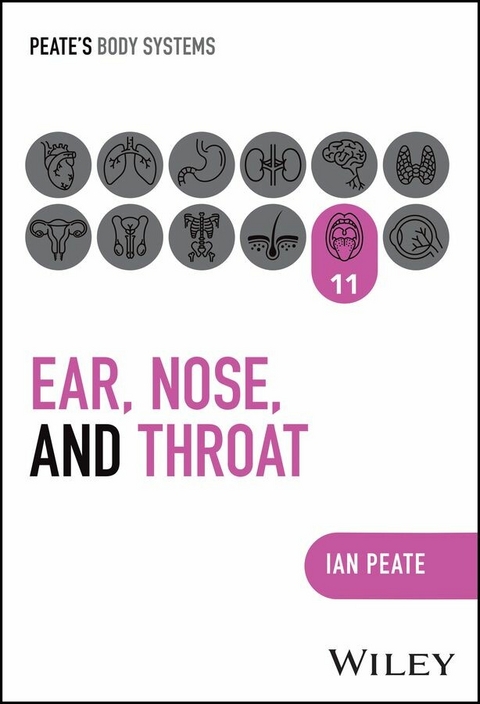
PEATE'S BODY SYSTEMS
EAR, NOSE AND THROAT
A CONCISE, ILLUSTRATED, AND ACCESSIBLE GUIDE TO THE EAR, NOSE AND THROAT
Each of the twelve volumes in Peate's Body Systems series is rooted in the belief that a deep and thorough understanding of the human body is essential for providing the highest standard of care. Offering clear, accessible and up-to-date information on different body systems, this series bridges the gap between complex scientific concepts and practical, everyday applications in health and care settings. This series makes for an invaluable resource for those committed to understanding the intricacies of human biology, physiology and the various systems that sustain life.
Ear, Nose and Throat is the perfect companion for students and newly registered practitioners across nursing and allied health fields with an interest in Ear, Nose and Throat (ENT) care, providing a comprehensive yet easy-to-digest guide for both academic and clinical application.
- Equips healthcare students and practitioners with the necessary information to provide safe and competent care
- Features colourful illustrations to aid comprehension, clarify complicated concepts, and render content more engaging and accessible
- Empowers readers to adapt to a rapidly evolving healthcare landscape, preparing them for the future of healthcare delivery
- Contains information necessary for effective patient care of those with tinnitus, Ménière's disease, sinusitis, and other ENT diseases and conditions
IAN PEATE is a Visiting Professor at Northumbria University, a Senior Clinical Fellow at the University of Hertfordshire, and a Professorial Fellow at the University of Roehampton. He is also the Editor-in-Chief of the British Journal of Nursing and the Consultant Editor of the Journal of Paramedic Practice and the International Journal of Advancing Practice.
PEATE S BODY SYSTEMS EAR, NOSE AND THROAT A CONCISE, ILLUSTRATED, AND ACCESSIBLE GUIDE TO THE EAR, NOSE AND THROAT Each of the twelve volumes in Peate s Body Systems series is rooted in the belief that a deep and thorough understanding of the human body is essential for providing the highest standard of care. Offering clear, accessible and up-to-date information on different body systems, this series bridges the gap between complex scientific concepts and practical, everyday applications in health and care settings. This series makes for an invaluable resource for those committed to understanding the intricacies of human biology, physiology and the various systems that sustain life. Ear, Nose and Throat is the perfect companion for students and newly registered practitioners across nursing and allied health fields with an interest in Ear, Nose and Throat (ENT) care, providing a comprehensive yet easy-to-digest guide for both academic and clinical application. Equips healthcare students and practitioners with the necessary information to provide safe and competent careFeatures colourful illustrations to aid comprehension, clarify complicated concepts, and render content more engaging and accessibleEmpowers readers to adapt to a rapidly evolving healthcare landscape, preparing them for the future of healthcare deliveryContains information necessary for effective patient care of those with tinnitus, M ni re s disease, sinusitis, and other ENT diseases and conditions
Chapter 1
Anatomy and Physiology: Ear, Nose and Throat
Disorders that affect the structures of the head and neck can vary greatly, from relatively minor issues to some of the most complex and challenging conditions encountered. The special senses of the ear, nose and throat are crucial for daily living; they often go unnoticed until a problem arises. These senses are integral to functions such as hearing, balance, smell, taste and breathing. When affected, these conditions can profoundly impact a person’s quality of life, influencing communication, eating, sleeping and overall well-being (Harkin 2019).
The sensory organs, such as the eyes and ears, transmit information to the brain, enabling us to understand and perceive the world around us. The eyes and ears serve as the pathways through which visual and auditory stimuli reach the brain.
The problems of the ear, nose and throat are very common; most people will experience nosebleeds, sore throats or earaches at some point in their lives. Many of these issues are successfully managed at home, often with the advice of a pharmacist or general practice nurse/general practitioner. However, some ear, nose and throat problems can be life-threatening, requiring an immediate visit to an emergency department, GP surgery and sometimes a period of nursing care at home following discharge.
When diseases or trauma affect these organs, they can compromise a person’s ability to maintain a safe environment and hinder their capacity to perform daily activities. Mobility may become restricted, and coupled with impaired communication, this can lead to social isolation and loneliness. Such conditions can create challenges related to safety, independence, communication and relationships with others (Meakin and Seewoodhary 2022).
To offer care and support to patients with ear, nose and throat problems effectively in a home or hospital setting, a fundamental knowledge of the anatomy and physiology of these structures is essential, along with a thorough understanding of the clinical features of common disorders.
This chapter provides an introduction to the anatomy and physiology of the ear, nose and throat. It will explore the intricate structures and functions of these organs, explaining how they work together to support the senses and daily activities. By understanding the underlying anatomy and physiology, those who offer care and support will gain a deeper appreciation of the importance of maintaining the health of the ear, nose and throat and the impact that disorders in these areas can have on overall health and daily functioning.
Anatomy and Physiology of the Ear
The ear is a complex organ. The ear is divided into three main distinct sections (see Figure 1.1):
- External (outer)
- Middle
- Inner
Figure 1.1 Ear
Each of these sections plays a crucial role in the process of hearing. Additionally, the inner ear is vital for maintaining the sense of balance.
External Ear
This aspect of the ear assists with the functions of the middle ear, although it is not an anatomical part of it. The external ear is also known as the outer ear, which consists of two main parts:
- Auricle (pinna): The visible part of the ear that is located outside the head. It is made of cartilage and skin and its primary function is to collect sound waves from the environment and direct them into the ear canal.
- External auditory canal (ear canal): A tube-like structure that extends from the auricle to the eardrum (tympanic membrane). It serves as a pathway for sound waves to travel from the auricle to the middle ear. The canal also helps protect the eardrum from foreign objects and infections.
The auricle and external acoustic meatus (external auditory canal) make up the external ear. The external ear collects and amplifies sound, which is transmitted to the middle ear. The asymmetrical shape introduces delays in the path of sound, which assist in sound localisation (see Figure 1.2).
Figure 1.2 Outer ear
The arterial blood supply is composed of the posterior auricular artery, the anterior auricular branch of the superficial temporal artery and the occipital artery. Veins accompany corresponding named arteries.
The external ear is supplied by the auriculotemporal (fifth cranial) nerve and contributions from cranial nerves VII, IX and X and the great auricular nerve.
Middle Ear
The key function of the middle ear (tympanic cavity) is bony conduction of sound via the transference of sound waves in the air collected by the auricle to the fluid of the inner ear (Peate 2022). The middle ear extends from the tympanic membrane to the oval window, containing the bony conduction elements of the ossicles. The walls of the tympanic cavity are complex with important associations. The middle ear is an airspace lined with a mucous membrane; it is connected to the nasopharynx by the eustachian tube, thus allowing for the equalisation of air pressure between the middle ear and the throat (and therefore atmospheric air). This equalisation of pressure ensures free movement of the tympanic membrane in response to sound waves conducted along the external ear canal.
Within the middle ear are three bones (the ossicles or ossicular chain) (see Figure 1.3):
- Hammer (malleus)
- Anvil (incus)
- Stirrup (stapes)
Figure 1.3 Middle ear
These interlink and are connected with the tympanic membrane. Vibrations of the tympanic membrane are conducted along the bones to the oval window; these vibrations are then transmitted via the oval window into the fluid of the inner ear. Movement in this fluid leads to stimulation of the hearing receptors.
Tympanic Membrane
The tympanic membrane is a thin, oval, semi-transparent membrane that separates the external ear from the middle ear. It receives air vibrations collected by the auricle and transfers them to the mobile tympanic membrane, which then passes the sound to the ossicles. The tympanic cavity contains various structures, including muscles, nerves and the eustachian tube.
Ossicles
A chain of movable bones called the ossicles – the malleus (hammer), incus (anvil) and stapes (stirrup) – extends from the deep surface of the tympanic membrane to the oval window. These bones transmit and amplify sound waves from the air to the perilymph in the inner ear.
Auditory Tube
The auditory tube or eustachian tube connects the middle ear to the nasopharynx. Its main function is to equalise pressure across the tympanic membrane.
Blood Supply and Innervation
The blood supply to the middle ear comes from several arteries, primarily from the external and internal carotid arteries. The auriculotemporal nerve (fifth cranial nerve), the tympanic nerve (ninth cranial nerve) and the auricular branch of the vagus nerve innervate the middle ear.
Inner Ear
The inner ear is also known as the labyrinth due to its complex network of canals. It consists of a membranous labyrinth that is enclosed within an osseous (bony) labyrinth. The vestibule and semicircular canals are involved in vestibular function (balance), while the cochlea, which is a coiled tube, is responsible for hearing (see Figure 1.4).
Figure 1.4 Inner ear
A layer of dense bone outlines the inner ear’s surface. The walls of the bony labyrinth are continuous with the surrounding temporal bone and they closely follow the contours of the membranous labyrinth, which is a delicate, interconnected network of fluid-filled tubes that houses sensory receptors.
Apart from two small areas near the cochlear spiral, the walls of the bony labyrinth are made of dense bone. The round window is a thin, membranous partition that separates the perilymph of the cochlear chambers from the air-filled middle ear. Collagen fibres connect the bony margins of the oval window to the base of the stapes.
Perilymph, a fluid similar to cerebrospinal fluid, flows between the bony and membranous labyrinths, while endolymph is contained within the membranous labyrinth. These fluids occupy separate compartments. The bony labyrinth can be divided into the vestibule, three semicircular canals and the cochlea.
Physiology of Hearing
The process of hearing involves a number of steps. An overview of these steps is outlined in Table 1.1.
Table 1.1 The physiology of hearing – an overview
| Component | Discussion |
|---|
| Sound wave capture | Sound waves are captured by the pinna and directed into the ear canal. |
| Eardrum vibration | Sound waves cause the eardrum to vibrate. |
| Ossicle movement | The vibrations are transmitted to the ossicles, which amplify and transfer them to the oval window of the cochlea. |
| Fluid motion in cochlea | The movement of the stapes at the oval window creates pressure waves in the fluid (endolymph) within the cochlea. |
| Hair cell stimulation | These pressure waves cause the basilar membrane (on which the organ of Corti rests) to move, bending the hair cells. The bending of hair cells opens ion channels, creating electrical signals. |
| Signal transmission to brain | These electrical signals are transmitted to the brain via the auditory... |
| Erscheint lt. Verlag | 4.2.2025 |
|---|---|
| Reihe/Serie | Peate's Body Systems |
| Sprache | englisch |
| Themenwelt | Medizin / Pharmazie ► Medizinische Fachgebiete |
| Naturwissenschaften ► Biologie | |
| Schlagworte | Ear, Nose and Throat care • Ear, Nose and Throat nursing book • ENT care • ENT care illustrations • ENT nursing • ENT nursing book • otorhinolaryngological care |
| ISBN-10 | 1-394-25266-8 / 1394252668 |
| ISBN-13 | 978-1-394-25266-4 / 9781394252664 |
| Informationen gemäß Produktsicherheitsverordnung (GPSR) | |
| Haben Sie eine Frage zum Produkt? |
 EPUB (Adobe DRM)
Kopierschutz: Adobe-DRM
Adobe-DRM ist ein Kopierschutz, der das eBook vor Mißbrauch schützen soll. Dabei wird das eBook bereits beim Download auf Ihre persönliche Adobe-ID autorisiert. Lesen können Sie das eBook dann nur auf den Geräten, welche ebenfalls auf Ihre Adobe-ID registriert sind.
Details zum Adobe-DRM
Dateiformat: EPUB (Electronic Publication)
EPUB ist ein offener Standard für eBooks und eignet sich besonders zur Darstellung von Belletristik und Sachbüchern. Der Fließtext wird dynamisch an die Display- und Schriftgröße angepasst. Auch für mobile Lesegeräte ist EPUB daher gut geeignet.
Systemvoraussetzungen:
PC/Mac: Mit einem PC oder Mac können Sie dieses eBook lesen. Sie benötigen eine
eReader: Dieses eBook kann mit (fast) allen eBook-Readern gelesen werden. Mit dem amazon-Kindle ist es aber nicht kompatibel.
Smartphone/Tablet: Egal ob Apple oder Android, dieses eBook können Sie lesen. Sie benötigen eine
Geräteliste und zusätzliche Hinweise
Buying eBooks from abroad
For tax law reasons we can sell eBooks just within Germany and Switzerland. Regrettably we cannot fulfill eBook-orders from other countries.
aus dem Bereich