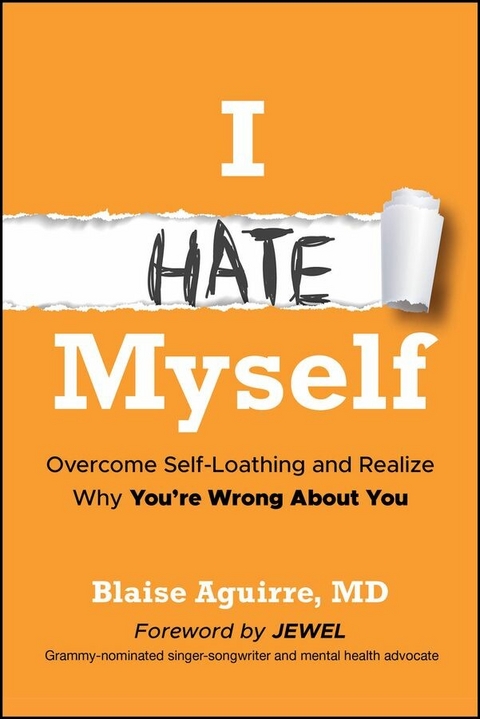
I Hate Myself (eBook)
348 Seiten
Wiley (Verlag)
978-1-394-29995-9 (ISBN)
Learn to understand the unaddressed symptom of mental health
In I Hate Myself: Overcome Self-Hatred and Realize Why You're Wrong About You, internationally known Assistant Professor of Psychiatry at Harvard Medical School Dr. Blaise Aguirre tackles the pervasive and often ignored issue of self-hatred. This book provides crucial insights into identifying and overcoming this deeply disturbing feeling, explaining why common practices of 'self-care' or 'self-love' often fall short in cases where self-hatred has become an integral part of a person's identity.
Dr. Aguirre shares compelling first-hand accounts from patients who have battled and conquered self-hatred, revealing the severe impact this feeling has on people from all walks of life and their loved ones. The book delves into the roots of self-hatred, associated mental health disorders, and offers practical strategies for overcoming these challenges.
In the book, you will:
- Learn to identify the origins and signs of self-hatred
- Understand the connection between self-hatred and suicidal behavior as well as to co-occurring disorders like borderline personality disorder and depression
- Discover effective strategies for transforming self-loathing into self-compassion
Perfect for those struggling with self-hatred and their loved ones, as well as mental health professionals, I Hate Myself offers a compassionate and practical approach to achieving self-acceptance. Start your journey towards healing today and embrace the self-worth you deserve.
BLAISE AGUIRRE is Assistant Professor in Psychiatry at Harvard Medical School in the Department of Psychiatry. He is a child and adolescent psychiatrist and the founding Medical Director of the 3East dialectical behavior therapy continuum of care at Harvard affiliated McLean Hospital. He is also the author of Coping with BPD, Mindfulness for Borderline Personality Disorder, DBT for Dummies, and Borderline Personality Disorder in Adolescents.
Learn to understand the unaddressed symptom of mental health In I Hate Myself: Overcome Self-Hatred and Realize Why You're Wrong About You, internationally known Assistant Professor of Psychiatry at Harvard Medical School Dr. Blaise Aguirre tackles the pervasive and often ignored issue of self-hatred. This book provides crucial insights into identifying and overcoming this deeply disturbing feeling, explaining why common practices of "e;self-care"e; or "e;self-love"e; often fall short in cases where self-hatred has become an integral part of a person's identity. Dr. Aguirre shares compelling first-hand accounts from patients who have battled and conquered self-hatred, revealing the severe impact this feeling has on people from all walks of life and their loved ones. The book delves into the roots of self-hatred, associated mental health disorders, and offers practical strategies for overcoming these challenges. In the book, you will: Learn to identify the origins and signs of self-hatred Understand the connection between self-hatred and suicidal behavior as well as to co-occurring disorders like borderline personality disorder and depression Discover effective strategies for transforming self-loathing into self-compassion Perfect for those struggling with self-hatred and their loved ones, as well as mental health professionals, I Hate Myself offers a compassionate and practical approach to achieving self-acceptance. Start your journey towards healing today and embrace the self-worth you deserve.
Introduction
Although I have been thinking about this topic for some time, I committed to write this book after a colleague who knew that I was very interested in the topic asked if I would do a consult with a young woman suffering with deep self‐loathing. I agreed and when I met the young person, it was clear just how intensely and enduringly she had experienced self‐hatred. I told her of my interest in the experience and that I believed that it could change. I asked her if she would be willing to work with me on changing this particular view of herself. To my surprise she said YES.
I say this because in the past, patients have told me that they are willing to work on self‐injury, or unhealthy relationships, on emotion regulation, but that self‐loathing was immutable and that they did not want to waste their time in therapy working on it.
I told the patient that there were no established protocols for working on self‐loathing and that in part we would take the current, though scant, knowledge on the topic and work together to focus on elements that worked and put aside the ones that either felt invalidating or that simply were not helpful.
Since there is limited research specific to self‐hate, I don't use an explicit treatment approach, but instead modify techniques from therapies that have proven effective in addressing related issues. I also found that by deeply listening to my patients' experiences, I gleaned valuable insights into what might work, and so I recruited some of them and asked them to collaborate with me in this endeavor. In writing this book, I have brought my patients' own voices in order to capture the totality of their interactions with the feeling of self‐hate. My hope was that their first‐hand experiences and insights would not only enrich the narrative but also provide valuable perspectives on your own journey from the certainty of self‐hatred to one where you can see that you have profound worth. What they shared exceeded all my expectations. Their worth is in their words and their reflections, and I hope that you as a reader will see that you are not alone. You are in a silent community that does not need to be silent nor need to believe the untruths you've believed. You will hear echoes of your own thoughts in their words and then use the exercises and strategies developed as extensions of their experience, as new tools on your path to overcoming self‐hatred. As I collected their experiences, I was reminded that even when a patient has largely overcome self‐hatred, their self‐loathing can still occasionally flair up.
“I nearly didn't send this to you because I felt that I could not contribute anything that would be helpful or incremental. The self‐hatred assignment was postponed by feelings of self‐hatred or at least self‐deprecating thoughts.”
This was the response to an email I had sent a patient, someone that I have known for many years, who has done so well in her life and yet who had struggled with self‐hatred for many years in her life. I was a little surprised by her response, because she seemed to be doing so much better, with a stable career, a stable group of friends, and optimism about the future, and yet self‐hatred remains. It is her experience, and those of so many others, that is the driving force behind this book.
One of the least focused‐on experiences in mental health is that of self‐loathing. In my career, I have been blessed to see so many people move from the depths of despair to enjoying the little moments of ordinary life. And yet, even for those who are working, or going to school, or are in committed relationships, self‐hatred can persist. Tragically, it is an experience that can lead to such despair, that those who are plagued by self‐loathing thoughts are at high risk for taking their life. If this is your struggle, it is essential that you know that suicide is not the answer to self‐hatred. You were not born with self‐hatred and once you realize that you can rewrite many of the false and hurtful conclusions about yourself, you can move from the contemplation of suicide to the embracing of a truer and more aspirational sense of who you are.
The Years Before
“I do not trust people who don't love themselves and yet tell me, I love you. There is an African saying which is: ‘Be careful when a naked person offers you a shirt.'”
—Maya Angelou, The Distinguished Annie Clark Tanner Lecture, 16th‐Annual Families Alive Conference, Weber State University, May 8, 1997
In the years before I thought more critically about the problem of self‐hatred, I worked with a patient, a senior in high school, who was dedicated to her recovery. She practiced new skills, she did her homework, she came to therapy every week, and slowly she moved from the ravages of emotional suffering to focusing on her academics and applying to college. She took up dance, which she had done as a child, and learned how to play the guitar. Over time she felt more in control of her life and went from seeing me twice a week to once a week and then once every two weeks. I noticed, though, that whenever she did something that she perceived as wrong or imperfect, that she would become extremely critical of herself.
“I hate myself,” she said one day.
“That's a bit harsh,” I said, “everyone makes mistakes.”
She looked at me with what I interpreted as confusion, and maybe even some scorn.
“You really don't get it. I hate myself. This is not about making mistakes. Yes, making mistakes highlights what a terrible person I am, but I hate myself now and I have always hated myself,” she said.
“But what about all the things that you are doing with your life. Your grades, your college applications, your guitar, your dance?” I persisted.
“Those things make me competent. They don't make me love myself,” she said definitively.
“I never knew this about you. Can you tell me more? What a terrible way to see yourself. How can you possibly imagine that you are so awful?”
She sat back and said: “Have a look at my life. I have ruined it. I have ruined the relationships that I care about. I probably ruin your life, too. Do you know why my parents are divorced? Me. Do you know why my boyfriend left me, and why I will never have a boyfriend again? Me. Do you see my scars? Do you know who made them? Me. Do you know why my mom is constantly worried sick? Me. Do you think she wants to spend six hours per week getting me back and forth to therapy? Do you think that she has nothing better to do with her time? It's because of me. I poison everything I touch, because I am toxic, and the world would be better off without me, such a toxic person.”
It saddened me that someone I thought so highly of, thought so poorly of herself. She insisted that she was pure loathing and that there was nothing endearing about her whatsoever.
Despite her gains, this self‐perspective did not budge, and in fact, my attempts to get her to see that she had good and love in her, increasingly felt invalidating.
“No matter how much you try to convince me otherwise, there is no good in me. It makes me think that you don't really know me, and that therapy is a waste of time. You are confusing my hard work at being more effective and less suicidal, with me caring about myself more. False, I just want to be able to make it through the day. Let's just focus on me being more effective.”
She continued to make great strides, got into her top choice of college though early action, was dancing regularly and had made some friends at school. The topic of her self‐loathing was left unaddressed, because she thought it was futile and that my bringing it up was invalidating. Also, I didn't know what to do and how to budge the debilitating and toxic symptom.
That Christmas, she came for session, and brought me a Christmas card. She had spent some weeks working on it, and the level of artistic precision, attention to color detail, and word sentiment, captured a devotion and dedication that I rarely find.
“Thank you,” I said. “You have gone to a lot of trouble to make it. It is beautiful and your words mean so much to me. You say so many nice things. Why did you make it?”
“You have helped me so much, and I appreciate it. I just wanted to show you how much it meant to me,” she said smiling.
“But I am confused, because what you write almost implies, that you care about me,” I said with intention. “I am sorry to say that I cannot accept your card. I cannot accept a lie.”
Her smile turned to shock. “What do you mean? Of course I care about you.”
“But caring is a form of love,” I persisted.
“So?” She seemed confused.
I asked, “Well how can you give me something that is not yours to give. If you steal $100 from someone, it is not yours to give to me. You can only authentically give me something that is truly yours to give. Otherwise, it is a lie. You give me a card that shows caring for me and gratitude for me, but you cannot give caring and love that you don’t have, and so you giving me those things is a lie, and I have to reject...
| Erscheint lt. Verlag | 4.2.2025 |
|---|---|
| Sprache | englisch |
| Themenwelt | Medizin / Pharmazie ► Gesundheitsfachberufe |
| Medizin / Pharmazie ► Medizinische Fachgebiete | |
| Schlagworte | overcoming self-loathing • self-hating behaviors • self-hating patients • self-hating signs • self-hatred strategies • self-hatred treatment • self-loathing • self-loathing strategies • Suicidality • suicidal patients • Suicide • treatment of suicidality |
| ISBN-10 | 1-394-29995-8 / 1394299958 |
| ISBN-13 | 978-1-394-29995-9 / 9781394299959 |
| Informationen gemäß Produktsicherheitsverordnung (GPSR) | |
| Haben Sie eine Frage zum Produkt? |
 EPUB (Adobe DRM)
Kopierschutz: Adobe-DRM
Adobe-DRM ist ein Kopierschutz, der das eBook vor Mißbrauch schützen soll. Dabei wird das eBook bereits beim Download auf Ihre persönliche Adobe-ID autorisiert. Lesen können Sie das eBook dann nur auf den Geräten, welche ebenfalls auf Ihre Adobe-ID registriert sind.
Details zum Adobe-DRM
Dateiformat: EPUB (Electronic Publication)
EPUB ist ein offener Standard für eBooks und eignet sich besonders zur Darstellung von Belletristik und Sachbüchern. Der Fließtext wird dynamisch an die Display- und Schriftgröße angepasst. Auch für mobile Lesegeräte ist EPUB daher gut geeignet.
Systemvoraussetzungen:
PC/Mac: Mit einem PC oder Mac können Sie dieses eBook lesen. Sie benötigen eine
eReader: Dieses eBook kann mit (fast) allen eBook-Readern gelesen werden. Mit dem amazon-Kindle ist es aber nicht kompatibel.
Smartphone/Tablet: Egal ob Apple oder Android, dieses eBook können Sie lesen. Sie benötigen eine
Geräteliste und zusätzliche Hinweise
Buying eBooks from abroad
For tax law reasons we can sell eBooks just within Germany and Switzerland. Regrettably we cannot fulfill eBook-orders from other countries.
aus dem Bereich