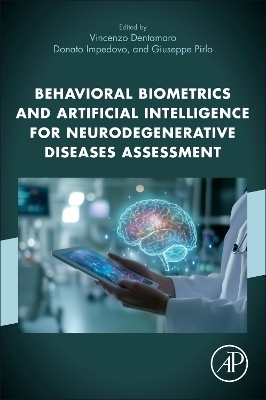
Behavioral Biometrics and Artificial Intelligence for Neurodegenerative Diseases Assessment
Academic Press Inc (Verlag)
978-0-443-13545-3 (ISBN)
- Noch nicht erschienen (ca. März 2026)
- Versandkostenfrei
- Auch auf Rechnung
- Artikel merken
In addition to its core coverage, the book delves into the practical applications of wearable sensors and the use of everyday devices like smartphones and tablets in assessments. It provides comprehensive chapters on how these technologies can aid clinicians and researchers in monitoring disease progression outside traditional clinical settings.
VINCENZO DENTAMARO received the degree in computer science from the Department of Computer Science, University of Bari, Italy and a Master Of Science in Machine Learning from Gerogia Institute of Technology Atlanta USA. He is currently PhD student at University of Bari “Aldo Moro with scholarship offered by InnovaPuglia S.p.A. Vincenzo is currently publishing on various pattern recognition journals and conferences. He is also reviewer for IEEE Access, Elsevier Pattern Recognition Journal, MDPI Sensor, MDPI Information and many more. He has previously published about indoor positioning and localization techniques on Microsoft Research Journal and holds two international patents on localization technologies. Previous work experience at Johnson Controls Inc. as Software Engineer, IBM Rome as an intern, CEO and CTO Nextome S.R.L . Seal of Excellence European Commission, 1st prize Busan Metropolitan City (South Korea), IBM's Global Mobile Innovator Tournament Award at the Mobile World Congress, MIT Technology Review award. DONATO IMPEDOVO is associate professor at Department of Computer Science of the University of Bari (IT). His research interests are in the field of signal processing, pattern recognition, machine learning and biometrics. He is co-author of more than 100 articles on these fields in both international journals and conference proceedings. He received the “distinction award in May 2009 at the International Conference on Computer Recognition Systems (CORES – endorsed by IAPR), and the first prize of the first Nereus-Euroavia Academic competition on GMES in October 2012. Prof. Impedovo is also very involved in research transfer activities as well as in industrial research, he has managed more than 25 projects funded by public institutions as well as by private SMEs. Prof. Impedovo is IEEE Access and IEEE OJ-CS Associate Editor, he serves as reviewer for many international journals including IEEE THMS, IEEE T-SMC, IEEE-TIFS, IEEE-TECT, Pattern Recognition and many others. He serves as reviewer and rapporteur for the EU in H2020 projects evaluation. He was the general co-chair of the International Workshop on Smart Cities and Smart Enterprises (SCSE 2018), International Workshop on Artificial Intelligence with Application in Health (WAIAH 2018), Emergent Aspects in Handwritten Signature Processing (EAHSP 2013) and of the International Workshop on Image-Based Smart City Application (ISCA 2015). He has been member of the scientific committee and program committee of many international conferences in the field of computer science, pattern recognition and signal processing such as the ICPR and ICASSP. He is IAPR member and IEEE senior member. GIUSEPPE PIRLO received the degree in computer science (cum laude) from the Department of Computer Science, University of Bari, Italy, in 1986. Since 1986, he was carrying out research in the field of computer science and neuroscience, signal processing, handwriting processing, automatic signature verification, biometrics, pattern recognition and statistical data processing. Since 1991, he was an Assistant Professor with the Department of Computer Science, University of Bari, where he is currently a Full Professor. He developed several scientific projects and authored over 250 papers on international journals, scientific books and proceedings. Prof. Pirlo is currently an Associate Editor of the IEEE Transactions on Human–Machine Systems. He also serves as a Reviewer for many international journals including the IEEE T-PAMI, the IEEE T-FS, the IEEE T-SMC, the IEEE T-EC, the IEEE T-IP, the IEEE T-IFS, the Pattern Recognition, the IJDAR, and the IPL. He was the general co-chair of the International Workshop on Smart Cities and Smart Enterprises (SCSE2018), of the International Workshop On Artificial Intelligence With Application In Health (WAIAH2017), of the International Workshop on Emerging Aspects in Handwriting Signature Processing, Naples, in 2013, the International Workshop on Image-based Smart City Applications, Genoa, in 2015, and the General Co-Chair of the International Conference on Frontiers in Handwriting Recognition, Bari, in 2012. He was a reviewer in the scientific committee and program committee of many international conferences in the field of computer science, pattern recognition and signal processing, such as the ICPR, the ICDAR, the ICFHR, the IWFHR, the ICIAP, the VECIMS, and the CISMA. He is also the editor of several books. He was an Editor of the Special Issue Handwriting Recognition and Other PR Applications of the Pattern Recognition Journal in 2014 and the Special Issue Handwriting Biometrics of the IET Biometrics Journal in 2014. He was the Guest Editor of the Special Issue of the Je-LKS Journal of the e-Learning and Knowledge Society Steps toward the Digital Agenda: Open Data to Open Knowledge in 2014. He is currently the Guest Co-Editor of the Special Issue of the IEEE Transactions on Human–Machine Systems on Drawing and Handwriting Processing for User-Centered Systems.
1. Introduction to neurodegenerative diseases
2. Machine learning
3. Feature extraction, feature selection, dimensionality reduction
4. Classification and Regression Models
5. Training and Testing by ensuring intrer-patient separation scheme
6. Model validation
7. Neural Networks
8. Deep Neural Networks for Computer Vision
9. Overview of modern architectures for image classification
10. Overview of modern architectures for time series classification
11. The mechanics of the movement
12. A review of noninvasive sensors and techniques for detecting the early sign of neurodegenerative disease using machine learning
13. Wearable sensors for Neurodegenerative disease assessment
14. Detection of early signs of neurodegenerative disease through smartphone app analyzing gait and five-time sit to stand tests
15. Detection of early signs of neurodegenerative disease through smartphones and speech audio
16. Detection of early signs of neurodegenerative disease through digital tablets and Handwriting
17. Computer Vision techniques for detecting neurodegenerative disease through neuroimaging techniques.
18. Explainable artificial intelligent techniques as a way to trust AI
19. Conclusions and future research directions
| Erscheint lt. Verlag | 1.3.2026 |
|---|---|
| Verlagsort | San Diego |
| Sprache | englisch |
| Maße | 191 x 235 mm |
| Themenwelt | Medizin / Pharmazie ► Medizinische Fachgebiete ► Neurologie |
| Medizin / Pharmazie ► Medizinische Fachgebiete ► Radiologie / Bildgebende Verfahren | |
| ISBN-10 | 0-443-13545-2 / 0443135452 |
| ISBN-13 | 978-0-443-13545-3 / 9780443135453 |
| Zustand | Neuware |
| Informationen gemäß Produktsicherheitsverordnung (GPSR) | |
| Haben Sie eine Frage zum Produkt? |
aus dem Bereich