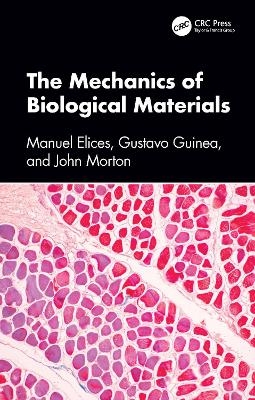
The Mechanics of Biological Materials
CRC Press (Verlag)
978-1-032-89277-1 (ISBN)
This book introduces the mechanical principles governing the behaviour of a wide range of biological materials, which are materials produced by a biological system. The approach is systematic and based on one-dimensional (fibres), two-dimensional (membrane), and three-dimensional (bulk) biological materials. The essential mathematical tools are developed from first principles and applied to materials as diverse as spider silk, blood vessels, and bone. It offers a progressive introduction of mathematics and mechanics concepts and offers detailed solutions to numerous worked examples.
Provides an essential gateway to access complex treatises in the important and demanding models governing the observed behaviour of biological materials
Teaches readers to exploit the wondrous properties found in nature in the development of biomimetic applications
Offers a progressive introduction of mathematics and mechanics concepts
Includes detailed solutions to numerous worked examples, case studies, and homework problems
The text is aimed at students of chemistry, materials engineering, and biology, who do not have a background in mechanics but wish to further their knowledge of the mechanics of biological materials.
A solutions manual is available to qualifying adopting professors.
Manuel Elices is a Foreign Member of the National Academy of Engineering, USA, Member of the Royal Spanish Academy of Sciences, Member of the Royal Spanish Academy of Engineering, and Emeritus Professor of Materials Science at the Polytechnical University of Madrid, Spain. Gustavo Guinea is a Corresponding Member of the Royal Spanish Academy of Sciences, Professor of Materials Science, former Director of the Centre for Biomedical Technology at the Polytechnic University of Madrid, Spain, and Head of the Laboratory for Biomaterials and Regenerative Engineering at this Centre. John Morton is a Fellow in Engineering Science at University College Oxford, UK.
0. Front Matter. Section I: Fibres. Materials Practically Unidimensional. 1. Biological Fibres. General Concepts. 2. Mechanical Behaviour of Fibres. 3. Examples Section. Section II. Membranes. Materials Practically Two Dimensional. 4. Biological Membranes. General Concepts. 5. Mechanical Properties. 6. Examples Section. Section III. Bulk Materials. Three dimensions need to be considered. 7. Biological Bulk Materials. General Concepts. 8. Mechanical Properties. 9. Examples. End Matter I. References. End Matter II. Index.
| Erscheinungsdatum | 19.07.2025 |
|---|---|
| Zusatzinfo | 18 Tables, black and white; 218 Line drawings, black and white; 29 Halftones, black and white; 247 Illustrations, black and white |
| Verlagsort | London |
| Sprache | englisch |
| Maße | 178 x 254 mm |
| Gewicht | 870 g |
| Themenwelt | Medizin / Pharmazie ► Physiotherapie / Ergotherapie ► Orthopädie |
| Studium ► 1. Studienabschnitt (Vorklinik) ► Physiologie | |
| Technik ► Maschinenbau | |
| Technik ► Medizintechnik | |
| ISBN-10 | 1-032-89277-3 / 1032892773 |
| ISBN-13 | 978-1-032-89277-1 / 9781032892771 |
| Zustand | Neuware |
| Informationen gemäß Produktsicherheitsverordnung (GPSR) | |
| Haben Sie eine Frage zum Produkt? |
aus dem Bereich