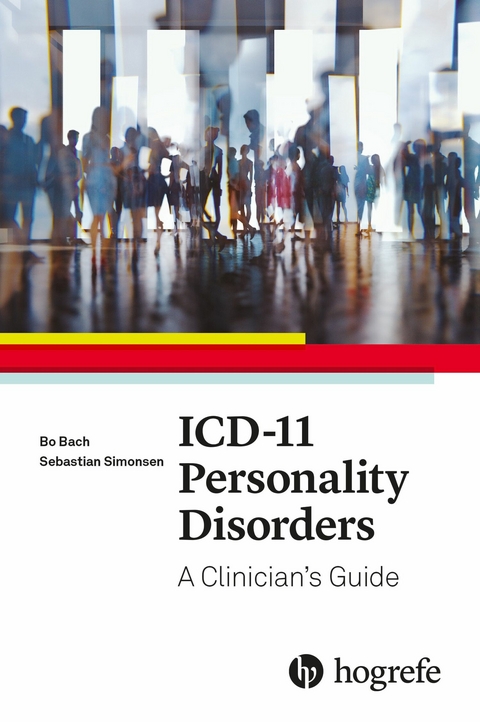
ICD-11 Personality Disorders (eBook)
154 Seiten
Hogrefe Publishing GmbH (Verlag)
978-1-61334-648-8 (ISBN)
A practical roadmap to navigate the new ICD-11 classification of personality disorders- Written by leading ICD-11 and personality disorder experts- Illustrated with clinical examples- Full of practical tipsThis insightful book offers professionals a comprehensive guide for navigating the new way of diagnosing and understanding personality difficulties and disorders introduced in the ICD-11. Through in-depth clinical examples, these experienced authors illustrate clearly how to determine severity, specify the five trait domains, and interpret aspects of personality dysfunction, including specific combinations of trait domains. The book also provides guidelines for differential diagnosis in relation to a range of other persistent mental disorders, clinical decision- making, individualized treatment planning, necessary treatment intensity, and psychotherapeutic focus. Readers will appreciate the exploration of available standardized instruments for classification, as well as the guide using the old classifications in the ICD-10 and the DSM-5 with the ICD-11 guidelines in the appendix. This book provides a roadmap for psychologists, psychiatrists, other mental health professionals, and students to use the latest advancements in classification to enhance patient care of people with personality disorders.
|1|Chapter 1
Background
With the introduction of the World Health Organization’s (2024) Clinical Descriptions and Diagnostic Requirements for ICD-11 Mental, Behavioural and Neurodevelopmental Disorders there has been a paradigm shift in the way we understand and diagnose Personality Disorder. In this introductory chapter, we will describe the most important changes and their underlying clinical and scientific rationale as a starting point for the remaining chapters of the book.
The Purpose of This Book
ICD-11’s classification of Personality Disorder can be said to contain significant changes that require fundamental retraining of professionals as well as restructuring of clinical practice in general. In an attempt to support this challenging process, we have chosen to write a book that we hope clinicians will find useful for this purpose. We recommend that readers use the book as a guide that can be consulted as needed and should not necessarily be read from start to finish. For example, clinicians may want to begin by reading the section “A Crash Course in the Clinical Use of Personality Functioning and Traits” in Chapter 2 to understand the clinical rationale for the new classification. Chapter 2 also includes extensive differential diagnostic guidelines, which may be helpful in clinical practice. Next, it can be beneficial to familiarise yourself with the different capacities and manifestations of personality functioning in Chapter 3, which form the basis for the crucial assessment and description of severity in Chapter 4. Furthermore, Chapter 5 can be used to gain an overview of the five trait domains that describe the style and expression of the patient’s personality disturbances. When considering treatment options, it may be helpful to consult Chapter 6 for specific suggestions described for each level of severity as well as different combinations of trait domains. In the book’s appendix, we have chosen to include extra features that may be useful (“nice to know”) but not absolutely necessary (“need to know”) to get started using the new classification.
As a general clarification for readers, we tend to use terms such as “personality dysfunction,” “personality difficulties,” and “personality disturbances” |2|interchangeably. These terms are not diagnostic entities as such but apply to human personality functioning in a broader sense. The official ICD-11 classification is explicitly and exclusively referred to in terms of “Personality Difficulty,” “Mild Personality Disorder,” “Moderate Personality Disorder,” and “Severe Personality Disorder” along with the five trait domain specifiers (i.e., Negative Affectivity, Detachment, Dissociality, Disinhibition, and Anankastia) and the Borderline pattern specifier.
Brief Introduction to ICD-11 Personality Disorder
With ICD-11, Personality Disorder is described and diagnosed based on what it actually means to be a person, psychologically speaking, and in particular what it means to struggle with personality issues (Bender, 2019; Sharp & Wall, 2021; Tyrer et al., 2019). In short, ICD-11 guides us to diagnose Personality Difficulty and Personality Disorder based on general impairments in aspects of the self and interpersonal functioning, along with emotional, cognitive, and behavioural manifestations, as well as global psychosocial functioning and distress. Once these general aspects of personality functioning and manifestations are found to be present in the patient, the diagnosis can be further classified by severity (i.e., mild, moderate, severe) or the sub-diagnostic presence of Personality Difficulty. This can be further supplemented with a specification of one or more of the most prominent trait domains (i.e., Negative Affectivity, Detachment, Dissociality, Disinhibition, and Anankastia) in order to emphasise the individual expression of the diagnosis. Finally, there is also the option to further specify a code for a Borderline pattern when this can make a difference to the patient’s treatment. As shown in Table 1.1, only the first cluster of ICD-11 codes, that is, up to and including the severity levels, are generally used as the actual diagnoses, while the trait domains and Borderline pattern are only used as informative additional codes. With the World Health Organization’s (1992) International Statistical Classification of Diseases (10th ed.; ICD-10), clinicians applied 10 different types of Personality Disorder diagnoses, which in practice are completely equal in terms of severity. It is well known that several Personality Disorder types usually apply to the same patient (i.e., co-occurrence). With ICD-11, the focus has instead shifted to categories of overall severity, while the style or typology can be described using trait domains (see examples in Appendix B). For a more concrete introduction, we refer to the section “Crash Course in the Clinical Use of Personality Functioning and Traits” in Chapter 2.
| ICD-10 | ICD-11 |
| Categories 60.0 Paranoid 60.1 Schizoid 60.2 Dissocial 60.3 Emotionally Unstable [Borderline] 60.4 Histrionic 60.5 Anankastic 60.6 Anxious [Avoidant] 60.7 Dependent 60.8 Other Specific Type 60.9 Unspecified 61.0 Mixed Type Z73.1 Accentuation of Personality Traits (Sub-diagnostic) | Personality Disorder 10.Z Severity Unspecified Level of severity 50.7 Personality Difficulty (Sub-diagnostic) 10.0 Mild Personality Disorder 10.1 Moderate Personality Disorder 10.2 Severe Personality Disorder Additional specifier codes 11.0 Negative Affectivity 11.1 Detachment 11.2 Dissociality 11.3 Disinhibition 11.4 Anankastia 11.5 Borderline pattern |
The Creation of a New Classification
The now official ICD-11 classification of Personality Disorder was created through a lengthy and difficult process led by an international working group appointed by the World Health Organization (WHO). The working group was broadly constituted to ensure diverse expertise and geographical representation (Tyrer, 2005; Tyrer et al., 2019; Tyrer, Crawford, & Mulder, 2011). The original working group included Peter Tyrer (psychiatrist) from the UK, Mike Crawford (psychiatrist) from the UK, Roger Mulder (psychiatrist) from New Zealand, Roger Blashfield (psychologist) from the USA, Alireza Farnam (psychiatrist) from Iran, Andrea Fossati (psychologist) from Italy, Michaela Swales (psychologist) from Wales, Dusica Lecic-Tosevski (psychiatrist) from Serbia, David Ndetei (psychiatrist) from Kenya, Nestor Koldobsky (psychiatrist) from Argentina, and Lee Anna Clark (psychologist) from the USA.
Since its launch over 30 years ago, the ICD-10 (“blue book”) has explicitly recognised the scientific and practical problems with the classification of Personality Disorder and pointed out a need for a new classification: “a new approach to the description of Personality Disorders is required” (World Health Organization, 1992, p. 20). At the same time, there has been broad agreement in the literature about these problems, while there has been less agreement about how to specifically address them (Clark, 2007; |4|Ekselius et al., 1993; Frances, 1980; Kiesler, 1986; Skodol et al., 2013; Tyrer & Alexander,...
| Erscheint lt. Verlag | 25.11.2024 |
|---|---|
| Sprache | englisch |
| Themenwelt | Geisteswissenschaften ► Psychologie ► Persönlichkeitsstörungen |
| Medizin / Pharmazie ► Medizinische Fachgebiete ► Psychiatrie / Psychotherapie | |
| Schlagworte | Advancements in clinical practice • Classification of personality disorders • Diagnosis of personality disorders • ICD-11 • Psychiatric assessment |
| ISBN-10 | 1-61334-648-4 / 1613346484 |
| ISBN-13 | 978-1-61334-648-8 / 9781613346488 |
| Informationen gemäß Produktsicherheitsverordnung (GPSR) | |
| Haben Sie eine Frage zum Produkt? |
 EPUB (Wasserzeichen)
DRM: Digitales Wasserzeichen
Dieses eBook enthält ein digitales Wasserzeichen und ist damit für Sie personalisiert. Bei einer missbräuchlichen Weitergabe des eBooks an Dritte ist eine Rückverfolgung an die Quelle möglich.
Dateiformat: EPUB (Electronic Publication)
EPUB ist ein offener Standard für eBooks und eignet sich besonders zur Darstellung von Belletristik und Sachbüchern. Der Fließtext wird dynamisch an die Display- und Schriftgröße angepasst. Auch für mobile Lesegeräte ist EPUB daher gut geeignet.
Systemvoraussetzungen:
PC/Mac: Mit einem PC oder Mac können Sie dieses eBook lesen. Sie benötigen dafür die kostenlose Software Adobe Digital Editions.
eReader: Dieses eBook kann mit (fast) allen eBook-Readern gelesen werden. Mit dem amazon-Kindle ist es aber nicht kompatibel.
Smartphone/Tablet: Egal ob Apple oder Android, dieses eBook können Sie lesen. Sie benötigen dafür eine kostenlose App.
Geräteliste und zusätzliche Hinweise
Buying eBooks from abroad
For tax law reasons we can sell eBooks just within Germany and Switzerland. Regrettably we cannot fulfill eBook-orders from other countries.
aus dem Bereich