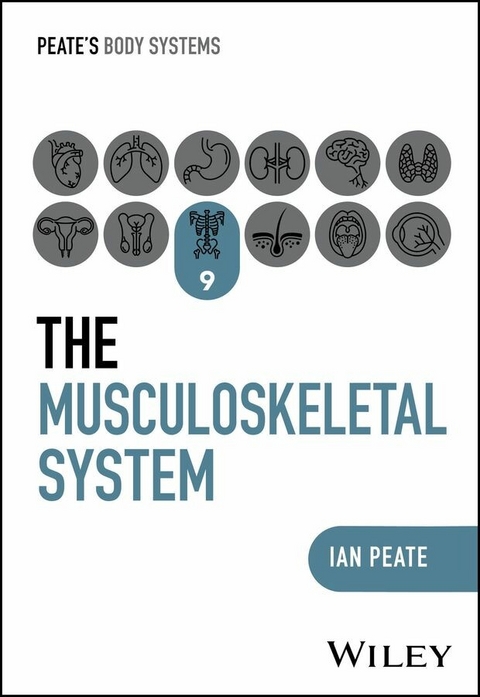
The Musculoskeletal System (eBook)
Wiley (Verlag)
978-1-394-25260-2 (ISBN)
PEATE'S BODY SYSTEMS THE MUSCULOSKELETAL SYSTEM
A CONCISE, ILLUSTRATED, AND ACCESSIBLE GUIDE TO THE MUSCULOSKELETAL SYSTEM
Each of the twelve volumes in Peate's Body Systems series is rooted in the belief that a deep and thorough understanding of the human body is essential for providing the highest standard of care. Offering clear, accessible and up-to-date information on different body systems, this series bridges the gap between complex scientific concepts and practical, everyday applications in health and care settings. This series makes for an invaluable resource for those committed to understanding the intricacies of human biology, physiology and the various systems that sustain life.
The Musculoskeletal System is the perfect companion for students and newly registered practitioners across nursing and allied health fields with an interest in musculoskeletal care, providing a comprehensive yet easy-to-digest guide for both academic and clinical application.
- Equips healthcare students and practitioners with the necessary information to provide safe and competent care
- Features colourful illustrations to aid comprehension, clarify complicated concepts, and render content more engaging and accessible
- Empowers readers to adapt to a rapidly evolving healthcare landscape, preparing them for the future of healthcare delivery
- Contains information necessary for effective patient care of those with osteoarthritis, osteoporosis, bone cancer, and other musculoskeletal diseases and conditions
IAN PEATE is a Visiting Professor at Northumbria University, a Senior Clinical Fellow at the University of Hertfordshire, and a Professorial Fellow at the University of Roehampton. He is also the Editor-in-Chief of the British Journal of Nursing and the Consultant Editor of the Journal of Paramedic Practice and the International Journal of Advancing Practice.
PEATE'S BODY SYSTEMS THE MUSCULOSKELETAL SYSTEMA CONCISE, ILLUSTRATED, AND ACCESSIBLE GUIDE TO THE MUSCULOSKELETAL SYSTEM Each of the twelve volumes in Peate's Body Systems series is rooted in the belief that a deep and thorough understanding of the human body is essential for providing the highest standard of care. Offering clear, accessible and up-to-date information on different body systems, this series bridges the gap between complex scientific concepts and practical, everyday applications in health and care settings. This series makes for an invaluable resource for those committed to understanding the intricacies of human biology, physiology and the various systems that sustain life. The Musculoskeletal System is the perfect companion for students and newly registered practitioners across nursing and allied health fields with an interest in musculoskeletal care, providing a comprehensive yet easy-to-digest guide for both academic and clinical application. Equips healthcare students and practitioners with the necessary information to provide safe and competent care Features colourful illustrations to aid comprehension, clarify complicated concepts, and render content more engaging and accessible Empowers readers to adapt to a rapidly evolving healthcare landscape, preparing them for the future of healthcare delivery Contains information necessary for effective patient care of those with osteoarthritis, osteoporosis, bone cancer, and other musculoskeletal diseases and conditions
Chapter 1
Anatomy and Physiology: The Musculoskeletal System
The musculoskeletal system (also known as the locomotor system) encompasses all the bones, cartilage, muscles, joints, tendons and ligaments within the body. It serves as the structural foundation, with bones providing shape, support and protection. The musculoskeletal system is required to sustain life through contraction of the diaphragm and heart muscle; to convey communication through facial expressions and body language and to protect internal structures such as the heart and lungs (Henstock 2021). Muscles, composed of fibres, facilitate both voluntary movements of body parts and involuntary actions within internal organs. The muscles are the active part of the apparatus of locomotion. In some cases, the musculoskeletal system is seen as two body systems in one or two systems that work very closely with each other, with one being the muscular system and the other the skeletal system. Without the skeleton to pull against, contracting muscle fibres cannot enable us to sit, stand, walk or run (Manfred 2022).
A fully functioning musculoskeletal system is fundamental to optimal health and well-being. Injury or disease involving this system can have a profound effect on an individual’s mobility and, therefore, their ability to perform activities of daily living and can result in temporary or permanent disability (Santy-Tomlinson and Lucas 2019).
Kinesiology, also known as body mechanics, focuses on analysing the movement of various body parts. Enabled by the musculoskeletal system, in tandem with the nervous system, bodily motion occurs. Employing appropriate body mechanics is paramount to ensuring the safety of both patients and healthcare providers (Peate 2019).
This chapter discusses the anatomy and physiology of the musculoskeletal system.
Muscles
While the skeletal system serves as the fundamental architectural framework of the human body, providing structural support and leverage, it is the muscular system that is chiefly responsible for executing movement by pulling on bones. Muscular contraction and relaxation are the primary mechanisms by which movement is achieved, with muscles functioning as the active agents in this process. It is important to recognise that muscles possess the capability to contract, thereby initiating movement, but they lack the inherent capacity to push; conversely, bones are inert structures and necessitate muscular action to prompt motion.
In addition to facilitating external locomotion, muscles fulfil essential roles in internal physiological processes. They are integral to the movement and maintenance of internal organs, including the heart, lungs and gastrointestinal system. Notably, cardiac muscle, characterised by its involuntary and rhythmic contractions, is indispensable for sustaining the cardiac cycle and ensuring effective circulation.
Muscles serve as the primary engine that drives bodily movement, converting energy into locomotion. Whether undertaking deliberate physical activities or engaging in automatic physiological functions, such as respiration and ocular movement, all actions are brought together by the coordinated activity of muscles. Even subtle, delicate expressions of emotion, such as smiling, kissing or frowning, involve intricate muscular coordination.
Muscle, also tissue, exhibits a thermogenic effect, this means that when muscles contract, they generate heat as a byproduct of their metabolic activity. This heat production helps to regulate body temperature and is instrumental in maintaining homeostasis and optimal physiological function.
Muscles in the human body often work in pairs known as agonist and antagonist muscles. These pairs are associated with joints and bones, enabling movement through the application of force. The agonist muscle is responsible for initiating and carrying out a specific movement, such as bending the arm at the elbow. Its counterpart, the antagonist muscle, performs the opposite action, working to relax and lengthen as the agonist contracts. This coordinated interaction allows for smooth, controlled movements and prevents excessive strain on joints and ligaments.
Body mechanics refers to the efficient use of the musculoskeletal system to perform tasks while minimising the risk of injury or strain. It involves proper alignment, posture and movement patterns to enhance biomechanical efficiency and reduce stress on the body’s structures.
Maintaining balance involves the coordination of muscles and sensory input from the vestibular system (inner ear) and proprioceptors (sensory receptors in muscles and joints). Muscles throughout the body, especially those in the legs and core, work together to adjust body position and counteract external forces, such as gravity or changes in terrain, to prevent falls and maintain stability.
Posture refers to the alignment of the body’s musculoskeletal structures, including the spine, pelvis and limbs, while sitting, standing or moving. Proper posture distributes the body’s weight evenly, reducing strain on muscles, ligaments and joints. Muscles of the trunk, neck and back play a crucial role in supporting the spine and maintaining an upright posture, especially during prolonged sitting or standing activities.
Body alignment involves positioning the body segments in optimal alignment to minimise stress and strain on the musculoskeletal system. This includes maintaining a neutral spine, aligning the head, shoulders and hips and distributing body weight evenly between the feet. Proper body alignment ensures efficient movement patterns and reduces the risk of overuse injuries or musculoskeletal imbalances.
Muscle Tissues
There are three types of muscle tissue, and they have distinct structures and functions, but they all play essential roles in movement, support and physiological processes within the body:
- Skeletal
- Cardiac
- Smooth
See Figure 1.1.
Figure 1.1 Muscle tissue
Table 1.1 discusses the different types of muscle tissue.
Table 1.1 Different types of muscle tissue
| Skeletal muscle | Smooth muscle | Cardiac muscle |
|---|
| Attached to bones or the skin (facial muscles only) | Found in the walls of hollow visceral organs and blood vessels | Located in the walls of the heart |
| Single, long cylindrical cells | Single, narrow, rod‐shaped cells | Branching chains of cells |
| Striated, multinucleated cells | Non‐striated, uninucleated cells | Striated, uninucleated cells |
| Under voluntary control | Involuntary control | Involuntary control |
Skeletal Muscle
The skeletal muscles make up the muscular system of the body (made up of over 600 muscles), accounting for 40–50% of the body weight in an adult. Skeletal muscle consists of elongated, single-striated fibres ranging in length from a few centimetres to 40 cm, each containing multiple nuclei. Unlike other muscle types, skeletal muscle is under voluntary control, meaning it can be consciously relaxed or contracted through intentional effort; it is the only voluntary muscle of the body. Skeletal muscle is also known as striped or striated muscle because of the banded patterns of the cells seen under the microscope.
The sarcolemma, which is the muscle cell membrane, encloses the sarcoplasm, the cytoplasm of the muscle cell. Tubules originating from the sarcolemma extend into the sarcoplasm, facilitating rapid distribution of contraction signals throughout the muscle fibre. Within the muscle fibre, myofibrils are responsible for contraction and are composed of bundles of filaments consisting of actin and myosin. These filaments are organised into functional units known as sarcomeres, with actin filaments positioned centrally within the sarcomere and myosin filaments located at either end. The Z line demarcates the boundaries of the sarcomere, while the M line is situated at its midpoint. Actin and myosin filaments are interconnected by cross bridges, which repeatedly engage and disengage during contraction, leading to the shortening of the sarcomere. The release of calcium from various structures triggers muscle contraction. Each muscle fibre is enveloped by a layer of endomysium, which bundles together to form fascicles, each of which is further encased in perimysium. Figure 1.2 shows the motor and muscle units.
Figure 1.2 The motor and muscle units
The site where the nerve impulse initiates muscle contraction is known as the neuromuscular junction (NMJ). Each muscle fibre possesses a single NMJ where the neurone’s axon connects to the fibre. Near the motor endplate, at the terminal end of the axon, there exists a synaptic cleft that separates the nerve from the motor endplate, although they are not in direct contact. Muscle activation occurs through chemical transmission, with acetylcholine, contained within the axon, binding to receptors on the motor endplate.
The binding of acetylcholine at the NMJ triggers a series of events that result in the generation of an action potential, the spread of the action potential across the sarcolemma and into the interior of the muscle fibre and ultimately the release of calcium ions and the muscle contractions.
Cardiac Muscle
The fibres are striated and branched, typically containing a single nucleus centrally located. At each end, they connect through specialised thickenings...
| Erscheint lt. Verlag | 22.1.2025 |
|---|---|
| Reihe/Serie | Peate's Body Systems |
| Sprache | englisch |
| Themenwelt | Medizin / Pharmazie ► Medizinische Fachgebiete |
| Naturwissenschaften ► Biologie | |
| Schlagworte | musculoskeletal nursing • musculoskeletal nursing book • musculoskeletal system illustrations • Musculoskeletal system nursing • musculoskeletal system nursing book • ortho nursing • orthopaedic nursing • orthopaedic nursing book |
| ISBN-10 | 1-394-25260-9 / 1394252609 |
| ISBN-13 | 978-1-394-25260-2 / 9781394252602 |
| Informationen gemäß Produktsicherheitsverordnung (GPSR) | |
| Haben Sie eine Frage zum Produkt? |
 EPUB (Adobe DRM)
Kopierschutz: Adobe-DRM
Adobe-DRM ist ein Kopierschutz, der das eBook vor Mißbrauch schützen soll. Dabei wird das eBook bereits beim Download auf Ihre persönliche Adobe-ID autorisiert. Lesen können Sie das eBook dann nur auf den Geräten, welche ebenfalls auf Ihre Adobe-ID registriert sind.
Details zum Adobe-DRM
Dateiformat: EPUB (Electronic Publication)
EPUB ist ein offener Standard für eBooks und eignet sich besonders zur Darstellung von Belletristik und Sachbüchern. Der Fließtext wird dynamisch an die Display- und Schriftgröße angepasst. Auch für mobile Lesegeräte ist EPUB daher gut geeignet.
Systemvoraussetzungen:
PC/Mac: Mit einem PC oder Mac können Sie dieses eBook lesen. Sie benötigen eine
eReader: Dieses eBook kann mit (fast) allen eBook-Readern gelesen werden. Mit dem amazon-Kindle ist es aber nicht kompatibel.
Smartphone/Tablet: Egal ob Apple oder Android, dieses eBook können Sie lesen. Sie benötigen eine
Geräteliste und zusätzliche Hinweise
Buying eBooks from abroad
For tax law reasons we can sell eBooks just within Germany and Switzerland. Regrettably we cannot fulfill eBook-orders from other countries.
aus dem Bereich