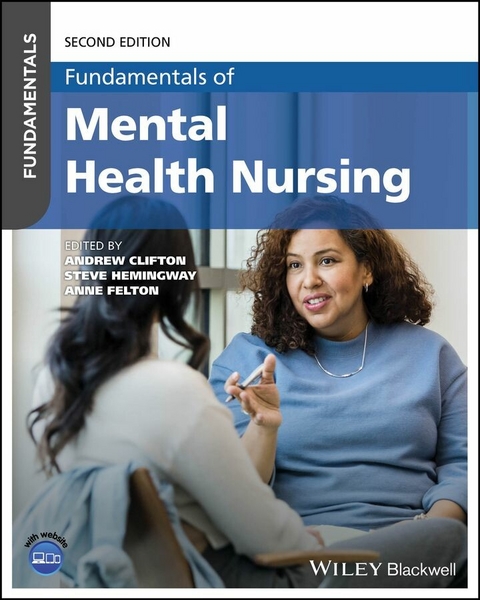
Fundamentals of Mental Health Nursing (eBook)
1228 Seiten
Wiley-Blackwell (Verlag)
978-1-394-17873-5 (ISBN)
Evidence-based introduction to the role of the mental health nurse, covering social, political, psychological, and biological aspects of mental health
Fundamentals of Mental Health Nursing is an accessible, evidence-based introduction to the role of the mental health nurse, exploring the concepts of mental health and distress, ethics and accountability, key nursing models to be aware of, and the prevalence, predisposing factors, and features of the most commonly occurring mental health problems. This book places mental health conditions and interventions within a wider holistic context, situates recovery at the centre of mental health nursing practice, and links key concepts to mental health across the lifespan.
This second edition contains revised content throughout as well as five new chapters on race, ethnicity, and diversity; sexuality, gender, and identity; global challenges for mental health; care planning in mental health; and transition to registration in leadership and resilience. Fundamentals of Mental Health Nursing includes:
- Different ways of defining mental health, and how different definitions can potentially ignore social factors that may influence health, such as poverty
- Social, political, and psychological factors that impact mental wellbeing and recovery, from cultural inequalities to poor housing, to trauma and cognitive behavior
- Biological theory related to mental health, covering brain structure, neurochemistry, medication, and more
- Today's most common mental health problems including anxiety, mood disorders, psychosis, substance misuse, eating disorders, and organic disorders
Fundamentals of Mental Health Nursing is a comprehensive and easy-to-understand reference on the subject for student nurses enrolled in pre-registration graduate nursing programmes, as well as early career nurses, nurses returning to practice, and healthcare assistants and assistant practitioners.
ABOUT THE EDITORS
Andrew Clifton is Associate Professor in the School of Nursing, Midwifery and Public Health at the University of Suffolk.
Steve Hemingway is Senior Lecturer in Mental Health Nursing at the University of Huddersfield.
Anne Felton is Head of the Institute of Health and Allied Professions, Nottingham Trent University.
CHAPTER 1
What is mental health?
Carmel Bond
Department of Nursing and Midwifery, Sheffield Hallam University, Sheffield, UK
Anne Felton
Institute of Health and Allied Professions, Nottingham Trent University, Nottingham, UK
Steve Hemingway
School of Human and Health Science, University of Huddersfield, Huddersfield, UK
Andrew Clifton
School of Nursing, Midwifery & Public Health, University of Suffolk, Ipswich, UK
LEARNING OUTCOMES
By the end of this chapter, you will be able to:
- Understand and consider the different ways of defining mental health.
- Recognise the impacts of different theories of mental health on approaches to nursing care.
- Explain how social, political, biological and psychological factors impact mental wellbeing and recovery.
Test your knowledge
- What does the term ‘mental health’ mean to you?
- What factors do you think impact an individual’s mental health?
- Can you think of any interventions which are used to treat mental illness?
Introduction
Mental health problems are one of the most significant health issues in modern society and are predicted to increase in the future (World Health Organization [WHO], 2023a). This has consequences for individuals, the social and economic wellbeing of communities, as well as the demand placed on health services. As a student nurse, it is important for you to consider the impacts of this on the way in which mental health services are delivered and structured. However, there is some debate surrounding the factors that influence mental wellbeing. This is due to the lack of definitive evidence supporting one explanation over another, and the difficulties with representing the complexity of mental distress.
This chapter will provide a range of definitions of mental health, and consider the debates which surround understanding and explaining mental health problems. It will introduce the key theories underpinning interventions which aim to improve mental health. Activities are included to support your understanding of the theories surrounding mental health problems.
Mental health in context
Historically, people who experience or have experienced some type of mental distress have not been served well by society at large. Early civilisations believed that mental illness was a curse from the gods and those people suffering ill health were considered evil; in particular, some women were classified as witches. There was little progress in the Middle Ages and people experiencing mental illness were deemed to be possessed or controlled by some form of evil demon (Porter, 2003). The early nineteenth century asylums, a spill‐over from the workhouses where the poor and destitute were housed, mainly had a custodial function as many of the residents were incarcerated via the penal system (Jones, 2023).
The Mental Treatment Act of 1930 was a significant change in mental health legislation and a move toward a more enlightened period where ‘lunatics’ became ‘patients’ and admitted to mental ‘hospitals’ voluntarily. However, Goffman (1961) sheds light on the inhumane practices and rituals which often took place in these institutions, where patients were stripped of their individuality and dignity (Braslow, 2023). Goffman (1961) put forth the idea of ‘total institutions’ where the ‘passive’ individual was ‘controlled, powerless’ and forced to adjust their sense of self within regimes of strict surveillance (Shreeya, 2018).
Contemporary mental health services are now mainly provided in the community or at home, where care, support and treatment are focused on recovery (Evans et al., 2019). Despite these developments there are still fierce debates within mental health circles over what causes mental ill health, how (and why) it is classified, and what treatments and interventions produce the best outcomes for people who use mental health services.
Arguably, one of the most significant developments in relation to our understanding of mental health is the perspective from the user/survivor movement. The user/survivor movement in the UK has been situated in the context of the ‘new social movements’ which were based on experiences of shared identity and oppression – others include black civil rights, women’s rights, and LGBTQ+ social movement groups (Beresford and Brosnan, 2021). Additionally, in the UK other more traditional types of campaign groups like Mind, Rethink Mental Illness and Heads Together have emerged to improve mental health policy and offer support and advice to individuals experiencing a mental health problem. Therefore, when we are considering definitions, ideas, perspectives or theories of mental health, it is important to factor in the wider political contexts that can be dismissive of the status quo and current biomedical orthodoxies.
Definitions of mental health
The World Health Organization defines mental health as ‘a state of mental well‐being that enables people to cope with the stresses of life, realise their abilities, learn well and work well, and contribute to their community’ (WHO, 2023b). This concept of mental health acknowledges that it is more than feeling healthy and well but is an experience also characterised by social, economic and community life. Mind (2023), an important mental health charity and campaign group, suggests the following:
Good mental health means being generally able to think, feel and react in the ways that you need and want to live your life. But if you go through a period of poor mental health you might find the ways you're frequenty thinking, feeling or reacting become difficult, or even impossible, to cope with. This can feel just as bad as a physical illness, or even worse.
(Mind, 2023)
Reflective exercise 1.1
Having read these statements above, which are reflective of a particular definition of mental health, make a list of the factors that you believe contribute to your own mental health wellbeing. A few examples have been included in the box below, but you can include anything that you feel is important. You might have ideas of your own, or you may use some of the wellbeing indicators provided by Mind (2023) above.
| Statement | Ranking |
|---|
| Feeling good most of the time |
| Spending time with my family |
| You love yourself |
When you have made the list, rank these in order of importance. When complete you might want to reflect on the following.
- Is there anything that these statements have in common?
- What influenced your ranking of the statements?
- What features (e.g. relationships, emotions) does your list include?
Definitions of mental health are a helpful starting point to understand what the absence of health means, and when this may lead to people needing the support of mental health services. When examining notions of mental health, it is important to recognise that mental health is an experience that we all have. This perspective enables the consideration of how mental wellbeing can be promoted across all communities.
There are many ways of conceptualising mental health, and some have criticised the usefulness of these definitions. MacDonald (2006) highlights that they can lead to us thinking of mental health as a fixed state; it is either something you have or something that you don’t. This can overlook the fluid nature of wellbeing. These definitions also often exclude the possibility of experiencing a range of typical human emotions such as sadness (as well as happiness), which are an important and potentially enriching part of human life.
Definitions of mental health and wellbeing are problematic, as they often reduce conceptualisations of health to the individual level and ignore social factors that may influence health, such as poverty (McDonald, 2006). This can be seen to a degree in the WHO definition – if you are not able to be in paid employment, does this automatically mean you are unhealthy?
Capturing notions of mental health can be difficult due to the diverse range of views on what it is and how it should be defined. Mental health problems have a wide variety of explanations as to their cause, and how best to treat different forms of distress. The following sections in this chapter briefly outline a series of models/theories which seek to explain the experience of mental health problems.
Theories of mental health: biological theory and interventions
Brain structure
The brain is a complex organ which, together with groups of nerve cells and other structures, controls thinking, reactions to surroundings, and forming decisions and plans. The central nervous system regulates our vital bodily functions, for example breathing and heartbeat. Different areas of the brain are linked to learning, memory and emotions, alongside the five senses (sight, smell, hearing, taste, and...
| Erscheint lt. Verlag | 23.1.2025 |
|---|---|
| Reihe/Serie | Fundamentals |
| Mitarbeit |
Herausgeber (Serie): Ian Peate |
| Sprache | englisch |
| Themenwelt | Medizin / Pharmazie ► Pflege |
| Schlagworte | Anxiety • Cognitive behavior • Eating Disorders • gender mental health • mental health diversity • Mood Disorders • neurochemistry • organic disorders • Psychosis • race mental health • sexuality mental health • Substance Misuse • Trauma |
| ISBN-10 | 1-394-17873-5 / 1394178735 |
| ISBN-13 | 978-1-394-17873-5 / 9781394178735 |
| Informationen gemäß Produktsicherheitsverordnung (GPSR) | |
| Haben Sie eine Frage zum Produkt? |
 EPUB (Adobe DRM)
Kopierschutz: Adobe-DRM
Adobe-DRM ist ein Kopierschutz, der das eBook vor Mißbrauch schützen soll. Dabei wird das eBook bereits beim Download auf Ihre persönliche Adobe-ID autorisiert. Lesen können Sie das eBook dann nur auf den Geräten, welche ebenfalls auf Ihre Adobe-ID registriert sind.
Details zum Adobe-DRM
Dateiformat: EPUB (Electronic Publication)
EPUB ist ein offener Standard für eBooks und eignet sich besonders zur Darstellung von Belletristik und Sachbüchern. Der Fließtext wird dynamisch an die Display- und Schriftgröße angepasst. Auch für mobile Lesegeräte ist EPUB daher gut geeignet.
Systemvoraussetzungen:
PC/Mac: Mit einem PC oder Mac können Sie dieses eBook lesen. Sie benötigen eine
eReader: Dieses eBook kann mit (fast) allen eBook-Readern gelesen werden. Mit dem amazon-Kindle ist es aber nicht kompatibel.
Smartphone/Tablet: Egal ob Apple oder Android, dieses eBook können Sie lesen. Sie benötigen eine
Geräteliste und zusätzliche Hinweise
Buying eBooks from abroad
For tax law reasons we can sell eBooks just within Germany and Switzerland. Regrettably we cannot fulfill eBook-orders from other countries.
aus dem Bereich