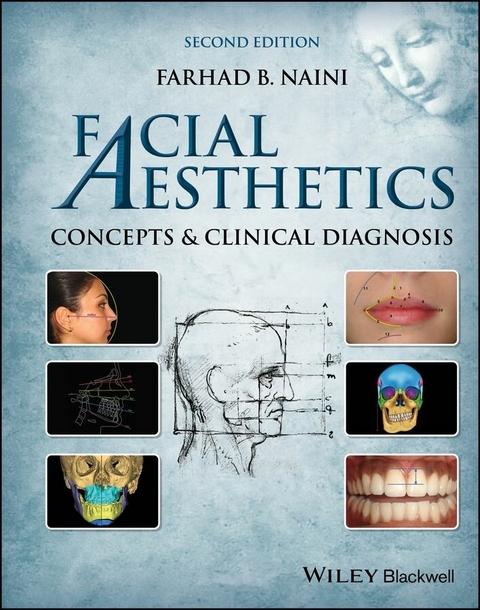
Facial Aesthetics (eBook)
1708 Seiten
Wiley-Blackwell (Verlag)
978-1-119-51075-8 (ISBN)
The definitive reference on facial aesthetic analysis and reconstructive surgery in dentistry
Facial Aesthetics: Concepts and Clinical Diagnosis is a unique resource for facial aesthetic surgery and dentistry. It incorporates all aspects relevant to the work of the clinician involved in the management of facial deformities, providing the comprehensive clinical guide on facial aesthetics. Structured over 24 easy-to-follow chapters, Part I of Facial Aesthetics covers the historical evidence and concepts for facial aesthetics, including philosophical and scientific theories on attractiveness, beauty, facial proportions, expression and the psychological implications of facial deformities. Part II provides the practical guidelines, including clinical evaluation and diagnosis, initial consultation interview, acquisition of diagnostic records, complete clinical examination, analysis of the craniofacial complex, and in-depth analysis of each individual facial region.
Revised and expanded, the second edition had extensive additions to many chapters as well as two new chapters on facial aging and ethnic variations in aesthetic analysis. Coupling research and practical clinical advice, numerous illustrations and diagrams are included throughout the text to elucidate key concepts and provide clinical context.
Written by a highly qualified practitioner and researcher in the field, Facial Aesthetics also provides:
- A refined understanding and appreciation of the human face
- Step-by-step aesthetic analysis of each facial region
- Detailed descriptions of the systematic clinical evaluation of the facial soft tissues and craniodentoskeletal complex
- In-depth analysis of 2D and 3D clinical diagnostic records
- Treatment planning from first principles
Facial Aesthetics is a comprehensive, practical reference and essential guide for facial aesthetic surgeons and aesthetic dentists, orthodontists, oral and maxillofacial surgeons, and plastic or reconstructive surgeons.
Farhad B. Naini is Consultant Orthodontist, Director of Research and Clinical Lead for Maxillofacial Surgery and Specialist Dentistry at Kingston Hospital NHS Foundation Trust, and Consultant Orthodontist in The Gillies Unit, Queen Mary's Hospital, King's College Hospital NHS Foundation Trust, London, UK. He is Honorary Professor at Kingston University London, UK.
The definitive reference on facial aesthetic analysis for aesthetic and reconstructive surgery and aesthetic dentistry Facial Aesthetics: Concepts and Clinical Diagnosis is a unique resource for facial aesthetic surgery and dentistry. Providing a comprehensive guide to both the art and science of facial aesthetics, the book incorporates all aspects relevant to the work of the clinician involved in the management of facial deformities. Revised and expanded with extensive additions, the second edition is structured over 24 easy-to-follow chapters with numerous illustrations and diagrams.Part I of Facial Aesthetics covers the historical evidence for facial aesthetics canons and concepts in depth. It incorporates all aspects relevant to the work of the clinician, including the philosophical and scientific theories of facial beauty, facial attractiveness research, facial proportions, facial expression, and the psychological ramifications of facial deformities. Part II of the book goes on to examine clinical evaluation and diagnosis in considerable detail under four sections, from the initial consultation interview and acquisition of diagnostic records, complete clinical examination and analysis of the craniofacial complex, in-depth analysis of each individual facial region, and the comprising craniodentoskeletal and soft tissue units and subunits, using a top-down approach, and finally focusing on smile and dentogingival aesthetic evaluation. Written by a highly qualified practitioner and researcher in the field, Facial Aesthetics also provides: Examination of facial aesthetics in a clinical context Step-by-step aesthetic analysis of each facial region Detailed descriptions of the systematic clinical evaluation of the facial soft tissues and craniodentoskeletal complex In-depth analysis of 2D and 3D clinical diagnostic records An evidence-based approach, from antiquity to contemporary scientific evidence, to the guidelines employed in planning the correction of facial deformities Treatment planning from first principles highlighted Facial Aesthetics is a comprehensive, practical reference and essential guide for practitioners with interest in refining their understanding and appreciation of the human face and applying practical protocols to their clinical diagnosis and treatment planning. It is essential reading for facial aesthetic surgeons and aesthetic dentists, orthodontists, oral and maxillofacial surgeons, as well as plastic and reconstructive surgeons.
Acknowledgements
I would like to thank the museums, libraries, archives and medical journals for permission to reproduce and redraw some of the figures in this book. Individual credits are provided in the respective figure legends throughout the book.
My special thanks are due to the Librarians and staff of the Royal Library for their kindness in allowing me to select the illustrations from the incomparable collection of Leonardo da Vinci's drawings in The Royal Collection at Windsor Castle, by Gracious Permission of His Majesty King Charles III.
I am particularly grateful to Martin Clayton, Head of Prints and Drawings at The Royal Collection Trust, and Carly Collier, Assistant Curator of Prints and Drawings at The Royal Collection Trust, for their time, expertise and kindness, and for allowing my wife, Hengameh, and me to delve through the Leonardo da Vinci archive in The Royal Collection. My sincere thanks also extend to my friend Professor Umberto Garagiola for arranging our visit to view the Leonardo da Vinci archive in the Biblioteca Ambrosiana in Milan.
I gratefully acknowledge the help of the following museums and libraries: Tate Gallery, London; National Gallery, London; British Museum, London; Natural History Museum, London; Ashmolean Museum, Oxford; British Library, London; Bodleian Library, Oxford; Stanza della Segnatura, Vatican City, Rome; Musei Vaticani, Vatican City, Rome; Pinacoteca Vaticana, Vatican City, Rome; Museo Nazionale Romano, Rome; Museo Archeologico Nazionale, Naples; Museo Nazionali di Capodimonte, Naples; Museo Archeologico Nazionale, Reggio di Calabria; Biblioteca Nazionale Braidense, Milan; Biblioteca Ambrosiana, Milan; Castello Sforzesco, Milan; Galleria degli Uffizi, Florence; Biblioteca Reale, Turin; Gallerie dell'Accademia, Venice; Gallerie dell'Accademia, Florence; Casa Buonarroti, Florence; Musée du Louvre, Paris; Archaeological Museum, Olympia; Archaeological Museum, Delphi; Acropolis Museum, Athens; National Archaeological Museum, Athens; Bayerische Staatsgemäldesammlungen, Munich; Sächsische Landesbibliothek, Dresden; Bibliothek zu Dresden, Dresden; Bibliothèque de l'Institut de France, Paris; Museum of Modern Art, New York; New Mexico Museum of Space History, New Mexico; Bertrand Russell Archives, McMaster University, Hamilton, Ontario; Succession Picasso/Design and Artists Copyright Society, London; Metropolitan Museum of Art, New York; New York Academy of Medicine, New York; National Gallery of Art, Washington; Egyptian Museum, Cairo; Czartoryski Museum, Kraków; Munch Museum, Munch–Ellingsen Group, Oslo.
My sincere thanks are due to the library staff of the Royal College of Surgeons of England and the Royal Society of Medicine for many acts of courtesy extending over a number of years, and to the staff of the British Library who went out of their way to obtain some very old and hard to find manuscripts. The expertise of library staff is too often unrecognized, and I offer them all my profound gratitude.
My sincere thanks to the editors and staff of the following medical journals for permission to redraw a number of figures used in this book: Plastic and Reconstructive Surgery (Wolters Kluwer Health); Annals of Surgery (Wolters Kluwer Health); Angle Orthodontist (E H Angle Education & Research Foundation., Inc.); American Journal of Physical Anthropology (John Wiley & Sons Ltd); American Journal of Orthodontics and Dentofacial Orthopedics (Elsevier); International Journal of Oral and Maxillofacial Surgery (Elsevier); Aesthetic Surgery Journal (Oxford University Press); Aesthetic Plastic Surgery (Springer Science + Business Media); The Journal of Prosthetic Dentistry (Elsevier); Acta Odontologica Scandinavica (Informa Healthcare, Taylor and Francis Group); Journal of the American Dental Association (American Dental Association); Archives of Facial Plastic Surgery (American Medical Association).
My earlier education was shaped by a number of remarkable teachers, notably Mr Christopher Town, Mr Terence Robinson and Dr Mark Innes. I owe the foundation of my undergraduate training to Professor Tim F Watson at Guy's Hospital – the superlative may be applied to him as a clinician, researcher and educator.
My interest in craniofacial anatomy and the developmental biology of the head and neck developed as an undergraduate student at Guy's Hospital, under the tutelage and guidance of Professors Martin Berry and Susan Standring – both truly inspirational teachers. I must also acknowledge the team at the Royal College of Surgeons of England, whose teaching of surgical anatomy is unique and memorable.
Warm thanks are due to the staff of those institutions in which I have pursued my clinical and academic training over a number of years. In chronological order, the United Medical and Dental Schools of Guy's and St Thomas' Hospitals, Manchester Dental Hospital, the Norman Rowe Maxillofacial Unit (Queen Mary's University Hospital, Roehampton), West Middlesex University Hospital, the Royal London Hospital and the Central Middlesex Hospital, Kingston Hospital and the Eastman Dental Hospital (University College London) and King's College London.
I must express my deep gratitude to my teachers during higher training, particularly the late Professor James ‘Jim’ Moss, and many others. I must make special mention of the late Mr Raymond Edler, Consultant Orthodontist, whose unsurpassed clinical ability, pursuit of academic and educational excellence and care for patients with dentofacial and craniofacial deformities was second to none – a true gentleman whose example taught me the value of a great teacher. As a young House Surgeon, it was on the joint orthognathic surgery clinics between Ray Edler and Peter Blenkinsopp (consultant maxillofacial surgeon and Head of the former Norman Rowe Maxillofacial Unit, now retired), that my interest in orthognathic surgery began.
The reputation of a clinical department depends on the devotion of many people, too numerous to mention individually. I would like to take this opportunity of thanking my orthodontic consultant colleagues and consultant maxillofacial surgeons Mehmet Manisali, Helen Witherow and Ashraf Messiha, remarkably gifted surgeons and dear friends with whom it is a great pleasure to work. Warm thanks also to our nurses for their tireless effort, orthodontic and maxillofacial technologists and all other members of the team. Collective thanks to successive generations of my senior registrars, registrars, house surgeons, clinical and academic postgraduate students and clinical fellows, of whose achievements I am immensely proud. Special thanks are due to all my patients for permission to use their photographs in this book.
My sincere thanks to Katharine A Phillips, MD, Professor of Psychiatry, DeWitt Wallace Senior Scholar, and Residency Research Director in the Department of Psychiatry of Weill Cornell Medical College, and Attending Psychiatrist at the New York‐Presbyterian/Weill Cornell Medical Center. Professor Phillips is the internationally renowned authority on body dysmorphic disorder; her research has been ongoing for over three decades, and I am grateful for her expertise and advice.
My thanks also to Ronald Hübner, Professor of Psychology, University of Konstanz, Baden‐Württemberg, Germany, for sharing his expertise on the works of Hogarth and Fechner in relation to his interesting ongoing research.
Special thanks to Val Lambros, Professor of Plastic Surgery in California (retired), for many discussions and for sharing his wisdom and wide knowledge of facial ageing, which is invaluable.
My sincere thanks to Professor Martin Kemp, Emeritus Professor in the History of Art at the University of Oxford and the internationally recognized authority on Leonardo da Vinci, for his valuable advice; to Professor Paul Ekman, a pioneer in the study of emotions and their relation to facial expressions, for providing a number of the figures for Chapter 3; to Dr Jacques Treil, radiologist, Laboratoire d'Anthropobiologie, Département d'Imagerie Médicale in Toulouse, for providing Figure 10.37; and to Drs Joseph Daniel, Alistair Cobb, Mladen Otasevic, Peta Smith and Souphiyeh Samizadeh. My sincere thanks extend to the late Professor Leslie Farkas and, in particular, to Mrs Susanna Farkas for her help and kindness.
Special thanks are due to my friend and colleague Dr Daljit S Gill (Consultant Orthodontist, Great Ormond Street Hospital, London, and Consultant Orthodontist/Honorary Senior Lecturer, Eastman Dental Hospital/University College London) – for his contribution to Chapters 23 and 24 and the many helpful suggestions throughout the writing of this book.
I am grateful to the team at Wiley‐Blackwell for their dedication, professionalism and enthusiasm for this book.
My last and most important expressions of gratitude must go to my parents, Nasrin and Bahram Baghaie Naini, and my brother, Jamshid, for instilling in me the unbiased search for truth as the basis for education – their example, sacrifices and encouragement remain my greatest source of inspiration; and to my wife Hengameh, for invaluable advice that comes from a keen artistic intellect and aesthetic insight, and for the kindest heart combined with an exceptionally analytical mind, capable of lateral thinking the likes of which I have never encountered. I managed to reach conclusions for some of the more complex issues discussed in this book after long and thought‐provoking discussions with her. Hengameh also created the illustrations, which form so essential a feature of this book. I cannot...
| Erscheint lt. Verlag | 14.1.2025 |
|---|---|
| Sprache | englisch |
| Themenwelt | Medizin / Pharmazie ► Allgemeines / Lexika |
| Medizin / Pharmazie ► Zahnmedizin | |
| Schlagworte | Dental Occlusion • facial aesthetic surgery • facial deformities treatment • facial deformity correction • facial dentistry • Facial Proportions • Hengameh Naini • lip aesthetics • Malocclusion • oral function • Smile aesthetics • tooth inclination |
| ISBN-10 | 1-119-51075-9 / 1119510759 |
| ISBN-13 | 978-1-119-51075-8 / 9781119510758 |
| Informationen gemäß Produktsicherheitsverordnung (GPSR) | |
| Haben Sie eine Frage zum Produkt? |
 EPUB (Adobe DRM)
Kopierschutz: Adobe-DRM
Adobe-DRM ist ein Kopierschutz, der das eBook vor Mißbrauch schützen soll. Dabei wird das eBook bereits beim Download auf Ihre persönliche Adobe-ID autorisiert. Lesen können Sie das eBook dann nur auf den Geräten, welche ebenfalls auf Ihre Adobe-ID registriert sind.
Details zum Adobe-DRM
Dateiformat: EPUB (Electronic Publication)
EPUB ist ein offener Standard für eBooks und eignet sich besonders zur Darstellung von Belletristik und Sachbüchern. Der Fließtext wird dynamisch an die Display- und Schriftgröße angepasst. Auch für mobile Lesegeräte ist EPUB daher gut geeignet.
Systemvoraussetzungen:
PC/Mac: Mit einem PC oder Mac können Sie dieses eBook lesen. Sie benötigen eine
eReader: Dieses eBook kann mit (fast) allen eBook-Readern gelesen werden. Mit dem amazon-Kindle ist es aber nicht kompatibel.
Smartphone/Tablet: Egal ob Apple oder Android, dieses eBook können Sie lesen. Sie benötigen eine
Geräteliste und zusätzliche Hinweise
Buying eBooks from abroad
For tax law reasons we can sell eBooks just within Germany and Switzerland. Regrettably we cannot fulfill eBook-orders from other countries.
aus dem Bereich