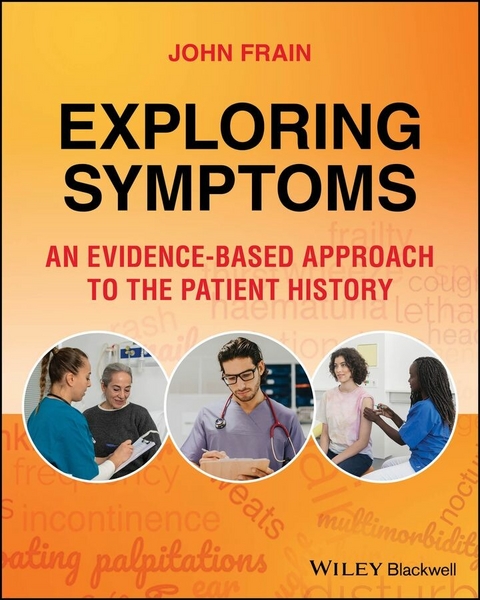
Exploring Symptoms (eBook)
906 Seiten
Wiley-Blackwell (Verlag)
978-1-394-21883-7 (ISBN)
Understand the relationship between disease and description with this invaluable guide
Correctly interpreting patient symptoms is one of the most critical components of medical diagnosis and treatment. Though each instance of any given disease will share features with others, each patient's experience is unique, and assessment of their condition depends on taking and interpreting an individual patient's history. Correct diagnosis and treatment decisions rely on a sound, evidence-based approach to this crucial clinical interaction.
Exploring Symptoms - An Evidence-based Approach to the Patient History offers a rigorous analysis of the complex relationship between symptoms and patient communication. Carefully connecting basic sciences such as anatomy and physiology with the development of symptoms in each body system, this book surveys evidence for how patients tend to experience and describe symptoms and how these descriptions can shape diagnosis and treatment. It's a must-have volume for students and clinicians looking to concretely improve patient outcomes.
Exploring Symptoms - An Evidence-based Approach to the Patient History readers will also find:
- Detailed discussion of patient thresholds for presenting symptoms to healthcare professionals
- Analysis of individual symptom epidemiology and its general expression at both the patient and population level
- An inclusive approach with concrete advice for addressing the needs of a diverse patient body
Exploring Symptoms - An Evidence-based Approach to the Patient History is ideal for undergraduate and postgraduate students, as well as healthcare educators and postgraduate-allied health professionals. It is also a useful tool for early-years practitioners and general practitioners.
Dr. John Frain is Clinical Associate Professor and GEM Director of Clinical Skills at the University of Nottingham, UK.
Understand the relationship between disease and description with this invaluable guide Correctly interpreting patient symptoms is one of the most critical components of medical diagnosis and treatment. Though each instance of any given disease will share features with others, each patient s experience is unique, and assessment of their condition depends on taking and interpreting an individual patient s history. Correct diagnosis and treatment decisions rely on a sound, evidence-based approach to this crucial clinical interaction. Exploring Symptoms - An Evidence-based Approach to the Patient History offers a rigorous analysis of the complex relationship between symptoms and patient communication. Carefully connecting basic sciences such as anatomy and physiology with the development of symptoms in each body system, this book surveys evidence for how patients tend to experience and describe symptoms and how these descriptions can shape diagnosis and treatment. It s a must-have volume for students and clinicians looking to concretely improve patient outcomes. Exploring Symptoms - An Evidence-based Approach to the Patient History readers will also find: Detailed discussion of patient thresholds for presenting symptoms to healthcare professionals Analysis of individual symptom epidemiology and its general expression at both the patient and population level An inclusive approach with concrete advice for addressing the needs of a diverse patient body Exploring Symptoms - An Evidence-based Approach to the Patient History is ideal for undergraduate and postgraduate students, as well as healthcare educators and postgraduate-allied health professionals. It is also a useful tool for early-years practitioners and general practitioners.
1
Exploring Symptoms
KEY POINTS
- ‘80% of diagnoses are made on the basis of the history’
- Physical examination and choice of investigations are directed by the history
- A good medical history requires effective communication
- History‐taking can be affected by cognitive bias
- Listening to the patient is crucial
- Accurate diagnosis depends on inclusive history‐taking
1.1 This History of the History
Interviewing the patient has always been essential in diagnosing illnesses and managing their health conditions. We know little about the structure of the consultation prior to the nineteenth century. However, listening was a virtue associated with the competent doctor [1]. The patient's description of their symptoms enabled the doctor to make a diagnosis. Good listening skills were essential to the doctor's employment, as only wealthier patients were able to pay for the services of a doctor [1].
1.1.1 What We Know Now
Medical students are told ‘80% of diagnoses are made from the history’. Where does this come from? A study by Hampton in 1975 at Queen's Medical Centre, Nottingham, UK examined 80 outpatient referral letters and compared the initial diagnosis in the letter with the final diagnosis following investigation [2]. The initial diagnosis based on the history alone was correct for 82.5% of patients. Examination clarified the diagnosis for a further 8.75% (7/80 patients) and investigation another 8.75% (7/80). Clearly, the choice of examination and investigation is also influenced by the patient's history. In six patients (7.5%), the history and examination could not make a diagnosis. However, investigation led to a confirmed diagnosis in only one of these patients. The authors concluded ‘more emphasis must be placed on teaching students accurate history‐taking’ and ‘more emphasis must be placed on research into communication between patient and physician’ [2].
Surprisingly, and sadly in the era of evidence‐based medicine, the diagnostic accuracy of the history is under‐researched. Hampton's sample was small, and the method used does not meet modern standards for a diagnostic accuracy study [3]. Medicine has changed greatly since 1975 with the availability of more accurate imaging modalities, blood tests and other investigations. One might expect the history to have declined relatively in importance to other diagnostic methods.
Nonetheless, the available evidence is, despite advances in other diagnostic technologies, around 80% of diagnoses continue to be on the patient's history [4–6]. Furthermore, more recent studies suggest nuance for accuracy of the history exists between different specialities, types of clinical problems, levels of clinical experience and acute versus chronically ill patients [7–9]. Again, sample sizes are small and methodology could be improved. However, the maxim of 80% of diagnoses being made by the history remains correct.
Clear communication with patients, clinician understanding of patient's description of their symptoms, accurate diagnosis and patient understanding requires a more detailed and nuanced understanding of how the history works. The history may indeed be ‘our greatest diagnostic technology’ [10]. It is certainly likely to be our most cost‐effective healthcare technology. Like any technology, it can be used well or badly. We need to better understand how it works and how to harness its potential for the benefit of patients.
1.1.2 What the History Is Not
Understanding the patient's history and making a diagnosis requires the clinician to interpret the patient's description of their symptoms in the light of the clinician's own knowledge of anatomy, physiology and the pathophysiology of how symptoms arise, develop and why patients present them to a clinician. Inattention to primary data (symptoms) from the history and failure to develop working hypotheses based on these has been described as ‘clinical hypocompetence’ [11].
It is important for clinicians, teachers and students to understand this. As Faith Fitzgerald has commented:
The word ‘history’ has changed over the years to include less and less of the story of the symptoms and the story of the patient, and more and more of the story of the patient's previous medical investigations [12].
The following contains no information about the origins, risk factors, development, patient's perspective or treatment of patient's symptoms:
Mr X went to see his GP because he had chest pain. The GP did some blood tests, an electrocardiogram (ECG) and sent him for a chest x‐ray. These were all normal, so the GP referred him for an exercise test, and he is now waiting to see the consultant to find out about his diagnosis
Effective history‐taking, including its presentation in verbal or written form (see Chapter 15), shows evidence of comprehensive data gathering, data synthesis and a differential diagnosis with explicit reasoning to justify the diagnosis given (Box 1.1).
The first history tells us nothing about the patient's experience of their symptoms but is just a list of events and investigations. It is the second version of this patient's history that connects the patient's description of their experience of chest pain with the clinician's, and the reader's, knowledge of the pathophysiology of coronary heart disease. An understanding of the epidemiology of coronary heart disease in a patient of this age, these risk factors and this description of pain has an 80–95% pretest probability of having this condition [13] (see Chapter 4).
1.1.3 Patient‐Centred History‐Taking
The post‐World War II era has seen further development of the Enlightenment's understanding of the person, autonomy and human rights. Individuals, communities and nations expect to determine their own lives. Article 25 of the Universal Declaration of Human Rights stipulates the right of all to a standard of living adequate for themselves and their families including medical care [14]. Healthcare is now not only ‘what is the matter with the patient?’ but also ‘what matters to the patient?’ [15].
Our ideal now is patient‐centred care based on the belief that each patient ‘has to be understood as a unique human being’ [16]. This is scientifically rational, for while patients with, for example, coronary heart disease all have the same condition, they do not all have the same threshold for presentation to a clinician, give the same identical history, describe their symptoms the same way or have the same concerns about their meaning nor do they always fit the textbook or lecturer's description of how they should do so. This is easily appreciated by listening to online resources such as http://Healthtalk.org where one can follow several patients with the same condition from initial symptoms through to treatment and living with their condition [17].
Box 1.1 The Patient with Chest Pain
Mr Heaney is a 58‐year‐old man who smokes and is diabetic. He presented to his GP with a two‐week history of central chest pain brought on by exertion. The pain is dull and heavy in character. He says it radiates down his left arm. The pain is relieved by stopping and resting. It usually stops within 2–3 minutes though now it is lasting longer, maybe up to five minutes. It is also relieved by a glyceryl trinitrate (GTN) spray, prescribed for him by his GP. Mr Heaney has been doing some heavy work in his garden over the past three weeks as he is relaying a patio. He is worried this may be a heart problem as his father developed angina at a similar age and died of a heart attack at 66 years of age.
Mr Heaney's problems are pain which is brought on by exertion. It causes him to stop until the rest allows it to settle. The pain radiates and is getting worse. He has a family history of ischaemic heart disease.
Based on his description of the character and distribution of the pain, I think Mr Heaney has typical angina which is possibly worsening. He has risk factors for cardiovascular disease of smoking, diabetes and has now been found to be mildly hypertensive today which give him an increased pretest probability for coronary heart disease. My other diagnoses would be musculoskeletal chest pain due to the heavy work in his garden or physical deconditioning.
A frequent comment from students taking their first histories is ‘but I don't know what questions to ask…’. This arises from the assumption that history‐taking requires simply administering a preset list of questions for the patient's condition and it will generate the correct diagnosis. As of 2024, there are more than 10 000 known diseases [18]. It is a misconception that history‐taking could ever require simply asking the right questions for the condition. If you don’t know the diagnosis at the outset, how would you know which set of questions to ask? If diagnoses were simply a case of asking the right...
| Erscheint lt. Verlag | 13.1.2025 |
|---|---|
| Sprache | englisch |
| Themenwelt | Medizin / Pharmazie ► Allgemeines / Lexika |
| Medizin / Pharmazie ► Medizinische Fachgebiete | |
| Medizin / Pharmazie ► Studium | |
| Schlagworte | anatomy • Clinical Assessment • Clinical Reasoning • Diagnostic accuracy • diagnostic medicine • diagnostic technology • epidemiology • inclusive medicine • Medical Communication • patient presentation • Patient Relations • Physiology |
| ISBN-10 | 1-394-21883-4 / 1394218834 |
| ISBN-13 | 978-1-394-21883-7 / 9781394218837 |
| Informationen gemäß Produktsicherheitsverordnung (GPSR) | |
| Haben Sie eine Frage zum Produkt? |
 EPUB (Adobe DRM)
Kopierschutz: Adobe-DRM
Adobe-DRM ist ein Kopierschutz, der das eBook vor Mißbrauch schützen soll. Dabei wird das eBook bereits beim Download auf Ihre persönliche Adobe-ID autorisiert. Lesen können Sie das eBook dann nur auf den Geräten, welche ebenfalls auf Ihre Adobe-ID registriert sind.
Details zum Adobe-DRM
Dateiformat: EPUB (Electronic Publication)
EPUB ist ein offener Standard für eBooks und eignet sich besonders zur Darstellung von Belletristik und Sachbüchern. Der Fließtext wird dynamisch an die Display- und Schriftgröße angepasst. Auch für mobile Lesegeräte ist EPUB daher gut geeignet.
Systemvoraussetzungen:
PC/Mac: Mit einem PC oder Mac können Sie dieses eBook lesen. Sie benötigen eine
eReader: Dieses eBook kann mit (fast) allen eBook-Readern gelesen werden. Mit dem amazon-Kindle ist es aber nicht kompatibel.
Smartphone/Tablet: Egal ob Apple oder Android, dieses eBook können Sie lesen. Sie benötigen eine
Geräteliste und zusätzliche Hinweise
Buying eBooks from abroad
For tax law reasons we can sell eBooks just within Germany and Switzerland. Regrettably we cannot fulfill eBook-orders from other countries.
aus dem Bereich