


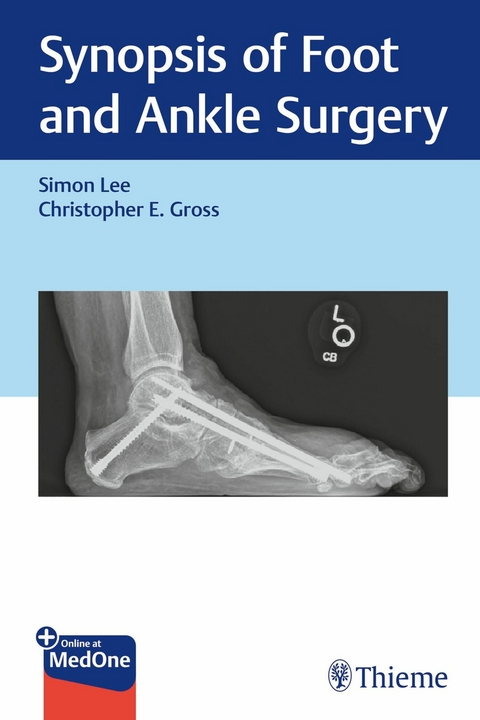
Synopsis of Foot and Ankle Surgery (eBook)
967 Seiten
Thieme Medical Publishers (Verlag)
978-1-63853-494-5 (ISBN)
An expert, concise guide on the pathophysiology and treatment of foot and ankle disordersFoot and ankle problems can be quite complex and constitute a large percentage of orthopaedic conditions, including congenital and acquired deformities, arthritis, tumors, heel pain, nerve damage, trauma, and more. Synopsis of Foot and Ankle Surgery, edited by renowned foot and ankle surgeons and educators Simon Lee and Christopher E. Gross, is an easy-to-read resource covering a wide range of foot and ankle fundamentals. The book fills a gap in the literature, and in particular orthopaedic resources, by providing a reader-friendly handbook for medical students and junior residents who need quick and reliable clinical information at their fingertips.This textbook serves as a primer for beginners as well as a resource for more established clinicians to expand current understanding and knowledge of foot and ankle pathologies and techniques. The opening five chapters lay an essential groundwork, covering anatomy, an overview of surgical approaches, biomechanics, imaging basics, and medical history and physical examination. Common and less prevalent conditions are addressed in the 18 subsequent chapters, while the final two chapters discuss orthotics and prosthetics and orthobiologics, respectively.Key FeaturesContributions from world-renowned experts in their respective fieldsA succinct resource detailing the clinical intricacies and challenges inherent to foot and ankle surgeryPearls and concepts to enhance learning, knowledge, clinical rotations, and careersHigh-quality illustrations and surgical photographs enrich understanding of underlying anatomy and techniquesThis indispensable resource will help medical students, orthopaedic and podiatric residents, nurses, and physician assistants to expand knowledge on foot and ankle anatomy and improve management of a comprehensive range of conditions.
1 Foot and Ankle Anatomy
Jie Chen, Natalie R. Black, Randal Morris, and Vinod K. Panchbhavi
Abstract
The foot and ankle comprise one of the most functionally important structures in the human body. Key to understanding the complex pathology and debilitating conditions is a solid foundation in foot and ankle anatomy. Containing 26 bones, 30 joints, and more than 100 tendons, ligaments, and muscles, the foot is intricate in design. The ankle is a constrained joint whose stability is afforded by a complex interplay between various ligaments, and our understanding of this interplay continues to evolve. This chapter outlines the unique anatomy of this fascinating region, emphasizes high-yield facts, and provides common test questions.
1.1 Ankle
1.1.1 Arthrology
1.1.1.1 Distal Tibiofibular Joint (Syndesmosis)
-
Articulation between the convex medial side of distal fibula and the concave lateral aspect of distal tibia ( ▶ Fig. 1.1). ▶ [1]
Fig. 1.1 Ankle osteology.
-
Allows for small degree of external rotation and proximal to distal translation of the fibula against the tibia.
-
Serves to keep the ankle mortise intact by maintaining the spatial relationship of the distal tibia and the distal fibula.
-
Borders of the ankle mortise includes the tibial plafond superiorly, medial malleolus medially, and the lateral malleolus laterally.
-
Stabilized by syndesmotic ligaments (see below). See Figure 1.2
1.1.1.2 Ankle Joint
-
Hinge-type joint between the distal tibia, distal fibula, and talus.
-
Primarily acts in plantar and dorsiflexion, but also components of internal and external rotation.
-
-
Normal range of motion (ROM) is around 20 degrees dorsiflexion and 50 degrees plantar flexion.
-
The talar dome has a biconcave surface with a central sulcus.
-
The talus is wider anteriorly than posteriorly, leading to increased instability in plantar flexion.
-
Ankle chondrocytes are uniformly horizontally aligned and stiff, have decreased permeability, are less responsive to catabolic mediators, and synthesize proteoglycans at a greater rate, which leads to increased repair capacity. Thus, there is a lower incidence of primary ankle degenerative joint disease (DJD) compared to the knee and hip.
-
Medial and lateral stability is provided by the robust deltoid ligament and strong lateral ligaments including the anterior talofibular ligament and calcaneofibular ligament.
-
1.1.2 Ligaments
1.1.2.1 Syndesmosis
-
Four syndesmotic ligaments ( ▶ Fig. 1.2) ▶ [2], ▶ [3]:
Fig. 1.2 Ankle syndesmosis.
-
Injury here indicates “high ankle sprain.
-
Anterior inferior tibiofibular ligament (AITFL).
-
Origin: tibial anterolateral tubercle.
-
Insertion: fibular anterior tubercle.
-
Weakest syndesmotic ligament.
-
-
Posteroinferior tibiofibular ligament (PITFL).
-
Origin: tibial posterior tubercle.
-
Insertion: posterior lateral malleolus.
-
Strongest syndesmotic ligament.
-
-
Interosseous ligament (IOL).
-
Inferior transverse ligament (ITL).
-
1.1.2.2 Lateral Ligaments
-
Anterior talofibular ligament ( ▶ Fig. 1.3):
Fig. 1.3 Ankle lateral ligaments.
-
Attaches the anterior distal fibula to the talar neck.
-
Resists inversion in plantar flexion.
-
Most commonly injured in “low ankle sprains.”
-
-
Calcaneofibular ligament:
-
Attaches the distal fibula to the calcaneus, crossing the subtalar joint.
-
Runs deep to the peroneal tendons.
-
Resists inversion in neutral or dorsiflexion.
-
Second most commonly injured in low ankle sprains.
-
-
Posterior talofibular ligament:
-
Attaches the posterolateral distal fibula to the posterolateral talus.
-
Strongest lateral ligament.
-
Rarely torn.
-
-
Lateral talocalcaneal ligament:
-
Attaches the talar lateral process to the lateral calcaneus.
-
1.1.2.3 Medial Ligaments
-
Thickest and strongest ligaments in the ankle ( ▶ Fig. 1.4).
Fig. 1.4 Medial ankle ligaments.
-
Superficial deltoid:
-
Four parts: anterior tibiotalar, tibionavicular, tibiocalcaneal, and posterior tibiotalar.
-
Origin on the anterior colliculus of the medial malleolus.
-
Resists ankle eversion.
-
-
Deep deltoid:
-
Origin on the posterior colliculus of the medial malleolus.
-
Resists external rotation and lateral translation.
-
Stronger than the superficial deltoid.
-
-
Spring ligament.
-
Calcaneonavicular ligament.
-
Connects the sustentaculum tali of the calcaneus to the plantar navicular.
-
Plays important role in maintaining the medial longitudinal arch by acting as a sling to support the talar head.
-
1.2 Hindfoot
1.2.1 Osteology
1.2.1.1 Talus
-
Around 60% covered with articular cartilage ( ▶ Fig. 1.1). ▶ [4]
-
No tendinous attachments.
-
Divided into the talar head, neck, body, and posterior and lateral processes.
-
Blood supply is through three main arteries: posterior tibial artery, dorsalis pedis artery, and perforating peroneal artery.
-
Dominant blood supply to the body is through the artery of the tarsal canal, a branch of the posterior tibial artery.
-
Retrograde blood flow from the neck places the body at risk of avascular necrosis with talar neck fractures.
-
-
The lateral process is at risk of fracture in snowboarders.
-
Attachment site of the lateral talocalcaneal ligament.
...
-
| Erscheint lt. Verlag | 12.2.2025 |
|---|---|
| Sprache | englisch |
| Themenwelt | Medizin / Pharmazie ► Gesundheitsfachberufe ► Kosmetik / Podologie |
| Medizinische Fachgebiete ► Chirurgie ► Unfallchirurgie / Orthopädie | |
| Medizin / Pharmazie ► Medizinische Fachgebiete ► Orthopädie | |
| Schlagworte | foot and ankle • orthopaedic resident • Pathology • Podiatry • Primer • surgeon |
| ISBN-10 | 1-63853-494-2 / 1638534942 |
| ISBN-13 | 978-1-63853-494-5 / 9781638534945 |
| Informationen gemäß Produktsicherheitsverordnung (GPSR) | |
| Haben Sie eine Frage zum Produkt? |
 EPUB (Wasserzeichen)
DRM: Digitales Wasserzeichen
Dieses eBook enthält ein digitales Wasserzeichen und ist damit für Sie personalisiert. Bei einer missbräuchlichen Weitergabe des eBooks an Dritte ist eine Rückverfolgung an die Quelle möglich.
Dateiformat: EPUB (Electronic Publication)
EPUB ist ein offener Standard für eBooks und eignet sich besonders zur Darstellung von Belletristik und Sachbüchern. Der Fließtext wird dynamisch an die Display- und Schriftgröße angepasst. Auch für mobile Lesegeräte ist EPUB daher gut geeignet.
Systemvoraussetzungen:
PC/Mac: Mit einem PC oder Mac können Sie dieses eBook lesen. Sie benötigen dafür die kostenlose Software Adobe Digital Editions.
eReader: Dieses eBook kann mit (fast) allen eBook-Readern gelesen werden. Mit dem amazon-Kindle ist es aber nicht kompatibel.
Smartphone/Tablet: Egal ob Apple oder Android, dieses eBook können Sie lesen. Sie benötigen dafür eine kostenlose App.
Geräteliste und zusätzliche Hinweise
Buying eBooks from abroad
For tax law reasons we can sell eBooks just within Germany and Switzerland. Regrettably we cannot fulfill eBook-orders from other countries.
aus dem Bereich


