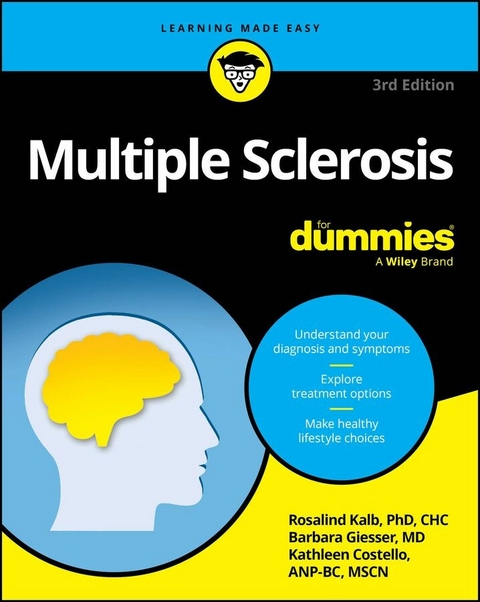
Multiple Sclerosis For Dummies (eBook)
549 Seiten
For Dummies (Verlag)
978-1-394-30093-8 (ISBN)
Everyone's MS is different-learn the best way to manage yours
Multiple sclerosis (MS) is a chronic, unpredictable autoimmune disease that affects millions of people worldwide. It poses unique challenges for people with MS and their care partners because the symptoms (many of which are invisible to others) are so variable from day to day and month to month. Multiple Sclerosis For Dummies helps you and your loved ones understand the importance of early treatment and become familiar with all of the latest treatment options and therapies. You aren't alone-this compassionate guide includes resources for connecting with the right MS care provider, building a care team, managing your emotions and stress, and getting the support you need. Plus, you'll get tips for making lifestyle choices that help you along your MS path.
- Discover information on the latest diagnostic information, treatments, and symptom management strategies
- Learn why it's so important to take care of your mental health and emotional wellbeing as you treat your MS
- Get pointers for talking to MS care providers and your loved ones, advocating for yourself, and making decisions alongside your care team
- Find trustworthy books, websites, and community resources to expand your knowledge and improve your health
Multiple Sclerosis For Dummies is a great starting point for anyone facing a new MS diagnosis or looking for updated information. Partners and family members will also learn how to care for themselves while caring for the person they love.
Rosalind Kalb, PhD, CHC, is a clinical psychologist and lead senior programs consultant at Can Do MS, a health and wellness organization for those affected by MS.
Barbara Giesser, MD, is a neurologist and director of the MS Comprehensive Care Clinic at the Pacific Neuroscience Institute.
Kathleen Costello, ANP-BC, MSCN, is chief operating officer at Can Do MS.
Everyone's MS is different learn the best way to manage yours Multiple sclerosis (MS) is a chronic, unpredictable autoimmune disease that affects millions of people worldwide. It poses unique challenges for people with MS and their care partners because the symptoms (many of which are invisible to others) are so variable from day to day and month to month. Multiple Sclerosis For Dummies helps you and your loved ones understand the importance of early treatment and become familiar with all of the latest treatment options and therapies. You aren't alone this compassionate guide includes resources for connecting with the right MS care provider, building a care team, managing your emotions and stress, and getting the support you need. Plus, you'll get tips for making lifestyle choices that help you along your MS path. Discover information on the latest diagnostic information, treatments, and symptom management strategies Learn why it's so important to take care of your mental health and emotional wellbeing as you treat your MS Get pointers for talking to MS care providers and your loved ones, advocating for yourself, and making decisions alongside your care team Find trustworthy books, websites, and community resources to expand your knowledge and improve your health Multiple Sclerosis For Dummies is a great starting point for anyone facing a new MS diagnosis or looking for updated information. Partners and family members will also learn how to care for themselves while caring for the person they love.
Chapter 1
Meeting MS Face to Face
IN THIS CHAPTER
Exploring how MS affects your brain
Determining what triggers MS
Recognizing the uniqueness of your MS
Taking a peek at the available MS treatments
Understanding the impact of MS on your family and work life
Gearing up to keep your life on track
Because you’ve picked up this book, we’re assuming that your doctor has delivered the news that you have multiple sclerosis (MS). Or, perhaps they said that you may have this disease, or that you probably have this disease (which makes you wonder why you can’t get a clear answer). Whether you got the news yesterday or several months ago, you’re probably trying to figure out what it means for you, for your future, and for your family. In other words, you have about a zillion questions about what’s in store.
Chances are, the answers you’ve received so far haven’t been all that satisfying — mostly because MS still can’t be cured, no one knows what causes it, and no doctor can predict with any certainty how your MS is going to behave in the future. However, the good news is that the treatment options are expanding, and people with MS are busy getting on with their lives — and there is every chance that you will too.
In this chapter, which is an introduction to MS and an overview of what we cover in the rest of the book, we fill you in on the available MS info — including what scientists have been able to discover about the workings of this disease and what questions remain to be answered. We explain why your MS is different from everyone else’s, and we introduce you to the treatment strategies that can help you manage your MS. Finally, we glance at the ways that MS can affect life at home and at work, and we show you what you can do to ensure the best possible quality of life for you and the people you love.
Introducing the Roles of Your Immune and Nervous Systems in MS
Surprise! Even though MS is described as the most common neurologic disorder diagnosed in young adults, the problem doesn’t appear to originate with the nervous system. Instead, decades of research have pointed to the body’s immune system as the culprit. Some kind of malfunction in the immune system interferes with the functioning of the body’s nervous system, resulting in the symptoms commonly associated with MS. The current thinking is that the glitch is an autoimmune problem, which basically means that your body is mistakenly attacking and damaging some of its own healthy tissues and cells. We explain the autoimmune process in the section “What happens in MS” later in the chapter, but for now, understanding how the immune system is supposed to work when it’s healthy is important.
The immune system: Your body’s frontline defender
The immune system — which is a complex network of proteins, tissues, and circulating cells — is your body’s frontline defense in the fight against infection by viruses, bacteria, and other bad guys. When confronted with an infection, the immune system gears up to neutralize the foreign invader and make you healthy again.
In order for your immune system to do its job properly, it has to be able to distinguish between the good guys (the cells, tissues, and organs that make up your body) and the bad guys (any foreign invader, such as a virus or bacteria that doesn’t share your genes). And get this: If the hormones of pregnancy didn’t suppress it, a pregnant woman’s immune system is so powerful that it could reject the developing fetus (which shares only some of her genes). (Check out Chapter 16 to read more about how pregnancy hormones appear to affect MS.)
The nervous system: Your body’s CEO
The nervous system, which controls almost all bodily functions, is made up of neurons, each of which consists of a cell body and its long extension — the axon. And many axons are covered by a protective or insulating coating called myelin. The neurons are gathered into small- and large-sized bundles called nerves.
The system is basically divided into three parts: The central nervous system (CNS), which consists of the brain, spinal cord, and optic nerves, is the target of the immune system damage done in MS. The peripheral nervous system (PNS) includes the branching network of nerves and axons that connects the CNS to muscles, sensory organs, and glands in the rest of the body. The autonomic nervous system (ANS) controls vital functions such as heartbeat, digestion, and breathing automatically (so we don’t have to remember to breathe!).
MS is essentially a disease of the CNS.
The nervous system conducts electrical signals throughout the body to communicate these basic functions:
- Motor signals: These signals, which move from the CNS through the PNS to muscles and other organs, control movement, strength, and other bodily functions.
- Sensory signals: These signals go back to the CNS from the eyes, ears, skin, and other sensory organs, and they provide information about the environment from those organs.
- Integrative signals: These signals travel from nerve cell to nerve cell within the nervous system and are thought to be responsible for many cognitive functions, such as learning, thinking, and memory (check out Chapter 9 for information about cognitive changes in MS).
These electrical signals are like the current in an electrical wire: When everything is working fine, they travel long distances along the myelin-covered axons in the CNS, jumping from one axon to another as needed. The myelin (like the insulation around an electrical wire) is what helps speed the electrical signals on their journey and smooths out any bumps along the way.
What happens in MS
After you understand the role of the immune system and the nervous system, you can begin to understand how MS affects them. In autoimmune diseases like MS (and rheumatoid arthritis, Crohn’s disease, lupus erythematosus, and Type I diabetes, among others), the immune system loses the ability to distinguish the good guys from the bad guys, and so it starts attacking the normal tissues in the body. In MS, this autoimmune response targets the myelin coating around the axons in the CNS, the axons themselves, and the cells that produce the myelin — called oligodendrocytes.
The autoimmune attack happens in part because of a breakdown in the blood brain barrier (BBB) — the specialized blood vessels that protect the brain from invaders. The breakdown in the BBB allows immune cells that have been living harmlessly in your blood to travel into your CNS to attack the myelin and axons, which results in the symptoms associated with MS. The autoimmune process in MS follows these steps (see Figure 1-1):
- The inflammation that occurs during an MS relapse (also called an attack or exacerbation) damages the BBB, allowing the movement of immune cells into the CNS. (Skip to Chapter 6 for more info about MS relapses.)
- Toxic substances are released into the CNS, which can increase inflammation and result in the breakdown of myelin (in a process called demyelination) and the axons, sometimes even affecting the nerve cell bodies.
- Nervous system cells called astrocytes move into the locations where the damage has occurred, and they form scar tissue (giving rise to the name multiple sclerosis, which means multiple scars).
FIGURE 1-1: A view of the inflammation and demyelination process.
In addition to this acute process, it is now known that the immune system sets up shop inside the central nervous system and provokes a slower, more insidious type of damage — an underlying worsening that continues over a person’s lifetime with MS. Many MS specialists refer to this worsening as a smoldering process. This means that the underlying damage inside the CNS and the inflammatory process that starts outside the CNS are both occurring with varying degrees of severity in every person with MS.
The results of this autoimmune process aren’t all that pretty: The inflammation can cause swelling, which interferes with the conduction of signals in the nervous system. The demyelination results in a loss of insulating myelin around the neurons’ axons, which slows or interrupts nervous system conduction. The autoimmune process also causes axonal damage (transection) or axonal loss, which breaks the connections between the nervous system and parts of the body. (Figure 1-2 shows the steps involved in demyelination and axonal loss.) And finally, the smoldering process includes activation of microglia and other cells in the CNS that contribute to MS damage and progression.
FIGURE 1-2: Healthy and demyelinated axons.
This whole process results in the symptoms that we describe in Chapters 7, 8, and 9. (Flip to Chapter 6 to read about the treatments that can reduce the inflammation and slow the destructive process.)
Taking advantage of the body’s natural recovery process
The body has a natural capacity to heal some of the damage caused by MS. For example, partial healing occurs following each MS relapse. Here’s how it works: The inflammation that occurs during an MS relapse causes edema — the accumulation of...
| Erscheint lt. Verlag | 3.1.2025 |
|---|---|
| Sprache | englisch |
| Themenwelt | Sachbuch/Ratgeber ► Gesundheit / Leben / Psychologie |
| Medizin / Pharmazie ► Allgemeines / Lexika | |
| Schlagworte | book about ms • coping with ms • Living with MS • MS • ms awareness • Ms books • ms doctor • ms management • ms research • ms treatment • Multiple Sclerosis • multiple sclerosis diet • multiple sclerosis lifestyle • multiple sclerosis relief • what is ms |
| ISBN-10 | 1-394-30093-X / 139430093X |
| ISBN-13 | 978-1-394-30093-8 / 9781394300938 |
| Informationen gemäß Produktsicherheitsverordnung (GPSR) | |
| Haben Sie eine Frage zum Produkt? |
 EPUB (Adobe DRM)
Kopierschutz: Adobe-DRM
Adobe-DRM ist ein Kopierschutz, der das eBook vor Mißbrauch schützen soll. Dabei wird das eBook bereits beim Download auf Ihre persönliche Adobe-ID autorisiert. Lesen können Sie das eBook dann nur auf den Geräten, welche ebenfalls auf Ihre Adobe-ID registriert sind.
Details zum Adobe-DRM
Dateiformat: EPUB (Electronic Publication)
EPUB ist ein offener Standard für eBooks und eignet sich besonders zur Darstellung von Belletristik und Sachbüchern. Der Fließtext wird dynamisch an die Display- und Schriftgröße angepasst. Auch für mobile Lesegeräte ist EPUB daher gut geeignet.
Systemvoraussetzungen:
PC/Mac: Mit einem PC oder Mac können Sie dieses eBook lesen. Sie benötigen eine
eReader: Dieses eBook kann mit (fast) allen eBook-Readern gelesen werden. Mit dem amazon-Kindle ist es aber nicht kompatibel.
Smartphone/Tablet: Egal ob Apple oder Android, dieses eBook können Sie lesen. Sie benötigen eine
Geräteliste und zusätzliche Hinweise
Buying eBooks from abroad
For tax law reasons we can sell eBooks just within Germany and Switzerland. Regrettably we cannot fulfill eBook-orders from other countries.
aus dem Bereich