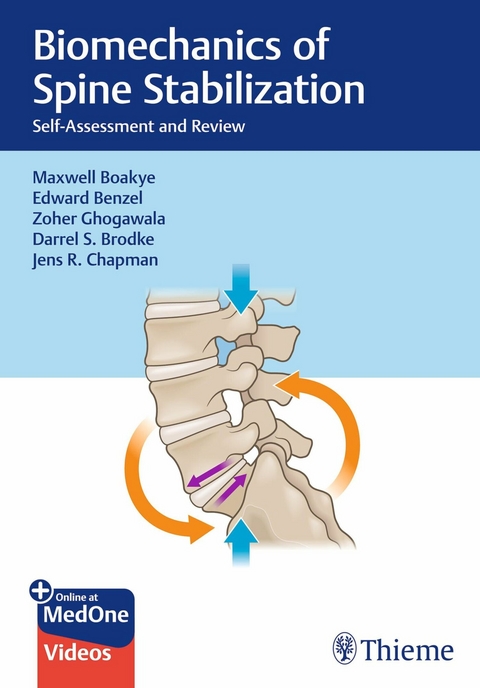
Biomechanics of Spine Stabilization (eBook)
418 Seiten
Georg Thieme Verlag KG
978-1-68420-582-0 (ISBN)
1 Biomechanically Relevant Anatomy and Material Properties of the Spine and Associated Elements
Ghani Haider, Kelly H. Yoo, Neelan Joseph Marianayagam, Anand Veeravagu
1.1 Learning Objectives
-
Understand the distinctive anatomical features present in the cervical, thoracic, and lumbar regions of spine.
-
Understand the intricate functional interplay and structural aspects of the spine including the craniocervical junction.
-
Analyze the clinical significance of divergent vertebral anatomies and their associated joints and ligaments, discerning their implications in the onset, progression, and management of spinal pathologies, thereby informing tailored treatment approaches.
1.2 Questions
▶▶ Question 1
From which part of the cervical vertebra do foraminal osteophytes most commonly emerge?
-
A. Lamina
-
B. Facet joints
-
C. Uncinate process
-
D. Vertebral body
-
E. Pedicle
▶▶ Question 2
In which region of the spine does the spinal canal have the minimum cross-sectional area, providing minimal room for neural element protection?
-
A. Cervical
-
B. Upper thoracic
-
C. Lower thoracic
-
D. Lumbar
-
E. Sacral
▶▶ Question 3
With regard to the size of pedicles, where is pedicle screw instrumentation safest?
-
A. Cervical
-
B. Upper thoracic
-
C. Lower thoracic
-
D. Lumbar
-
E. Sacral
▶▶ Question 4
In cervical and thoracic spine pedicle screw instrumentation, a small breach is most likely to involve which spinal tract?
-
A. Spinothalamic tract
-
B. Corticospinal tract
-
C. Dorsal columns
-
D. Rubrospinal tract
-
E. Spino-cerebellar tract
▶▶ Question 5
From which junction do the transverse processes of the vertebrae emerge?
-
A. Pedicle and vertebral body
-
B. Pedicle and lamina
-
C. Lamina and facet joint
-
D. Two lamina
-
E. Spinous process and lamina
▶▶ Question 6
Which structure primarily bears the axial load of the spine?
-
A. Vertebral body
-
B. Facet joints
-
C. Lamina
-
D. Spinous process
-
E. Transverse process
▶▶ Question 7
Which spinal ligament, due to its relatively long moment arm, provides significant resistance to forward flexion of the spine?
-
A. Anterior longitudinal ligament
-
B. Posterior longitudinal ligament
-
C. Ligamentum flavum
-
D. Capsular ligament
-
E. Interspinous ligament
▶▶ Question 8
Of all the ligaments in the spine, which one has the highest proportion of elastic fibers, surpassing any other human tissue?
-
A. Anterior longitudinal ligament
-
B. Posterior longitudinal ligament
-
C. Ligamentum flavum
-
D. Capsular ligament
-
E. Interspinous ligament
▶▶ Question 9
Among the following regions of the spine, where is resistance to pedicle screw pullout the least?
-
A. Cervical spine
-
B. Sacrum
-
C. Upper thoracic spine
-
D. Lumbar spine
-
E. Lower thoracic spine
▶▶ Question 10
At which level does the vertebral artery typically enter the transverse foramen?
-
A. C5
-
B. C6
-
C. C7
-
D. C1
-
E. C2
▶▶ Question 11
The relatively steep orientation of lumbosacral junction predisposes the lumbosacral region to what kind of injury?
-
A. Translational
-
B. Rotational
-
C. Compression
-
D. Distraction
-
E. Flexion-extension
▶▶ Question 12
Which form of sacro-iliac fixation provides the most robust construct when fixing the lumbar spine to the pelvis?
-
A. S-rods
-
B. Sacro-iliac screws
-
C. Sacral screws
-
D. Anterior plating
-
E. Posterior trans-iliac plating
▶▶ Question 13
Weakness of cortical bone at the vertebral end plate can lead to the formation of which of the following?
-
A. Schmorl’s node
-
B. Schuerman’s kyphosis
-
C. Klippel Feil anomaly
-
D. Hemi-vertebrae
-
E. Vertebral fusion
▶▶ Question 14
Compared to the coronal orientation of facet joints in the cervical spine, the sagittal orientation of facet joints in the lumbar spine limits what kind of motion?
-
A. Flexion
-
B. Extension
-
C. Rotation
-
D. Lateral bending
-
E. Translation
▶▶ Question 15
In the cervical spine, which joint allows for maximum rotation?
-
A. Occiput–C1 joint
-
B. C1–C2 joint at odontoid process
-
C. Combined rotation of C3–C6 joint
-
D. C2–C3 facet joint
-
E. Lateral atlanto-axial joint
▶▶ Question 16
During placement of trans-facet screws at C1–C2, which nerve should be kept in mind and protected?
-
A. Occipital nerve
-
B. Accessory nerve
-
C. Hypoglossal nerve
-
D. C2 nerve root
-
E. C3 nerve root
▶▶ Question 17
Which of the following structures have the highest strength to resist failure in the cervical spine?
-
A. Alar and transverse ligaments
-
B. Posterior longitudinal ligament
-
C. Anterior longitudinal ligaments
-
D. Tectorial membrane
-
E. Interspinous ligaments
▶▶ Question 18
In which region are herniated disks most common due to deficiency of ligaments?
-
A. Ventral
-
B. Dorsal
-
C. Lateral
-
D. Dorsolateral
...
| Erscheint lt. Verlag | 12.2.2025 |
|---|---|
| Sprache | englisch |
| Themenwelt | Medizinische Fachgebiete ► Chirurgie ► Neurochirurgie |
| Medizinische Fachgebiete ► Chirurgie ► Unfallchirurgie / Orthopädie | |
| Medizin / Pharmazie ► Medizinische Fachgebiete ► Orthopädie | |
| Schlagworte | Biomechanics • Foundations • fundamentals • Instrumentation • Self-Assessment • spinal stability • Spine Surgery • Stabilization |
| ISBN-10 | 1-68420-582-4 / 1684205824 |
| ISBN-13 | 978-1-68420-582-0 / 9781684205820 |
| Informationen gemäß Produktsicherheitsverordnung (GPSR) | |
| Haben Sie eine Frage zum Produkt? |
 EPUB (Wasserzeichen)
DRM: Digitales Wasserzeichen
Dieses eBook enthält ein digitales Wasserzeichen und ist damit für Sie personalisiert. Bei einer missbräuchlichen Weitergabe des eBooks an Dritte ist eine Rückverfolgung an die Quelle möglich.
Dateiformat: EPUB (Electronic Publication)
EPUB ist ein offener Standard für eBooks und eignet sich besonders zur Darstellung von Belletristik und Sachbüchern. Der Fließtext wird dynamisch an die Display- und Schriftgröße angepasst. Auch für mobile Lesegeräte ist EPUB daher gut geeignet.
Systemvoraussetzungen:
PC/Mac: Mit einem PC oder Mac können Sie dieses eBook lesen. Sie benötigen dafür die kostenlose Software Adobe Digital Editions.
eReader: Dieses eBook kann mit (fast) allen eBook-Readern gelesen werden. Mit dem amazon-Kindle ist es aber nicht kompatibel.
Smartphone/Tablet: Egal ob Apple oder Android, dieses eBook können Sie lesen. Sie benötigen dafür eine kostenlose App.
Geräteliste und zusätzliche Hinweise
Buying eBooks from abroad
For tax law reasons we can sell eBooks just within Germany and Switzerland. Regrettably we cannot fulfill eBook-orders from other countries.
aus dem Bereich