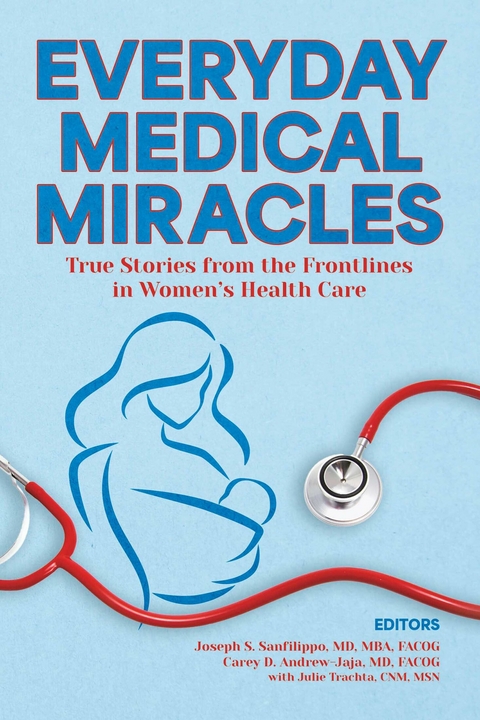
Everyday Medical Miracles (eBook)
244 Seiten
Bookbaby (Verlag)
979-8-3509-3986-6 (ISBN)
Forty Women's Health-Care Professionals, including physicians, nurses, midwives, physician assistants, nurse practitioners, a doula, and a medical assistant, are contributing authors.
Readers are led on a behind-the-scenes journey to witness real-life dramas such as:- the delivery of a baby in the front seat of a car- the physician who insisted on delivering her own baby at home- the challenge of a baby in distress with severe anemia, in utero, being treated with intrauterine blood transfusions- the attorney who delivered her own baby on the side of the road,- the patient who had a stroke while pregnant, had a healthy baby, who, years later, had her own child and now we have three generations! Expertise, empathy, and experience combine as these health-care professionals overcome obstacles, often tackling action-packed challenges. Their patients harbor fear mixed with perseverance as they hope for favorable outcomes whether these results are achievable or elusive. Facing daunting predicaments, the nurturing relationships and joint deliberations between patients and caregivers impact the careers of health-care professionals and change the lives of all concerned. In this compendium, clinical decision-making moves from abstract concepts to heart-pounding reality. These inspirational stories provide great tools for understanding the complex scenarios that abound in women's health care for both caregivers and patients. Ultimately, the many joyful results revealed in this book can best be described as everyday miracles.
Ready or Not, Here I Come
By Carey Andrew-Jaja, MD, FACOG
Dr. Carey Andrew-Jaja retired in 2019 as clinical professor of Obstetrics, Gynecology & Reproductive Sciences and attending physician at the University of Pittsburgh Medical Center, UPMC Magee-Womens Hospital in Pittsburgh, Pennsylvania. His forty-year career was dedicated to direct patient care, medical staff leadership, and the education of future physicians. He is a lead author and co-editor of Everyday Medical Miracles.
Story:
There she was, shorter than all the other Emergency Medical Technician (EMT) students who waited in the auditorium for the lecturer to arrive. Many friends had wondered whether Maya was physically strong enough to handle grueling tasks out in the field. But she never let her diminutive size hinder her at her summer job as an EMT. Maya felt competent enough to handle most situations. And yet she had her own questions: What is a rising college senior doing in an EMT class? And what’s happening to all her ambitions to become a doctor or a lawyer? She was ruminating on those questions as the obstetrics-gynecology (OB-GYN) lecturer, Dr. Jay, approached the podium to give his lecture on “How to Deliver a Baby Out in the Field.”
Dr. Jay’s resonant voice grabbed Maya’s attention. “Most of your deliveries will be smooth and easy, but you better be ready to handle the surprises. Imagine that you are the first responder to a pregnant woman’s home. She is in the late stages of labor and tells you that she felt a tiny kick in the vagina. What if you check and, indeed, the baby’s foot is there in the upper vagina? Do you grasp and drag out the baby? No. You call the OB unit at the nearby hospital you are heading to, so they are ready for skilled assistance while you monitor the baby and reassure the mother. Then, you get moving. Run intravenous fluids to help decrease the intensity of uterine contractions. If the mother feels an urge to push, ask her to pant, not to bear down. Above all, do not pull on the baby. And do not hasten the delivery until the buttocks appears at the vaginal opening. At that point, delivery is inevitable and necessary. You should then encourage the mother to push with contractions while you gently support the baby. If the baby is in distress or no further progress is happening, there are advanced maneuvers to facilitate a safe delivery. Beyond these lectures, you can learn the essentials at practical workshops with me. Feel free to sign up. Next scenario: What if the head has come out first, and you see a loop of cord around the baby’s neck? Yes, you will encounter this situation about 25 percent of the time. This is what you do . . .” Dr. Jay continued his presentation on obstetrical emergencies as the class listened and watched the projected slides. Maya absorbed it all and was eager to return to the field for her next challenge.
But before she knew it, life moved fast, and that summer of 1985 was over. Back to campus for senior year, Maya found herself enjoying advanced courses in Philosophy and English. She prepped hard and got accepted to law school. The next phase was turbocharged. After meeting her life partner and getting married, she soon graduated from law school. They both decided to settle in her hometown, where she got recruited to the University Law School faculty. One thing followed another, and soon they were living in the suburbs with two little boys of their own, now five and three years old. She had sought out and received her care from Dr. Jay, the OB-GYN who had lectured her EMT class on obstetrical emergencies years ago. Maya’s labors and deliveries were very rapid but otherwise uneventful. She and her husband felt blessed and wanted one more baby.
Pregnancy number three happened, and in the third trimester, everything felt too good to be true. At one of her visits, Dr. Jay proposed that Maya’s labor could be induced a couple of weeks before the due date, given her history of rapid labor. That way, she would deliver in a controlled environment. But Maya did not relish the idea of an induced labor nor the slightly increased risk of problems that the baby might experience if born too early. The doctor did not press the issue.
It was two weeks until her due date and a very productive day at her suburban campus office. The weather outside was unusually inviting. As Maya began heading out to meet some colleagues for lunch, she felt the first uterine contraction. She proceeded to her car in the parking lot and observed that the contractions were five minutes apart. She thought about going home, but home was in the other direction from the hospital. She decided to drive towards the hospital and then call her husband, who had to rush home to consolidate the plans for their two children and the nanny. Maya’s contractions became extremely strong and were occurring every minute. The hospital was still five miles away, at least ten or fifteen minutes before she could get into the hands of a professional caregiver. Maya pulled off the interstate and into the nearby neighborhood. She parked in a safe roadside spot, dialed 911, and yelled out her status and location.
Suddenly, she felt an intense pressure in the vagina—a large gush of warm fluid splashed all over her car seat. The 911 dispatch called back, but she couldn’t answer. They already knew where to find her.
Panting heavily, Maya heaved herself over the gear stick in the center console and onto the passenger front seat and quickly reclined it as far back as possible. Her dark gray skirt was fully drenched. She pulled it up and yanked off her underpants. Excruciating pressure filled up her vagina like it was going to burst. She fought the unbearable force, but it was overwhelming. One more contraction swept down from her belly, and Maya was overcome. The fight for control was over. Spontaneously, the entire baby’s head came through the vagina. Maya reached between her legs and felt the baby’s damp, matted hair, but the rest of the body was still held up. She reached farther in and felt a rope-like umbilical cord around the baby’s neck. She squeezed it gently and palpated a pulse within the cord.
As though she were in a dream, Maya began to hear Dr. Jay’s voice from that very first lecture.
The voice: Curl your finger between the loop of cord and the baby’s neck.
She did just that.
If the cord is too tight and the baby’s anterior shoulder has come through the pubic arch, then double-clamp and cut the cord between the clamps to prevent it from ripping.
Maya checked, as she recalled that an excessively tight cord would block blood flow to the baby, leading to imminent danger. Fortunately, the loop of cord was not tight.
Gently drag the loop of cord over the baby’s head, like a necklace.
She slipped the cord over the baby’s head, and suddenly the shoulders popped out. A chubby baby girl emerged onto the car seat and immediately let out a piercing cry. Mesmerized as she was, Maya grabbed and clutched the baby tightly to her chest.
There was a knock on the passenger side window. She looked at two paramedics as they opened the passenger-side front door.
“What took you so long?” Maya asked.
One of the paramedics gave an apologetic shrug in response and promptly noticed the large clump of blood on the car seat between Maya’s legs, then said to her: “Congratulations! Sorry, the baby beat us to it. But the placenta is not yet delivered, and it looks like you are bleeding quite a bit.”
As they exchanged a few more observations, Maya continued to feel a heavy stream of blood gushing from her vagina. The paramedics’ voices began to fade, and in Maya’s mind, the events seemed to be happening in a distant time and place. The paramedics appeared to be mumbling to themselves while cutting the umbilical cord, working on her, and transporting her to their ambulance. In her surreal state, she could swear they were taking instructions from Dr. Jay’s lecture from a decade earlier.
“And what if you have delivered the baby and then you notice that mother is bleeding profusely? You must caress the uterus to make it contract. Give a utero-tonic agent such as oxytocin or methergine to firm up the uterus. In addition, you should check in the vagina for any tears that need to be repaired. If you find such a tear, place firm pressure on that site with sterile gauzes. And remember to continue applying gentle massage on the uterus to prevent heavy bleeding.”
The paramedic caressed Maya’s uterus and gave her a dose of oxytocin, just like Dr. Jay would recommend. The placenta came out. They checked it thoroughly, and it was completely intact.
They secured Maya in the ambulance, locked up her car, and took off for the hospital while running intravenous fluids full blast into her circulation.
At the hospital emergency suite, Dr. Jay met Maya and gathered details of the day’s events from her and the paramedics. He quickly assessed the beautiful baby girl and declared that she passed her initial assessment with flying colors. Maya herself was doing much better. The bleeding had slowed down to a trickle. All she needed were a couple of stitches to...
| Erscheint lt. Verlag | 2.1.2025 |
|---|---|
| Sprache | englisch |
| Themenwelt | Medizin / Pharmazie |
| ISBN-13 | 979-8-3509-3986-6 / 9798350939866 |
| Informationen gemäß Produktsicherheitsverordnung (GPSR) | |
| Haben Sie eine Frage zum Produkt? |
 EPUB (Ohne DRM)
Größe: 1,9 MB
Digital Rights Management: ohne DRM
Dieses eBook enthält kein DRM oder Kopierschutz. Eine Weitergabe an Dritte ist jedoch rechtlich nicht zulässig, weil Sie beim Kauf nur die Rechte an der persönlichen Nutzung erwerben.
Dateiformat: EPUB (Electronic Publication)
EPUB ist ein offener Standard für eBooks und eignet sich besonders zur Darstellung von Belletristik und Sachbüchern. Der Fließtext wird dynamisch an die Display- und Schriftgröße angepasst. Auch für mobile Lesegeräte ist EPUB daher gut geeignet.
Systemvoraussetzungen:
PC/Mac: Mit einem PC oder Mac können Sie dieses eBook lesen. Sie benötigen dafür die kostenlose Software Adobe Digital Editions.
eReader: Dieses eBook kann mit (fast) allen eBook-Readern gelesen werden. Mit dem amazon-Kindle ist es aber nicht kompatibel.
Smartphone/Tablet: Egal ob Apple oder Android, dieses eBook können Sie lesen. Sie benötigen dafür eine kostenlose App.
Geräteliste und zusätzliche Hinweise
Buying eBooks from abroad
For tax law reasons we can sell eBooks just within Germany and Switzerland. Regrettably we cannot fulfill eBook-orders from other countries.
aus dem Bereich