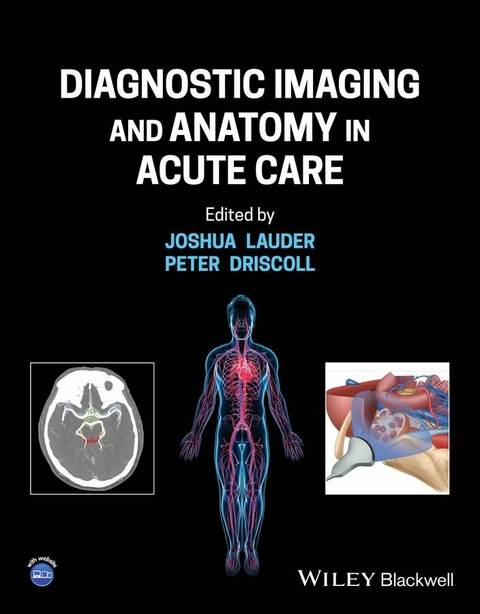
Diagnostic Imaging and Anatomy in Acute Care (eBook)
562 Seiten
Wiley-Blackwell (Verlag)
978-1-119-80946-3 (ISBN)
Image-focused introductory text exploring various contemporary radiology modalities including X-ray, CT, Nuclear medicine, MRI, Ultrasound, and Interventional
Diagnostic Imaging and Anatomy in Acute Care provides an overview of imaging modalities, focusing on plain radiology, CT, ultrasound and MRI. Nuclear medicine and interventional radiology are also included in cases relevant to acute care. To aid in reader understanding, this book includes a multitude of pictures annotated with clinically relevant anatomy, enabling readers to compare normal anatomy with pathology and cross reference with previous anatomical knowledge.
Diagnostic Imaging and Anatomy in Acute Care includes discussion on:
- How to effectively utilize radiology services when managing acute cases which are commonly present in emergency and urgent care
- Tips for dealing with time-sensitive situations where immediate reporting is not available
- Specific terminology pertaining to each different modality and how each modality can be interpreted systematically
- Methods to identify key abnormalities through effective usage of pattern recognition
Diagnostic Imaging and Anatomy in Acute Care is an essential reference on this subject for front line clinicians involved in acute care, specialty doctors who would like to know more about imaging modalities, nurses and allied health professionals with an interest in anatomy and imaging, and students of the above disciplines.
Joshua Lauder Consultant Radiologist at ELHT, UK and Lead for Radiology at UCLan, UK. He has specialist interests in MSK radiology, head and neck radiology, medical education and artificial intelligence in imaging. Author of nine imaging chapters in ABC major trauma book. Reviewer for Journal of Cranio-Maxillo-Facial surgery. Expert advisor for 'Complete Anatomy' software. Presented at national and international conferences in radiology and medical education.
Peter Driscoll Professor and lead for Clinical Anatomy, UCLan, UK. He was previously a Professor, Royal College of Emergency Medicine; Director of the Physician Associate programme, UCLan. Co-founder of the European Trauma Course and the Advanced Life Support Group. Editor and author of several publications and books dealing with various aspects of emergency care and trauma management.
Image-focused introductory text exploring various contemporary radiology modalities including X-ray, CT, Nuclear medicine, MRI, Ultrasound, and Interventional Diagnostic Imaging and Anatomy in Acute Care provides an overview of imaging modalities, focusing on plain radiology, CT, ultrasound and MRI. Nuclear medicine and interventional radiology are also included in cases relevant to acute care. To aid in reader understanding, this book includes a multitude of pictures annotated with clinically relevant anatomy, enabling readers to compare normal anatomy with pathology and cross reference with previous anatomical knowledge. Diagnostic Imaging and Anatomy in Acute Care includes discussion on: How to effectively utilize radiology services when managing acute cases which are commonly present in emergency and urgent care Tips for dealing with time-sensitive situations where immediate reporting is not available Specific terminology pertaining to each different modality and how each modality can be interpreted systematically Methods to identify key abnormalities through effective usage of pattern recognition Diagnostic Imaging and Anatomy in Acute Care is an essential reference on this subject for front line clinicians involved in acute care, specialty doctors who would like to know more about imaging modalities, nurses and allied health professionals with an interest in anatomy and imaging, and students of the above disciplines.
CHAPTER 1
Radiology Introduction
Joshua Lauder1 and Peter Driscoll2
1 East Lancashire Hospitals NHS Trust, University of Central Lancashire and University of Manchester, UK
2 School of Medicine and Dentistry, University of Central Lancashire, Preston, UK
1.1 Section/Chapter Order
The sections are arranged so they go through the various imaging modalities, starting with plain radiology, then ultrasound, CT and MR. The chapters in each section go from simple to more complex where information from the previous chapters is used.
This introductory chapter provides an overview of the different modalities covered in the book, the rationale for their use and an explanation of common terminology. Our advice is to scan this initially. Then, as you read other parts of the book, you will be encouraged to return to relevant parts in this chapter to refresh your memory.
Each of the remaining chapters starts with a clinical case and the images used in the acute situation. There are then questions asking for a differential diagnosis and preliminary interpretation of the images. The imaging modality is then explained along with a review of the relevant anatomy. The chapter concludes with the questions being reviewed and answers provided.
1.2 Imaging Modalities
Through this book you will develop an overview of each imaging modality and its advantages and limitations. Often, the best way to learn this is using examples of normal anatomy and pathology so you will be referred to relevant images in the other chapters.
Don't get bogged down in the technical aspects of physics and scan acquisition (unless you are particularly interested). Radiology interpretation is primarily pattern based and appreciating the image is the most important bit.
Radiological terminology will be introduced here and throughout the book. It helps to understand what these terms mean as they crop up throughout radiology reports. Being able to link the terminology with what you can see in the image is a vital step in using these investigations appropriately.
1.3 Ionising Radiation
It helps to divide the imaging modalities into those which expose the patient to ionising radiation and those which don't.
| Exposure to ionising radiation | No exposure to ionising radiation |
|---|
| X‐ray CT (computed tomography) Nuclear medicine | Ultrasound MRI (magnetic resonance imaging) |
Ionising radiation is a type of energy released in the form of electromagnetic waves (e.g. gamma/X‐rays) or particles (neutrons, beta or alpha). In diagnostic radiology, it is nearly all in the form of high‐energy electromagnetic waves. Ionising particles are used more in clinical oncology.
As these waves are high energy, they can displace the electrons from atoms in the body, which causes them to ionise. This ionisation can cause mutations in DNA and has the potential to induce cancers at high doses or cumulative low doses. For this reason, any ionising radiation exposure must be justified.
The benefit from the diagnostic test should outweigh the future cancer risk.
TABLE 1.1 Approximate radiation doses for various types of exposure.
Source: Public Health England/Crown/Public domain.
| Dental X‐ray | 0.005 mSv |
| 100 g of Brazil nuts | 0.01 mSv |
| Chest X‐ray | 0.014 mSv |
| Transatlantic flight | 0.08 mSv |
| Nuclear power station worker average annual occupational exposure (2010) | 0.18 mSv |
| V/Q perfusion component | 1 mSv |
| Computed tomography (CT) scan of the head | 1.4 mSv |
| UK average annual radiation dose | 2.7 mSv |
| Low‐dose CT chest | 1.5 mSv |
| CT pulmonary angiography (CTPA) | 6.1 mSv |
| Average annual radon dose to people in Cornwall (UK) | 6.9 mSv |
| Whole‐body CT | 10 mSv |
| Positron emission tomography (PET)/CT | 22 mSv |
Radiation dose in medicine is measured in millisievert units (mSv). As this is an abstract unit, it is useful to think about the dose in relation to the natural background radiation (Table 1.1). This varies from region to region, largely because of radon gas emission. Background radiation from the cosmos and ingested food also contributes. However, calculating the exact risk of developing cancer from a particular radiological test is an inexact process, extrapolated from the high doses of exposure at Hiroshima and Nagasaki. It is estimated that 1 mSv exposure has approximately a 1 in 20 000 risk of causing a fatal cancer.
1.4 X‐ray (Plain Radiography)
This is the oldest of the radiology modalities and well recognised by most healthcare staff. A few key points are worth keeping in mind when looking at plain films.
- They are a 2D representation of the 3D structures of the body. Hence overlapping of structures is a common problem.
- High‐density structures appear white. Other names for high density are opacity or opacification. A dense region in a bone is called sclerosis.
- Low‐density structures appear black. Other names for low density are lucent or lucency. A low‐density region in a bone is called lytic.
X‐rays are still used a great deal and are very useful, particularly for assessing structures of very high density (bones, MSK Chapter 4 – Figure 4.10; joints, MSK Chapter 2 – Figure 2.1; metal implants, MSK Chapter 2 – Figure 2.4, etc.) or very low density (lungs, Resp Chapter 12 – Figure 12.2 or bowel gas, Abdo Chapter 20 – Figure 20.6). Another big advantage is their relatively low exposure to ionising radiation.
The limitations with plain radiographs become evident with intermediate‐density structures, like most organs, muscle, tendons (MSK Chapter 5 – Figure 5.7) and ligaments. They tend to appear as homogenous grey shadows. Joint effusions are visible in certain joints (MSK Chapter 3 – Figure 3.12) but you will not be able to differentiate between simple fluid, pus or blood.
1.5 Computed Tomography
1.5.1 Scan Acquisition
The annual number of CT scans performed in the NHS increased from 1 million to 6 million from 1997 to 2020.
CT relies on X‐rays and so exposes the patient to ionising radiation. The method for acquiring an image is similar to plain radiography, with an X‐ray source firing through the patient to a detector. In CT this X‐ray source is rotated around the patient (tomography) as they are advanced through the scanner. This allows the whole body to be covered in a matter of seconds. The results are analysed electronically (computed) and the scan subsequently displayed in a picture archiving and communications system (PACS) system.
A CT scan contains hundreds (or sometimes thousands) of cross‐sections through the patient. This is the key difference from plain radiography. A useful analogy is to think of a building. A traditional plain X‐ray is like taking a photograph of a building, resulting in an image with 2D representation of a 3D structure. CT is like having the blueprints of the building, with detailed floor plans on every level.
1.5.2 Multiplanar Reformatting (MPR)
Each pixel of a CT image is actually a cube in 3D space, termed a voxel. Because of this, PACS software allows CT scans to be instantly reformatted into any desired anatomical plane. Axial, coronal and sagittal planes are the standard ones and are used at least 90% of the time. Occasionally it may be useful to create oblique planes along a certain part of anatomy (Figure 1.2).
FIGURE 1.1 Axial (a) and sagittal views (b). The latter is taken in the midline as demonstrated by the red localiser line in image (a). When viewing a sagittal slice which is not in the midline (d), it is not always apparent which side of the body is being imaged. This is a common problem with neuro imaging as the brain and spine are anatomically symmetrical. By referring to the axial slice and localiser line (c), we can see that (d) is showing the left side.
1.5.3 Anatomical Planes and Orientation
The convention in radiology is that the image is viewed as if the patient is facing the practitioner. This initially applied to x‐rays taken in a frontal projection but has been continued into CT imaging where the axial plane is predominantly used. Consequently, the left‐hand side of the screen will relate to the patient's right‐hand side (Figure 1.3). The convention...
| Erscheint lt. Verlag | 31.12.2024 |
|---|---|
| Sprache | englisch |
| Themenwelt | Medizin / Pharmazie ► Allgemeines / Lexika |
| Medizin / Pharmazie ► Medizinische Fachgebiete ► Notfallmedizin | |
| Schlagworte | Acute Care • anatomy imaging • CT radiology • imaging modality interpretation • Interventional Radiology • Medical Imaging • MRI radiology • Nuclear medicine radiology • radiology services • Ultrasound radiology • X-ray radiology |
| ISBN-10 | 1-119-80946-0 / 1119809460 |
| ISBN-13 | 978-1-119-80946-3 / 9781119809463 |
| Informationen gemäß Produktsicherheitsverordnung (GPSR) | |
| Haben Sie eine Frage zum Produkt? |
 EPUB (Adobe DRM)
Kopierschutz: Adobe-DRM
Adobe-DRM ist ein Kopierschutz, der das eBook vor Mißbrauch schützen soll. Dabei wird das eBook bereits beim Download auf Ihre persönliche Adobe-ID autorisiert. Lesen können Sie das eBook dann nur auf den Geräten, welche ebenfalls auf Ihre Adobe-ID registriert sind.
Details zum Adobe-DRM
Dateiformat: EPUB (Electronic Publication)
EPUB ist ein offener Standard für eBooks und eignet sich besonders zur Darstellung von Belletristik und Sachbüchern. Der Fließtext wird dynamisch an die Display- und Schriftgröße angepasst. Auch für mobile Lesegeräte ist EPUB daher gut geeignet.
Systemvoraussetzungen:
PC/Mac: Mit einem PC oder Mac können Sie dieses eBook lesen. Sie benötigen eine
eReader: Dieses eBook kann mit (fast) allen eBook-Readern gelesen werden. Mit dem amazon-Kindle ist es aber nicht kompatibel.
Smartphone/Tablet: Egal ob Apple oder Android, dieses eBook können Sie lesen. Sie benötigen eine
Geräteliste und zusätzliche Hinweise
Buying eBooks from abroad
For tax law reasons we can sell eBooks just within Germany and Switzerland. Regrettably we cannot fulfill eBook-orders from other countries.
aus dem Bereich