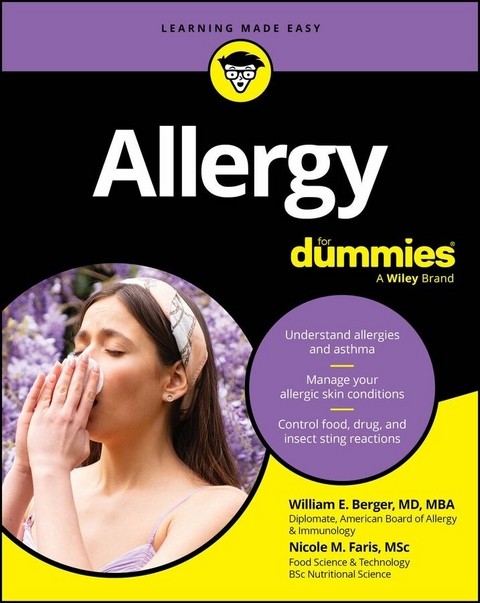
Allergy For Dummies (eBook)
498 Seiten
For Dummies (Verlag)
978-1-394-25669-3 (ISBN)
All the info you need to understand your allergies and manage symptoms
Allergy For Dummies is your one-stop source for comprehensive information on the different types of allergies and their triggers, along with tips on allergy management and prevention. Accessible, Dummies-style explanations will help you deal with hay fever, asthma, eczema, drug allergies, food sensitivities, and beyond-for yourself or anyone under your care. Get answers to your allergy-related questions, understand your triggers, and learn what you can do about allergies of all types. Ensure that you're in control and receive the help you need, with this friendly guide.
- Identify what's ailing you by getting tested for allergies and asthma
- Learn to treat food allergies, allergic skin conditions, drug reactions, and insect stings
- Know how to prevent anaphylaxis, and what to do if it occurs
- Understand your treatment options and find resources for additional information
Allergy For Dummies is for the millions of people around the world who suffer from some kind of allergic sensitivity and need a thorough and approachable guide on the topic.
William E. Berger, MD, MBA, has more than 40 years of clinical experience diagnosing and treating patients with allergies and asthma. He founded the Allergy & Asthma Associates of Southern California, where he practiced both adult and pediatric allergy and immunology.
Nicole M. Faris, MSc, has devoted her career to advancing the understanding of allergies, drawing on more than 20 years of experience in industry, pediatric research, and patient advocacy. Her personal journey with food allergies has enriched her perspective on effective allergy care.
All the info you need to understand your allergies and manage symptoms Allergy For Dummies is your one-stop source for comprehensive information on the different types of allergies and their triggers, along with tips on allergy management and prevention. Accessible, Dummies-style explanations will help you deal with hay fever, asthma, eczema, drug allergies, food sensitivities, and beyond for yourself or anyone under your care. Get answers to your allergy-related questions, understand your triggers, and learn what you can do about allergies of all types. Ensure that you're in control and receive the help you need, with this friendly guide. Identify what's ailing you by getting tested for allergies and asthma Learn to treat food allergies, allergic skin conditions, drug reactions, and insect stings Know how to prevent anaphylaxis, and what to do if it occurs Understand your treatment options and find resources for additional information Allergy For Dummies is for the millions of people around the world who suffer from some kind of allergic sensitivity and need a thorough and approachable guide on the topic.
Chapter 1
Knowing What’s Ailing You
IN THIS CHAPTER
Introducing allergic ailments
Connecting allergies and other conditions
Defining the spectrum of allergic conditions
Making sense of allergy signs and symptoms
Recognizing life-threatening reactions
Allergy is a descriptive term for a wide variety of hypersensitivity disorders (meaning that you’re excessively sensitive to one or more substances to which most people do not normally react).
Living a healthy, fulfilling life with allergies involves many of the same general diagnostic, treatment, and preventive measures that we explain throughout this book. In fact, the symptoms of seemingly disparate ailments such as allergic rhinitis (hay fever), most cases of asthma, atopic dermatitis (allergic eczema), food allergies, and other allergic conditions basically result from your immune system’s similar, hyperreactive response to otherwise harmless substances that doctors refer to as allergens. This chapter serves as your entry point into the world of allergies.
Understanding How Allergies Cause Clinical Symptoms
The word allergy is the ancient Greek terms for an abnormal response or overreaction. Contrary to popular belief, weak or deficient immune systems don’t cause asthma or allergy ailments. Rather, your body’s defenses work overtime, making your immune system too sensitive to substances that pose a real threat to your well-being. That’s why physicians often use the term hypersensitivity to refer to an allergy.
These are the main points to keep in mind when dealing with allergies:
- Allergies aren’t just hay fever. In addition to affecting your nose, sinuses, eyes, and throat (as in typical cases of allergic rhinitis), exposure to allergy triggers can also cause symptoms that involve other organs of your body, including your lungs, skin, and digestive tract. Figure 1-1 shows all the organs in your body that allergies and asthma can affect.
- These ailments aren’t infections or contagious. You don’t catch an allergy. However, as we explain in the section “Sensitizing your immune system” later in this chapter, you may inherit a genetic predisposition to develop hypersensitivities that can eventually appear as allergies.
- Allergies aren’t like trends or shoe sizes. You don’t really outgrow them. Extensive studies in recent years show that although your ailment can certainly vary in character and severity over your lifetime, it’s an ongoing physical condition that’s most likely always present in some form.
- Allergy triggers include allergens such as pollens, animal dander, dust mites, mold spores, various contact allergens, and certain foods, drugs, and venom from stinging insects. (See the section “Sensitizing your immune system” later in this chapter for more detailed classifications of these items.)
- Clinical reactions can also result from nonallergic triggers that act as irritants, including tobacco smoke, household cleaners, aerosol products, solvents, chemicals, fumes, gases, paints, smoke, and indoor and outdoor air pollution.
- Other forms of nonallergic triggers that can be mistaken as allergies are known as precipitating factors and include other medical conditions such as rhinitis, sinusitis, gastroesophageal reflux (GERD), and viral infections (colds, flu, COVID); physical stimuli such as exercise or variations in both air temperature and humidity levels; and sensitivities to food additives, such as sulfites, drugs such as beta-blockers (Inderal, Lopressor, Corgard, Timoptic), and aspirin and related over-the-counter nonsteroidal anti-inflammatory drugs (NSAIDs) such as ibuprofen (Advil, Motrin), ketoprofen (Actron, Orudis), naproxen (Aleve), and newer prescription NSAIDs known as COX-2 inhibitors, such as celecoxib (Celebrex).
- Allergies aren’t mutually exclusive conditions. Having one type of hypersensitivity doesn’t prevent you from developing others. You can have multiple sensitivities to different types of allergens, irritants, and precipitating factors. Many researchers (including Dr. Berger) consider allergic disorders a continuum of disease that can appear in many ways, depending on the nature and degree of your sensitivities, as well as your levels of exposure to triggers.
© John Wiley & Sons, Inc.
FIGURE 1-1: Allergies can affect organs throughout your body.
-
All that sneezes, drips, runs, congests, wheezes, waters, coughs, itches, erupts, or swells isn’t always due to an allergic reaction. That’s why, as we explain in the section “Diagnosing and Treating Your Allergies” later in this chapter, the first step to effectively treating the underlying cause of your symptoms is properly diagnosing your ailment.
- Although the majority of people with asthma also have allergies (and allergic rhinitis in most cases), some manifestations of asthma seem to develop without an allergic component. In cases of adult-onset asthma, which often develops in people older than 40 and is less common that child-onset asthma, atopy (a genetic tendency toward developing allergic hypersensitivity; see the next section) doesn’t appear to play an important role. Instead, precipitating factors such as sinusitis, GERD, nasal polyps, and sensitivities to aspirin and related NSAIDs are more likely to trigger this condition.
Triggering Allergic Reactions
Your immune system acts as your second line of defense against foreign substances. The main barrier against foreign substances is your largest organ — your skin. (Remember that for your next appearance on Jeopardy! Masters.)
Usually, your immune system protects you against infectious bacteria, viruses, parasites, and other harmful agents by producing antibodies that learn to recognize the invaders and subsequently fend them off without too much fuss. In fact, most of the time, as long as your immune system works well, you may not even know that this constant, ongoing process takes place to ensure your survival and good health.
However, with an allergic condition, your immune system overproduces antibodies against typically harmless or inoffensive substances such as pollens. Atopy (the genetic susceptibility that can predispose your immune system to develop hypersensitivities) is the inherited characteristic that usually determines why some people’s immune systems overreact and mount full-scale assaults when exposed to allergens, while others can ignore or innocuously eliminate those substances.
Here we explain atopy in more detail and describe how your family history may influence your risk of developing an allergic condition.
ALL IN THE ATOPIC FAMILY
Your genetically determined allergic predisposition (atopy) may present itself through different allergic conditions and target organs. This predisposition and a family history of allergies are the strongest predictors that you may develop asthma and/or other allergic conditions such as allergic rhinitis (hay fever), atopic dermatitis (allergic eczema), and food or drug hypersensitivities.
For example, your Uncle Ed may have allergic rhinitis, your sister may suffer from recurrent sinus and ear infections, and Cousin Al may have a childhood history of atopic dermatitis. Some of your especially unlucky relatives may even be “blessed” with a combination of all these allergic conditions, plus asthma, over the course of their lifetimes. (If you want to be the most popular member of your family, buy them a copy of this book.)
A typical atopic family history could consist of a person having atopic dermatitis as an infant, developing common atopic complications such as otitis media (ear infections — see Chapter 7) as a toddler, experiencing noticeable symptoms of allergic rhinitis in later childhood, and then developing asthma as a teenager.
However, an atopic history doesn’t appear to put you at greater risk than the general population for developing allergic contact dermatitis (see Chapter 12) or allergic reactions to insect stings (see Chapter 17). These conditions seem affect nonallergic and allergic people alike, for reasons that we explain in Chapter 2.
Sensitizing your immune system
A complex sensitization process, in which your immune system responds to allergens, causes allergic reactions. Allergens that your immune system may respond to include the following:
- Dust mites (see Chapter 4).
- Pollens from certain grasses, weeds, and trees (see Chapter 4).
- Mold spores (see Chapter 4).
- Dander from many animals, including cats, dogs, rabbits, birds, horses, as well as gerbils, guinea pigs, and other pet rodents (see Chapter 5).
- Foods, including peanuts, sesame, fish, shellfish, and tree nuts (in adults) and milk, eggs, soy and wheat (primarily in children). See Chapter 15 for more details.
- The venom of stinging insects, including honeybees, wasps, yellow jackets, hornets, and fire ants, all of which belong to the Hymenoptera order of insects (see Chapter 17).
- Drugs, including penicillin, and cephalosporins (see Chapter 16).
- Contact allergens (see...
| Erscheint lt. Verlag | 30.12.2024 |
|---|---|
| Sprache | englisch |
| Themenwelt | Medizin / Pharmazie ► Allgemeines / Lexika |
| Schlagworte | allergies • allergy asthma • allergy book • allergy cure • Allergy dummies • allergy prevention • allergy symptoms • allergy treatment • Asthma • asthma book • autoimmune book • autoimmune symptoms • Chronic cough • Food Allergies • food sensitivity • seasonal allergies |
| ISBN-10 | 1-394-25669-8 / 1394256698 |
| ISBN-13 | 978-1-394-25669-3 / 9781394256693 |
| Informationen gemäß Produktsicherheitsverordnung (GPSR) | |
| Haben Sie eine Frage zum Produkt? |
 EPUB (Adobe DRM)
Kopierschutz: Adobe-DRM
Adobe-DRM ist ein Kopierschutz, der das eBook vor Mißbrauch schützen soll. Dabei wird das eBook bereits beim Download auf Ihre persönliche Adobe-ID autorisiert. Lesen können Sie das eBook dann nur auf den Geräten, welche ebenfalls auf Ihre Adobe-ID registriert sind.
Details zum Adobe-DRM
Dateiformat: EPUB (Electronic Publication)
EPUB ist ein offener Standard für eBooks und eignet sich besonders zur Darstellung von Belletristik und Sachbüchern. Der Fließtext wird dynamisch an die Display- und Schriftgröße angepasst. Auch für mobile Lesegeräte ist EPUB daher gut geeignet.
Systemvoraussetzungen:
PC/Mac: Mit einem PC oder Mac können Sie dieses eBook lesen. Sie benötigen eine
eReader: Dieses eBook kann mit (fast) allen eBook-Readern gelesen werden. Mit dem amazon-Kindle ist es aber nicht kompatibel.
Smartphone/Tablet: Egal ob Apple oder Android, dieses eBook können Sie lesen. Sie benötigen eine
Geräteliste und zusätzliche Hinweise
Buying eBooks from abroad
For tax law reasons we can sell eBooks just within Germany and Switzerland. Regrettably we cannot fulfill eBook-orders from other countries.
aus dem Bereich