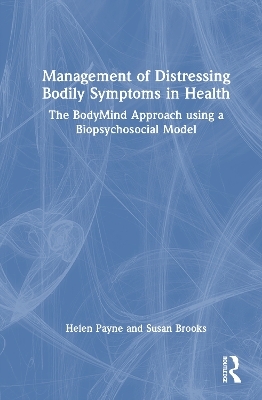
Management of Distressing Bodily Symptoms in Health
Routledge (Verlag)
978-1-032-60845-7 (ISBN)
Somatisation or medically unexplained symptoms (MUS) are distressing bodily symptoms for which tests and scans return normal. They can be incredibly debilitating conditions and people seek health care frequently due to their distress. They are common worldwide – yet there are few interventions available to help those suffering with the physical and emotional pain they cause. This book presents a solution to this problem by providing a comprehensive introduction to The BodyMind Approach (TBMA), developed by Helen Payne, and outlines guidance on applying TBMA principles to facilitated groupwork with patients/clients.
Readers will learn how TBMA’s biopsychosocial learning model can be used to support patients in their self-management of anxiety associated with body distress disorder, as well as their accompanying bodily felt experience. Chapters explore:
Adult learning theories and The BodyMind Approach
An overview of medically unexplained symptoms/body distress disorder
The BodyMind Approach
The BodyMind Approach Programme
Training of The BodyMind Approach facilitators
Qualitative research on The BodyMind Approach
Somatisation and adult attachment theory
The BodyMind Approach to support students in Higher Education
Somatisation, The BodyMind Approach and chronic stress
This unique book is essential reading for healthcare professionals and mental health practitioners as well as those who are, or wish to train, as a TBMA facilitator. It will also be a compelling read for a variety of other professions, including, but not limited to, dance movement psychotherapists, art psychotherapists, counsellors, health coaches, clinical psychologists, GPs, pain clinic staff and nurses.
Helen Payne, PhD, Professor of Psychotherapy, has been researching somatic symptoms since 2005. She works part time at the University of Hertfordshire conducting research and supervising doctoral students in the School of Health Medicine and Life Sciences, Department of Psychology, Sport and Geography. In 2012 she led the formation of Pathways2Wellbeing as Director and Clinical Manager for delivering TBMA in primary healthcare. She is a trainer in the Discipline of Authentic Movement. Susan Brooks, MSc, MA, MSc, MBA has worked as a teacher, social worker, biologist, senior manager, assistant chief probation officer and university senior lecturer. Susan offers an unusual skill mix which brings a holistic and truly biopsychosocial perspective to the understanding of distressing bodily symptoms. She joined Helen in 2012 as a Director in forming and managing the University of Hertfordshire spin out Pathways2Wellbeing and collaborated on the research projects.
Chapter 1 Adult Learning Theories and The BodyMind Approach
Chapter 2 Overview Medically Unexplained Symptoms/Body Distress Disorder
Chapter 3 The BodyMind Approach
Chapter 4 The BodyMind Approach Programme
Chapter 5 Training of Facilitators
Chapter 6 Qualitative Research on The BodyMind Approach
Chapter 7 Somatisation and Attachment Theory
Chapter 8 The BodyMind Approach® to Support Students in Higher Education: The Relationship between Student Stress, Somatisation and Mental Health
Chapter 9 Somatisation, The BodyMind Approach and Chronic Stress
Chapter 10 Epilogue
| Erscheinungsdatum | 19.07.2025 |
|---|---|
| Zusatzinfo | 2 Tables, black and white; 8 Line drawings, black and white; 2 Halftones, black and white; 10 Illustrations, black and white |
| Verlagsort | London |
| Sprache | englisch |
| Maße | 156 x 234 mm |
| Gewicht | 620 g |
| Themenwelt | Medizin / Pharmazie ► Medizinische Fachgebiete ► Psychiatrie / Psychotherapie |
| Medizin / Pharmazie ► Physiotherapie / Ergotherapie ► Ergotherapie | |
| ISBN-10 | 1-032-60845-5 / 1032608455 |
| ISBN-13 | 978-1-032-60845-7 / 9781032608457 |
| Zustand | Neuware |
| Informationen gemäß Produktsicherheitsverordnung (GPSR) | |
| Haben Sie eine Frage zum Produkt? |
aus dem Bereich