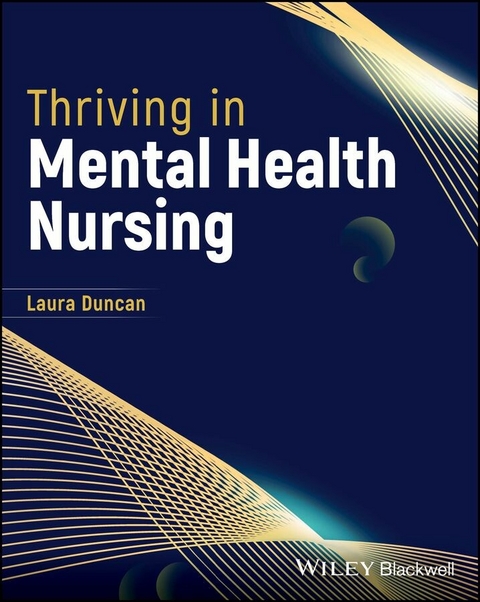
Thriving in Mental Health Nursing (eBook)
356 Seiten
Wiley-Blackwell (Verlag)
978-1-394-20237-9 (ISBN)
Comprehensive guide on what it means to be a mental health nurse, with up-to-date clinical perspectives and insightful case studies
Thriving in Mental Health Nursing delivers a 360-degree view of what it means to be a mental health nurse and how to be a resilient, positive, and proactive professional in the field. This book teaches readers to consider their own skills, development needs, and wellbeing while providing an overview of the latest clinical research within the field and what it means for their clients.
While most mental health nursing books focus on clinical skills and patient conditions, this book adopts a holistic approach to the profession by covering topics like managing personal trauma when providing trauma-focused care, understanding, avoiding, and overcoming burnout, and maintaining hope in a post-pandemic staffing crisis.
In-depth discussion, vignettes, relevant case studies, and activity suggestions support learning and engagement for healthcare professionals at every step of their careers, from first embarking on a training course to being an experienced mental health nurse. Special attention is paid to diversity and inclusivity themes including micro-aggressions, allyship, and more.
Other topics explored in Thriving in Mental Health Nursing include:
- Risk in the form of self-harm, suicide, violence, and aggression, with tips on how to take positive risks and manage risk safely when required
- Ethical issues in the field, including key perspectives on detaining individuals under the Mental Health Act (1983)
- Guidelines for identifying and addressing conflict, whether it arises between team members or from clients, including best practices for de-escalation
Thriving in Mental Health Nursing is an invaluable guide for all nurses in the field, from first-year nurses to the most experienced registered nurses, along with students seeking to understand the significant challenges and obstacles they may encounter.
Laura Duncan, Senior Lecturer and Mental Health Field Lead, University of Chester, and Primary Care Network Mental Health Lead, Cheshire and Wirral Partnership NHS Foundation Trust, UK.
Comprehensive guide on what it means to be a mental health nurse, with up-to-date clinical perspectives and insightful case studies Thriving in Mental Health Nursing delivers a 360-degree view of what it means to be a mental health nurse and how to be a resilient, positive, and proactive professional in the field. This book teaches readers to consider their own skills, development needs, and wellbeing while providing an overview of the latest clinical research within the field and what it means for their clients. While most mental health nursing books focus on clinical skills and patient conditions, this book adopts a holistic approach to the profession by covering topics like managing personal trauma when providing trauma-focused care, understanding, avoiding, and overcoming burnout, and maintaining hope in a post-pandemic staffing crisis. In-depth discussion, vignettes, relevant case studies, and activity suggestions support learning and engagement for healthcare professionals at every step of their careers, from first embarking on a training course to being an experienced mental health nurse. Special attention is paid to diversity and inclusivity themes including micro-aggressions, allyship, and more. Other topics explored in Thriving in Mental Health Nursing include: Risk in the form of self-harm, suicide, violence, and aggression, with tips on how to take positive risks and manage risk safely when requiredEthical issues in the field, including key perspectives on detaining individuals under the Mental Health Act (1983)Guidelines for identifying and addressing conflict, whether it arises between team members or from clients, including best practices for de-escalation Thriving in Mental Health Nursing is an invaluable guide for all nurses in the field, from first-year nurses to the most experienced registered nurses, along with students seeking to understand the significant challenges and obstacles they may encounter.
CHAPTER 2
Reflection
Reflection as a concept is about looking at our thoughts, feelings and actions and evaluating them. It is about analysing our reactions, those of our team and the impact of these upon our clients. Reflection is about understanding what we did well, what we did not do well and how we could improve in the future. Becoming a reflective practitioner who is able to consider our own strengths and weaknesses with a view to continual improvement should be the goal of every registered nurse and healthcare professional.
Reflection is a core concept within nursing, and it is a key feature of any modern nursing programme. The emphasis on the importance of reflection is fairly recent, and many of us who trained more than 10 years ago will have first completed a written reflection for revalidation when that became a core aspect of the process [Nursing and Midwifery Council (NMC), n.d.], but without this being included in our training, many of us have struggled with formal reflections. My first reflections for revalidation under the NMC standards were deeply unreflective! Reading back now, I can see clearly that they are merely descriptions of a situation without any deeper understanding of them. I have shown these ‘reflections’ to students as a learning exercise and invited critique, the first comment is always ‘they aren’t very reflective’. Now, registered nurses must write reflective accounts every 3 years; they may have ‘reflective practice’ sessions within their clinical team or they may ask student nurses to write reflections after an incident or issue. This is all absolutely fine, of course, but what many don’t recognise is that to be effective practitioners, we should always be reflecting.
Reflection is like any other skill, the more it is practised, the easier and more fluid it becomes. We can start with a theory‐based model to support us through our initial reflections, but many will find this to be a tedious and time‐consuming model with little new insight achieved. It is, however, essential to learn about the reflective models, similar to learning your scales when playing an instrument. Utilising a model such as Gibbs’ reflective cycle (Gibbs and Andrew, 2001) and following the stages of
- Description of the event (what happened?)
- Feelings (what were you thinking and feeling when the event occurred?)
- Evaluation (what was good and bad about the situation and how it occurred?)
- Analysis (what else can you find about the situation?)
- Conclusion (what else could you have done?)
- Action plan (if it arose again, what would you do?)
This can help to build and develop our early reflective skills. Following the cycle of reflection in a structured and repeated way helps to develop and make it into our muscle memory, again, like learning scales! What many people do, however, is only reflect on the big situations, such as an assault or an error that has occurred, and where reflection is, of course, very helpful in these scenarios, we should also be reflecting on the everyday situations and things that have gone well. Sometimes, there may have been a difficult incident that has occurred, and the reflection from it is that actually, this couldn’t have been prevented or handled in a different manner that would have changed the outcome. To become a truly ‘reflective practitioner’, we need to be reflecting almost all the time.
Activity
- Think about a scenario that you have been involved in recently that went better than expected.
- Follow Gibbs’ reflective cycle steps (above) to analyse the incident.
- Focus mainly on your feelings, if you have used a single adjective such as ‘it made me happy’, try and dig into that a little deeper. Was it just happy, or were you ‘proud’ of your work? Were you ‘hopeful’ for the other person? Were you ‘excited’ about the outcome?
- Review what you wrote for the ‘Evaluation’ section. The task was to reflect on a positive scenario, is your evaluation more positive than negative? If not, have another think and try and identify more positives in the scenario.
- What was your action plan? ‘I’d do it exactly the same again’ is still an action plan; we don’t have to find action points that aren’t necessary if it has been a positive outcome. An action plan could be ‘I’d approach the situation with more confidence next time because I know it has gone well before’ and that would be accurate and effective.
Vignettes
In this chapter, I will use two vignettes to demonstrate the concepts being discussed. I will first explore a reflection utilising Gibbs’ reflective model (Gibbs and Andrew, 2001), as I have tasked you with doing in the activity section. The second vignette will come later and explore more informal reflective principles.
- Description of the event
- In my role as a lecturer, I support many students during their studies and journey to becoming a nurse. For some students, this journey is not straightforward, and they may need to take a break from their studies for a number of reasons. I recently met with one student who has been having a very difficult time in her personal life, and her mental health was ultimately not good. She was struggling with many things, her mood being very bad, and it was having a negative effect on her studies. I have been a lecturer for a long time and have worked with several thousand students, many of whom have struggled during their programme and I can recognise that this is becoming an untenable situation for this particular student. She was struggling to an extent that she was going to start failing or missing assignments and practice placements. I can objectively see that taking a break from her studies to rest and recover will be more beneficial than struggling and possibly ending her studies because of failing assignments or her placements. We had a meeting, and after discussing all of the options and my concerns for her, she agreed to take a break from her studies and to seek help. She was very upset during our meeting, but we came to an agreement that this was the best way forward and that she can focus on her own well‐being now so that she can return and complete the programme to achieve her dream of becoming a mental health nurse.
- Feelings
- Going into the meeting, I was very nervous; I was worried there would be a negative outcome to the meeting, that I would cause further distress to the student, and that she could be in crisis if I did not handle this well. I was very conscious of listening to her thoughts and feelings throughout the meeting and being supportive of her when she was tearful and upset. I left the meeting feeling satisfied with the outcome and that this was the most supportive and positive action for her, but guilty that it had upset her. I was concerned for her well‐being and was ruminating on whether I had done the right thing for several days to come.
- Evaluation
- Overall, it was a positive outcome, and the student recognised that also. It was the right decision as she was not in a good place and could not focus on her studies; taking a few months to seek support, rest, and recover was the correct decision for her to be able to complete the programme successfully and achieve everything she wanted to in the future. I gave her space to be upset and to ask questions and supported her in reflecting on the situation herself to come to the conclusion that taking a break was the right decision. I didn’t rush the meeting; we talked about support mechanisms and what to do if she was further distressed or in crisis, and she agreed that she would seek support. One reflective tool that had a particularly strong effect was asking her what advice she would give to one of her peers who was going through everything she was; after some thought, she responded ‘to take a break’. I think that was a particularly strong realisation for her and supported her to recognise her clinical skills and knowledge.
- Analysis
- This is a scenario I have been in many times and will likely be in again and so reflecting upon it is important. I think the meeting itself went as well as it could have done; I believe the student understood that I cared about their well‐being and their future, and that is a really positive outcome from the situation. Recognising the student’s knowledge and skills was important and hopefully, this was empowering for her. I was very conscious of being positive and future focussed on how she would feel better, return to her studies, and thrive as a mental health nurse, which I truly believe is the case, and I think that maintaining that hope for her when she maybe couldn’t feel that herself at the moment was important.
- Conclusion
- I found myself worrying after the meeting had occurred, whether I had done the right thing, said the right things, etc., but completing this reflection has helped me identify that this was always going to be a difficult conversation that would be emotional in nature. I demonstrated my commitment and care to her studies and achievements throughout. A separate reflection to complete would be about whether, in the months preceding this, I had recognised that her mental health was deteriorating and if I could have intervened sooner to support her. I think my...
| Erscheint lt. Verlag | 11.12.2024 |
|---|---|
| Sprache | englisch |
| Themenwelt | Medizin / Pharmazie ► Pflege |
| Schlagworte | nurse ethics • nursing burnout • nursing care • nursing conflict • nursing development • nursing diversity • nursing inspiration • Nursing Leadership • nursing psychology • nursing risks • nursing self care • nursing training • nursing trauma |
| ISBN-10 | 1-394-20237-7 / 1394202377 |
| ISBN-13 | 978-1-394-20237-9 / 9781394202379 |
| Informationen gemäß Produktsicherheitsverordnung (GPSR) | |
| Haben Sie eine Frage zum Produkt? |
 EPUB (Adobe DRM)
Kopierschutz: Adobe-DRM
Adobe-DRM ist ein Kopierschutz, der das eBook vor Mißbrauch schützen soll. Dabei wird das eBook bereits beim Download auf Ihre persönliche Adobe-ID autorisiert. Lesen können Sie das eBook dann nur auf den Geräten, welche ebenfalls auf Ihre Adobe-ID registriert sind.
Details zum Adobe-DRM
Dateiformat: EPUB (Electronic Publication)
EPUB ist ein offener Standard für eBooks und eignet sich besonders zur Darstellung von Belletristik und Sachbüchern. Der Fließtext wird dynamisch an die Display- und Schriftgröße angepasst. Auch für mobile Lesegeräte ist EPUB daher gut geeignet.
Systemvoraussetzungen:
PC/Mac: Mit einem PC oder Mac können Sie dieses eBook lesen. Sie benötigen eine
eReader: Dieses eBook kann mit (fast) allen eBook-Readern gelesen werden. Mit dem amazon-Kindle ist es aber nicht kompatibel.
Smartphone/Tablet: Egal ob Apple oder Android, dieses eBook können Sie lesen. Sie benötigen eine
Geräteliste und zusätzliche Hinweise
Buying eBooks from abroad
For tax law reasons we can sell eBooks just within Germany and Switzerland. Regrettably we cannot fulfill eBook-orders from other countries.
aus dem Bereich