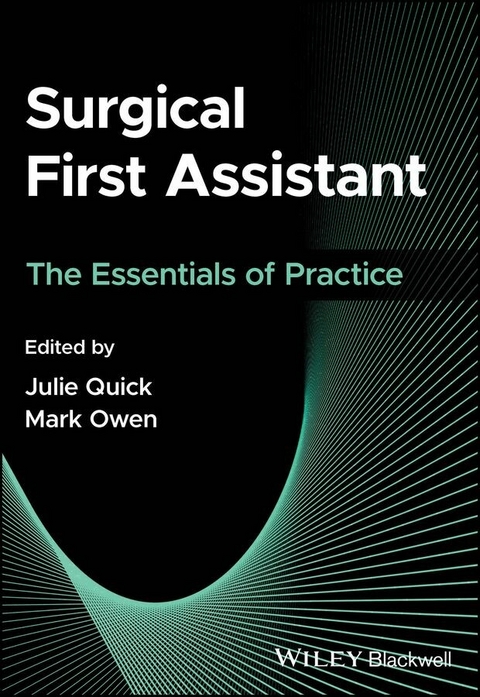
Surgical First Assistant (eBook)
274 Seiten
Wiley-Blackwell (Verlag)
978-1-394-21084-8 (ISBN)
A critical examination of an increasingly vital role in surgical practice
Surgical first assistants (SFAs) are registered nurses or operating department practitioners (ODPs) who play a crucial role in the operating theatre during surgical procedures. Under the direct supervision of the operating surgeon, an SFA provides continuous skilled assistance, performing a range of established responsibilities to assist the surgeon predominantly in the intraoperative phase of the patient's journey, but also in the pre- and post-operative phases. The role affords theatre nurses and ODPs the opportunity to expand their clinical responsibilities and provide assistance for patients undergoing surgery by undertaking post-qualifying education. More recently, an understanding of the knowledge and skills of the SFA role has been embedded into the undergraduate curricula for ODPs.
Surgical First Assistant: The Essentials of Practice provides a comprehensive and critical examination of the knowledge, skills and behaviours that are required by SFAs to ensure patient safety and quality care. Beginning with a historical overview of the SFA role, it proceeds to outline the legal, ethical and professional aspects of the role which allows the practitioner to critically reflect on SFA practice. It also offers an in-depth analysis of the SFA's responsibilities as defined by the Perioperative Care Collaborative through each phase of the patient's perioperative journey from pre-operative assessment to post-operative pain management.
Surgical First Assistant readers will also find:
- A text aligned with UK national standards and best practice
- Detailed discussion of topics including pre-operative preparation with the operating theatre, assisting with haemostasis, and many more
- An approach which explores both the technical and non-technical skills required by the SFA
Surgical First Assistant is ideal for registered nurses, ODPs, student and apprentice operating department practitioners.
Julie Quick, MSc, NMP, SCP, RN, is Senior Lecturer in Operating Department Practice at Birmingham City University, Birmingham, UK.
Mark Owen, SFA, ODP, is Senior Lecturer in Operating Department Practice at the University of Gloucestershire, Cheltenham, UK.
A critical examination of an increasingly vital role in surgical practice Surgical first assistants (SFAs) are registered nurses or operating department practitioners (ODPs) who play a crucial role in the operating theatre during surgical procedures. Under the direct supervision of the operating surgeon, an SFA provides continuous skilled assistance, performing a range of established responsibilities to assist the surgeon predominantly in the intraoperative phase of the patient s journey, but also in the pre- and post-operative phases. The role affords theatre nurses and ODPs the opportunity to expand their clinical responsibilities and provide assistance for patients undergoing surgery by undertaking post-qualifying education. More recently, an understanding of the knowledge and skills of the SFA role has been embedded into the undergraduate curricula for ODPs. Surgical First Assistant: The Essentials of Practice provides a comprehensive and critical examination of the knowledge, skills and behaviours that are required by SFAs to ensure patient safety and quality care. Beginning with a historical overview of the SFA role, it proceeds to outline the legal, ethical and professional aspects of the role which allows the practitioner to critically reflect on SFA practice. It also offers an in-depth analysis of the SFA s responsibilities as defined by the Perioperative Care Collaborative through each phase of the patient s perioperative journey from pre-operative assessment to post-operative pain management. Surgical First Assistant readers will also find: A text aligned with UK national standards and best practice Detailed discussion of topics including pre-operative preparation with the operating theatre, assisting with haemostasis, and many more An approach which explores both the technical and non-technical skills required by the SFA Surgical First Assistant is ideal for registered nurses, ODPs, student and apprentice operating department practitioners.
CHAPTER 1
The Historical Context of the Surgical First Assistant
Julie Quick1 and Mark Owen2
1 Birmingham City University, Birmingham, UK
2 University of Gloucestershire, Cheltenham, UK
As a non‐medical surgical assistant, the surgical first assistant (SFA) is an established role in many NHS Trusts and independent sector health organisations in the United Kingdom (UK). It is a role undertaken by registered practitioners who work as part of the extended surgical team, performing a range of established responsibilities to assist the surgeon, predominantly, in the intra‐operative phase of the patient’s journey but also in the pre‐ and post‐operative phases. Traditionally, the role afforded theatre nurses and operating department practitioners (ODPs) the opportunity to expand their clinical responsibilities and provide assistance for patients undergoing surgery by undertaking post‐qualifying education. More recently, an understanding of the knowledge and skills of the SFA role has been embedded into the undergraduate curricula for ODPs.
This chapter identifies the historical development of the SFA role from both clinical and academic viewpoints and affirms the SFA’s expert position as a wider member of the extended surgical team today. It briefly identifies the current responsibilities of the SFA that are further explored in subsequent chapters of the book.
THE ROLE OF THE NON‐MEDICAL SURGICAL ASSISTANT DURING CONFLICT
While the title ‘Surgical First Assistant’ has been in use since 2012, the role of the non‐medical surgical assistant is not a new concept and has been active within healthcare in the United Kingdom and overseas for many centuries in one role or another with varied titles. Rothrock (1999) identified that the non‐medical surgical assistant role has evolved significantly from the surgeons’ mates, who assisted on the battlefield and in hospitals in the 19th century. The first record of non‐medical surgical assistants was in the 19th Century when British nurses acted as surgeons’ assistants during the Crimean War. Under the direction and guidance of Florence Nightingale, they not only assisted with operations but also undertook additional skills to meet the high demand caused by the increasing number of casualties seen within hospitals at the time. Nurses were repeatedly called upon to act as surgeons’ assistants during times of conflict where, working under extreme conditions and with shortages of medical staff, the nurses perfected the role of first assistant; routinely assisting surgeons during operations but also expanding their role as required such as undertaking haemostasis and suturing (Rothrock 1999). This illustrates that non‐medical assistants were a valued addition to the surgical team and were able to develop their skills and abilities to fill the gaps caused by the shortage of medical colleagues. Following the notable success of nurses acting as first assistants in field hospitals during combat, non‐medical surgical assistant roles complete with certified training routes emerged from the 1960s onwards in the United States (Hains et al. 2017); however, unlike the early acceptance of non‐medical roles in other parts of the world, the SFA role took longer to establish in the United Kingdom.
The professional body, the College of Operating Department Practitioners (CODPs), in providing a historical overview of the development of the ODP profession, refers to several surgical assistance roles with some overlap (CODP 2021). These include ‘handlers’ who were employed by surgeons in the period prior to the development of anaesthesia to hold down patients. In the 19th century, ‘Surgerymen’ were responsible for seeing to instruments used by the surgeon, and ‘Box Carriers/Box Boys’ who were employed by the surgeon to carry boxes of instruments required by the operating surgeons. Beadles followed the surgeon and ensured cautery irons were kept heated and ready for immediate use by the operating surgeon (Pope 1962). A notable figure, Josiah Rampley, who attended approximately 40,000 operations as a surgical beadle, and whose name may appear familiar, invented the sponge holder and needle holder (CODP 2021; Pope 1962).
Lewin’s Report
Walpole Lewin’s report in 1970 on the organisation and staffing of operating departments recommended the training of a new grade of staff called operating department assistants who studied the City and Guilds 752 Hospital Operating Department Assistants training programme (CODP 2021). The City and Guilds’ training book, often referred to as the ‘blue book’, identified a number of skills including assisting with skin prep, draping of patients and identification, presentation and handling of instruments that may have been interpreted differently by different training centres and operating departments, and so some operating department assistants may have assisted the surgeon at this time.
CERTIFICATION
In the 1970s, the Department of Health and Social Security (1977) recognised the increasing contribution of nurses undertaking technical tasks that were either an extension of nursing practice or delegated by doctors. This recognition allowed registered nurses to extend their role following in‐house training, assessment and subsequent certification. The nurse acting as first assistant to the surgeon was one of these extended roles and certification for nurses continued through to the 1990s when the United Kingdom Central Council for Nurses, Midwives and Health Visitors (UKCC) became concerned that nurses were taking on additional skills erroneously under the impression that accountability was transferred to the assessor (McHale and Tingle 2007). Subsequent requirements, since replaced by the Nursing and Midwifery Council’s (NMC) Code of Conduct (2018), ensured that additional responsibilities undertaken by nurses were based upon the standards laid down in their professional frameworks. This guaranteed that nurses relied, and continue to rely, upon their clinical judgment supported by appropriate training to inform expanded practice.
NATIONAL ACCREDITATION
The implementation of national and international directives (National Health Service Management Executive 1991; Calman 1993; European Community 1993) in the early 1990s saw a number of clinical hours worked by medical staff reduce, and the time spent by surgical trainees in the clinical area condense. This led to a decline in the availability of doctors to assist routine operating lists. To overcome these shortages, theatre nurses – like nurses before them – stepped up to fill the gaps created by these directives. Taking on additional responsibilities ensured surgical services were maintained. Nurses, however, rapidly came under pressure to provide a level of assistance for which they were ill equipped. Hospitals introduced in‐house training programmes that Farrell (1999) argued were extremely varied and resulted in little or no standardisation of non‐medical surgical assistant roles. The National Association of Theatre Nurses (NATN) (now the Association for Perioperative Practice, to reflect the multidisciplinary theatre team) raised concerns over the sustainability of such practice and introduced guidelines to support nurses undertaking surgical assistant roles (NATN 1993, 1994). NATN issued additional guidance on developing non‐medically qualified roles within the perioperative environment that recommended clearly identified posts and nationally acceptable training programmes (NATN 1997). Consequently, the English National Board (ENB) for nursing, midwifery and health visiting which had the legal responsibility for nurse education, provided approval of the first nationally recognised first assistant course for nurses wishing to train as surgical assistants which were delivered by Schools of Nursing. The ENB also approved training for the Surgeon’s Assistant, the fore runner to the surgical care practitioner, a role undertaken by registered healthcare professionals who work as a member of the surgical team, but unlike the SFA, can perform some surgical interventions (RCS n.d.).
In the early 1990s, a consultation to assess the contribution of all non‐medical surgical assistants was undertaken and following positive reviews a joint working party was set up between the Royal College of Nursing (RCN) and the Royal College of Surgeons of England (RCS) to advance the concept of non‐medically qualified surgical assistants in practice. This group proposed that both nurses and allied health professionals could be safely trained to perform a variety of perioperative skills including assisting with surgery (RCS 1994). The addition of a non‐medical surgical assistant to the surgical team was considered to expedite surgery and improve patient care (DH 1999).
NATIONAL ASSOCIATION OF ASSISTANTS IN SURGICAL PRACTICE
In 2001, a voluntary professional body, the National Association of Assistants in Surgical Practice (NAASP), emerged to provide guidance and support for practitioners undertaking non‐medical surgical assistant roles or looking to implement them. NAASP published the advanced scrub practitioner (ASP) toolkit which defined the knowledge, skills and standards of the ASP role (Thatcher...
| Erscheint lt. Verlag | 11.12.2024 |
|---|---|
| Sprache | englisch |
| Themenwelt | Medizin / Pharmazie ► Medizinische Fachgebiete ► Chirurgie |
| Schlagworte | haemostasis • Human Factors • instrument handling • Medical Ethics • Non-technical skills • operating department • operating department practice • operating department practitioner • pain management • perioperative procedures • Preoperative Assessment • professional standards • Registered Nurses • surgical first assistance • surgical first assistant • Surgical Practice • tissue handling and retraction • Wound closure • wound management |
| ISBN-10 | 1-394-21084-1 / 1394210841 |
| ISBN-13 | 978-1-394-21084-8 / 9781394210848 |
| Informationen gemäß Produktsicherheitsverordnung (GPSR) | |
| Haben Sie eine Frage zum Produkt? |
 EPUB (Adobe DRM)
Kopierschutz: Adobe-DRM
Adobe-DRM ist ein Kopierschutz, der das eBook vor Mißbrauch schützen soll. Dabei wird das eBook bereits beim Download auf Ihre persönliche Adobe-ID autorisiert. Lesen können Sie das eBook dann nur auf den Geräten, welche ebenfalls auf Ihre Adobe-ID registriert sind.
Details zum Adobe-DRM
Dateiformat: EPUB (Electronic Publication)
EPUB ist ein offener Standard für eBooks und eignet sich besonders zur Darstellung von Belletristik und Sachbüchern. Der Fließtext wird dynamisch an die Display- und Schriftgröße angepasst. Auch für mobile Lesegeräte ist EPUB daher gut geeignet.
Systemvoraussetzungen:
PC/Mac: Mit einem PC oder Mac können Sie dieses eBook lesen. Sie benötigen eine
eReader: Dieses eBook kann mit (fast) allen eBook-Readern gelesen werden. Mit dem amazon-Kindle ist es aber nicht kompatibel.
Smartphone/Tablet: Egal ob Apple oder Android, dieses eBook können Sie lesen. Sie benötigen eine
Geräteliste und zusätzliche Hinweise
Buying eBooks from abroad
For tax law reasons we can sell eBooks just within Germany and Switzerland. Regrettably we cannot fulfill eBook-orders from other countries.
aus dem Bereich