


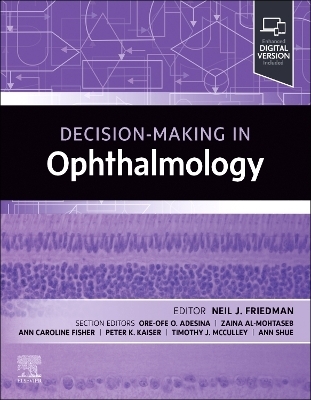
Decision-Making in Ophthalmology
Decision Making Series
Seiten
2026
Elsevier - Health Sciences Division (Verlag)
978-0-323-93040-6 (ISBN)
Elsevier - Health Sciences Division (Verlag)
978-0-323-93040-6 (ISBN)
- Noch nicht erschienen (ca. Juni 2026)
- Versandkostenfrei
- Auch auf Rechnung
- Artikel merken
Think systematically and follow a logical sequence throughout the steps of diagnostic decisions with Decision-Making in Ophthalmology. This valuable resource is perfect for ophthalmologists and trainees, as well as optometrists and primary care and emergency medicine physicians who need to make informed decisions about their patients' care on a day-to-day basis. Practical and easy to use, it’s filled with work-up and diagnostic algorithms that provide easy-to-follow guidance when encountering patients whose clinical presentation is unfamiliar or complex. Each point-of-care algorithm represents a common ophthalmic problem or disease, and offers a concise visual representation that clearly guides you through the steps of efficient and effective decision making.
Contains more than 230 algorithms with accompanying explanations, covering common general signs and symptoms as well as specific eye disorders, organized by subspecialty area
Covers all ophthalmic subspecialties, including orbit and lid, neuro-ophthalmology, pediatrics and strabismus, cornea and external disease, lens/cataract, glaucoma, posterior segment, trauma, and tumors
Color-coded for ease of understanding, helping you differentiate between the key information to gather and questions to consider, actions to take, and any relevant differential diagnoses
Provides step-by-step guidance for diagnosis of common complaints like vision loss, double vision, eye pain, red eye, and tearing; evaluation for elective procedures such as cosmetic eyelid surgery and refractive surgery; the latest treatment for dry eye disease, glaucoma, macular degeneration, childhood myopia, and retinopathy of prematurity; the use of ophthalmic viscoelastic devices and advanced technology intraocular lenses; management of refractive, cataract, and glaucoma intraoperative and postoperative surgical complications; approaches to traumatic injuries and non-accidental trauma; and much more
Shares the knowledge and expertise of editor Dr. Neil J. Friedman, who is joined by section editors who lend a well-rounded perspective across ophthalmic subspecialties: Drs. Ore-Ofe O. Adesina, Zaina Al-Mohtaseb, Ann Caroline Fisher, Peter K. Kaiser, Timothy J. McCulley, and Ann Shue
An eBook version is included with purchase. The eBook allows you to access all of the text, figures, and references, with the ability to search, customize your content, make notes and highlights, and have content read aloud. Additional digital ancillary content may publish up to 6 weeks following the publication date
Contains more than 230 algorithms with accompanying explanations, covering common general signs and symptoms as well as specific eye disorders, organized by subspecialty area
Covers all ophthalmic subspecialties, including orbit and lid, neuro-ophthalmology, pediatrics and strabismus, cornea and external disease, lens/cataract, glaucoma, posterior segment, trauma, and tumors
Color-coded for ease of understanding, helping you differentiate between the key information to gather and questions to consider, actions to take, and any relevant differential diagnoses
Provides step-by-step guidance for diagnosis of common complaints like vision loss, double vision, eye pain, red eye, and tearing; evaluation for elective procedures such as cosmetic eyelid surgery and refractive surgery; the latest treatment for dry eye disease, glaucoma, macular degeneration, childhood myopia, and retinopathy of prematurity; the use of ophthalmic viscoelastic devices and advanced technology intraocular lenses; management of refractive, cataract, and glaucoma intraoperative and postoperative surgical complications; approaches to traumatic injuries and non-accidental trauma; and much more
Shares the knowledge and expertise of editor Dr. Neil J. Friedman, who is joined by section editors who lend a well-rounded perspective across ophthalmic subspecialties: Drs. Ore-Ofe O. Adesina, Zaina Al-Mohtaseb, Ann Caroline Fisher, Peter K. Kaiser, Timothy J. McCulley, and Ann Shue
An eBook version is included with purchase. The eBook allows you to access all of the text, figures, and references, with the ability to search, customize your content, make notes and highlights, and have content read aloud. Additional digital ancillary content may publish up to 6 weeks following the publication date
Adjunct Clinical Professor Neil J. Friedman works in the Department of Ophthalmology at Stanford University School of Medicine, Partner, Mid-Peninsula Ophthalmology Medical Group, Menlo Park, CA, USA.
Working TOC:
Part 1: Common Signs and Symptoms
Section 1: Symptoms
Section 2: Signs
Part 2: Specific Ocular Disorders
Section 3: Orbit/Lid
Section 4: Neuro-ophthalmology
Section 5: Pediatrics/Strabismus
Section 6: Cornea/External Disease
Section 7: Anterior Segment
Section 8: Cataracts ad Glaucoma
Section 10: Uveitis
Section 11: Posterior Segment
| Erscheint lt. Verlag | 19.6.2026 |
|---|---|
| Reihe/Serie | Decision Making |
| Verlagsort | Philadelphia |
| Sprache | englisch |
| Maße | 216 x 276 mm |
| Gewicht | 450 g |
| Themenwelt | Medizin / Pharmazie ► Medizinische Fachgebiete ► Augenheilkunde |
| ISBN-10 | 0-323-93040-9 / 0323930409 |
| ISBN-13 | 978-0-323-93040-6 / 9780323930406 |
| Zustand | Neuware |
| Informationen gemäß Produktsicherheitsverordnung (GPSR) | |
| Haben Sie eine Frage zum Produkt? |
Mehr entdecken
aus dem Bereich


aus dem Bereich
1100 kommentierte Prüfungsfragen
Buch (2025)
Thieme (Verlag)
CHF 179,95
Ein systematischer Ansatz
Buch | Hardcover (2022)
Urban & Fischer in Elsevier (Verlag)
CHF 369,95


