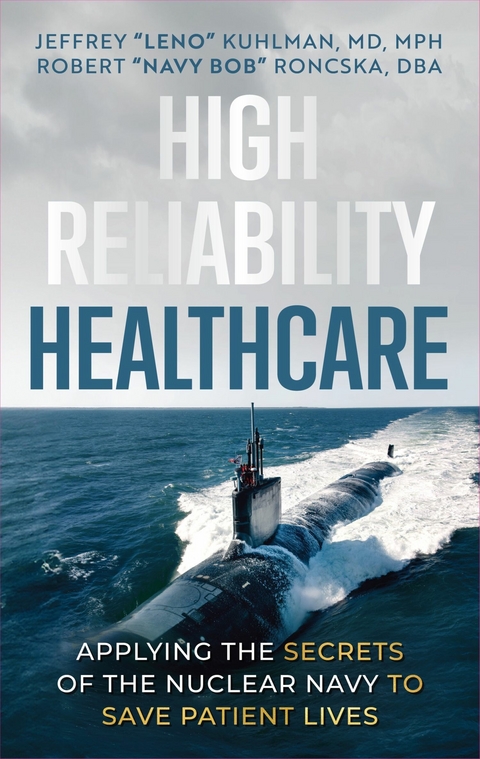
High Reliability Healthcare (eBook)
210 Seiten
Ballast Books (Verlag)
9781964934631 (ISBN)
Robert 'Navy Bob' Roncska, DBA, had a distinguished twenty-eight-year career in the US Navy, serving as the Pacific Fleet's top fast-attack submarine commodore and as the naval aide to President George W. Bush. He is currently a national speaker on leadership and high reliability, as well as an adjunct professor at the University of Central Florida School of Global Health Management and Informatics.
Mistakes can be fatal-this reality is all too familiar in the healthcare industry. Do you want better clinical outcomes, fewer errors, increased productivity, and highly reliable patient care? High Reliability Healthcare offers some actionable tips from the safest and most reliable industry ever: the nuclear navy. For over seventy-five years, the nuclear navy has operated highly enriched nuclear reactors with sailors in their twenties at the helm and has never experienced an accident. As Forbes reported, "e;The [US] Nuclear Navy has the best safety record of any industry."e;Jeffrey Kuhlman, MD, MPH, a retired navy physician and physician to the president, and Robert Roncska, DBA, a retired navy captain in the nuclear navy who carried the nuclear codes (AKA the football) for President George W. Bush, understand this better than anyone. After excelling as leaders in the military, they recognized the organizational leadership and team-building skills they learned in the US Nuclear Navy could be applied to healthcare an industry in dire need of an upgrade. With hundreds of thousands of patients becoming permanently disabled or dying each year due to medical errors, it's clear that the old approach to healthcare safety isn't working. Kuhlman and Roncska propose applying the wisdom of an unlikely mentor the US Nuclear Navy to patient care. In High Reliability Healthcare, they provide practical tools to turn healthcare into a high-reliability organization one that is safe and efficient even in a high-risk environment. They're ready to bring to healthcare what the nuclear navy has been successfully practicing for over seventy-five years.
INTRODUCTION
As the negligent homicide conviction and sentencing of nurse RaDonda Vaught recently unfolded, healthcare workers across the nation watched on with empathy and a dread of making a similar mistake themselves one day.
Vaught’s tragic error, which led to the death of seventy-five-year-old Charlene Murphey, occurred at Vanderbilt University Medical Center (VUMC) on December 26, 2017.1 With two years of experience, Vaught was busy as a float nurse helping other nurses as needed with multiple patients and training an orientee.2 Murphey, who had been admitted to VUMC due to dizziness and vision loss, was to undergo a positron emission tomography (PET) scan that day. Her physician had ordered her a sedative, Versed, to calm her anxiety prior to the procedure. Since Murphey’s primary nurse was occupied, the task of administering the medication fell to Vaught.
When Vaught accessed the automatic dispensing cabinet (ADC) for the appropriate medication, she didn’t recognize the drug in the patient’s profile by its generic name. Looking for Versed, she overrode the patient’s profile and typed “VE” into the computer search, then clicked on the first medication that appeared—vecuronium, a paralytic drug. Without confirming she had the correct medication, either at the ADC or the patient’s bedside, and without recognizing the physical differences between the two medications, Vaught gave the vecuronium to Murphey, then left her alone and unmonitored. Murphey died the next day as a direct result of the error.
Though Vaught immediately owned and reported the mistake to her employer, VUMC was not so transparent. The hospital reacted to the event by firing Vaught, negotiating a settlement with the family, hiding the incident from both the public and the state, and recording Murphey’s cause of death as “natural causes.” The full story didn’t come to light until ten months later when an anonymous tip prompted an investigation.
While there’s no denying Vaught messed up—as busy, distracted humans inevitably do—the bigger question is how did the system fail? What missing safeguards and contributing factors at VUMC led to such an error?
There were many holes in VUMC’s process. For instance, because an upgrade to the medical records at VUMC that year caused continuous slowdowns, nurses were instructed to override the ADC to avoid delays, and they did so on a daily basis.3 Despite the risks of ignoring the safeguard, VUMC required neither a second set of eyes to confirm medications obtained by override nor medication barcoding at the bedside.
In the British Journal of Anaesthesia, Dr. Connor Lusk and her fellow authors write of the tragedy, “RaDonda Vaught did not come to work that day to deliberately contribute to Charlene Murphey’s death but was set up to fail by a system that allowed a fatal mistake to happen.”4
Fatal Mistakes
Sadly, fatal mistakes are not rare in healthcare but an all-too-common occurrence. This became distressingly evident nearly a quarter of a century ago when the US Institute of Medicine warned of a nationwide healthcare crisis. A now-famous report titled To Err is Human: Building a Safer Health System called for a radical overhaul of US healthcare to reduce an alarming number of errors, mistakes, and failings that led annually to a huge number of patient injuries and deaths.5
In response, a whole cottage industry focused on building high reliability organizations (HROs) quickly developed. Hoping to make American healthcare significantly safer and more reliable, most improvement efforts since then have referred back to the principles of high reliability suggested by Karl Weick and Kathleen Sutcliffe (see Chapter 1). However, as Vaught’s story so painfully demonstrates, healthcare has not become highly reliable. In fact, it hasn’t even come close.
While we put the final touches on High Reliability Healthcare, we learned of an alarming report from the Johns Hopkins Armstrong Institute Center for Diagnostic Excellence. It estimated that 371,000 patients die and 424,000 become permanently disabled every year due to misdiagnoses, with a huge number of those errors being preventable. The report claimed that medical providers misdiagnose diseases about 11 percent of the time, with strokes misdiagnosed more than 17.5 percent of the time. Nearly 40 percent of all deaths and permanent disabilities can be traced to the incorrect diagnosis of just five diseases: stroke, sepsis, pneumonia, blood clots, and lung cancer. If medical professionals could reduce diagnostic errors by half in these five categories, the Johns Hopkins report said, we could decrease permanent disabilities and deaths by 150,000 a year.6
Such statistics are shocking and heartbreaking and cannot be ignored. We must spend time absorbing such reports and reflecting on how we got to this point. Why haven’t we done better?
An Urgent Question
We have witnessed amazing developments in technology and artificial intelligence since the arrival of the twenty-first century, but our rates of safety and reliability have barely moved. We also enjoy a wealth of consultants and management strategies, but those, too, have failed to improve our record of success.
We face an urgent question today: Why do we continue to believe that the academic approach we’ve been chasing high reliability with will work eventually when it hasn’t made an appreciable difference in twenty years?
A recent article in The New England Journal of Medicine described our problem. It concluded that “adverse events during hospitalization are a major cause of patient harm,” not unlike the same problem highlighted more than thirty years ago in the Harvard Medical Practice Study.7 The NEJM study identified “adverse events” in nearly one in four admissions, with approximately one-fourth of those events preventable. “These findings underscore the importance of patient safety and the need for continuing improvement,” the report said.8
But how can we improve patient safety? And how can we make those improvements continual? We’ve seen more than enough evidence that the time has come to try something else.
But what could that “something else” be if it’s not technology, new management systems, or AI?
An Unlikely Mentor
Both of us have extensive backgrounds in the US Navy. Over our decades there, we gained invaluable knowledge and experience related to safety and reliability.
Jeff is an MD with thirty years of naval medicine experience, sixteen of those years spent caring for US presidents (physician to the forty-fourth president, director of the White House medical unit, White House physician, and senior flight surgeon for Marine One from 1997–2013). Jeff has traveled to more than ninety countries, reviewing their healthcare resources. He currently serves as chief quality and safety officer for America’s largest hospital, guiding quality, risk, safety, and transformation.
Bob spent twenty-eight years in the US Navy, where he captained the nuclear submarine USS Texas and then served as commodore to Submarine Squadron 7 of the Pacific fleet, the largest nuclear submarine squadron in the world. Dubbed “Navy Bob” by President George W. Bush, he served as the naval aide to the president and carried the “nuclear football.” After retiring from the navy, Bob spent four years at AdventHealth as executive director for quality and safety. He now teaches courses on quality, leadership, and policy at the University of Central Florida. It should be noted that there has never been another officer of his seniority, trained in the culture of the nuclear navy, who has been a clinical safety leader within one of our nation’s largest hospital systems. His experience uniquely positions him to map the critical differences in safety practices between the nuclear navy and the healthcare industry.
A core part of the message of High Reliability Healthcare proposes that the US nuclear navy offers healthcare a treasure trove of insight and experience into how to operate in a far safer and more reliable way. While we’ll delve into the details in Parts Two and Three of this book, for now it’s enough to say that the organizational ecosystem developed by Admiral Hyman G. Rickover three-quarters of a century ago has spared the nuclear navy from suffering even one nuclear reactor accident since it launched its first nuclear submarine in 1954. The ecosystem Rickover created has made the nuclear navy the world’s most highly reliable organization—and the same concepts that fuel the nuclear navy’s incredible success can also transform healthcare into a truly safe and reliable enterprise.
Let’s Start a Movement
If you’ve concluded that we want to make a big change, you’re right. We’ve grown weary of seminars that present studies proving we’ve made no significant progress in making healthcare safer, and then continue to present the old familiar script.
Simply put, we’re stuck. More than twenty years ago, as an industry, we turned to a scholarly study designed to investigate how airlines and other organizations could best recover from disasters. We felt desperate to improve our safety and reliability but didn’t consider how we could make the findings of that academic study resonate with our...
| Erscheint lt. Verlag | 3.12.2024 |
|---|---|
| Sprache | englisch |
| Themenwelt | Medizin / Pharmazie ► Pflege |
| ISBN-13 | 9781964934631 / 9781964934631 |
| Informationen gemäß Produktsicherheitsverordnung (GPSR) | |
| Haben Sie eine Frage zum Produkt? |
 EPUB (Ohne DRM)
Größe: 2,9 MB
Digital Rights Management: ohne DRM
Dieses eBook enthält kein DRM oder Kopierschutz. Eine Weitergabe an Dritte ist jedoch rechtlich nicht zulässig, weil Sie beim Kauf nur die Rechte an der persönlichen Nutzung erwerben.
Dateiformat: EPUB (Electronic Publication)
EPUB ist ein offener Standard für eBooks und eignet sich besonders zur Darstellung von Belletristik und Sachbüchern. Der Fließtext wird dynamisch an die Display- und Schriftgröße angepasst. Auch für mobile Lesegeräte ist EPUB daher gut geeignet.
Systemvoraussetzungen:
PC/Mac: Mit einem PC oder Mac können Sie dieses eBook lesen. Sie benötigen dafür die kostenlose Software Adobe Digital Editions.
eReader: Dieses eBook kann mit (fast) allen eBook-Readern gelesen werden. Mit dem amazon-Kindle ist es aber nicht kompatibel.
Smartphone/Tablet: Egal ob Apple oder Android, dieses eBook können Sie lesen. Sie benötigen dafür eine kostenlose App.
Geräteliste und zusätzliche Hinweise
Buying eBooks from abroad
For tax law reasons we can sell eBooks just within Germany and Switzerland. Regrettably we cannot fulfill eBook-orders from other countries.
aus dem Bereich