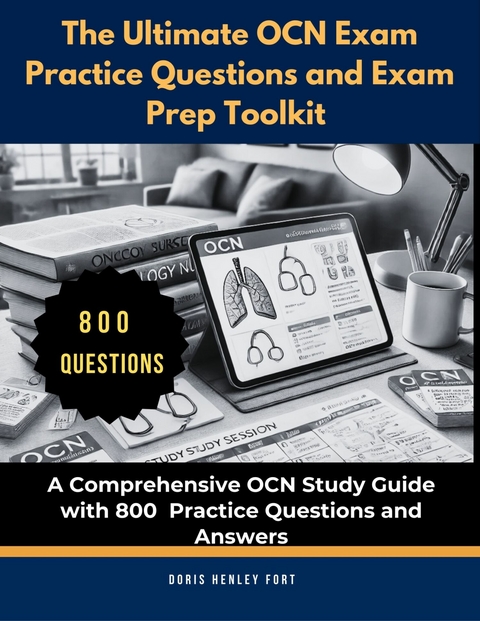
Ultimate OCN Exam Practice Questions and Exam Prep Toolkit (eBook)
350 Seiten
Publishdrive (Verlag)
978-1-7637425-7-4 (ISBN)
The Ultimate OCN Exam Prep Toolkit: Comprehensive Study Guide and Practice Question Bank is your all-in-one resource for mastering the Oncology Certified Nurse (OCN) exam. This essential toolkit provides a thorough and detailed study guide covering all exam topics, along with over 1,000 practice questions complete with detailed rationales to reinforce your understanding and test your knowledge.
Key features include:
Extensive Coverage of All OCN Exam Topics: Comprehensive chapters that delve into cancer biology, treatment modalities, symptom management, and more.
1,000+ Practice Questions: Test your knowledge with a vast bank of practice questions, each accompanied by detailed explanations to enhance learning.
Interactive Study Planner and Progress Tracker: Customize your study schedule, set goals, and track your progress with tools designed to fit your learning style.
Expert Tips and Strategies: Benefit from the wisdom and insights of OCN-certified professionals, including study strategies, exam-day tips, and personal anecdotes to keep you motivated and on track.
If you're a seasoned oncology nurse or new to the field, this guide is designed to provide the knowledge, tools, and confidence you need to excel on the OCN exam and advance your career in oncology nursing.
The Ultimate OCN Exam Prep Toolkit: Comprehensive Study Guide and Practice Question Bank is your all-in-one resource for mastering the Oncology Certified Nurse (OCN) exam. This essential toolkit provides a thorough and detailed study guide covering all exam topics, along with over 1,000 practice questions complete with detailed rationales to reinforce your understanding and test your knowledge.Key features include:Extensive Coverage of All OCN Exam Topics: Comprehensive chapters that delve into cancer biology, treatment modalities, symptom management, and more.1,000+ Practice Questions: Test your knowledge with a vast bank of practice questions, each accompanied by detailed explanations to enhance learning.Interactive Study Planner and Progress Tracker: Customize your study schedule, set goals, and track your progress with tools designed to fit your learning style.Expert Tips and Strategies: Benefit from the wisdom and insights of OCN-certified professionals, including study strategies, exam-day tips, and personal anecdotes to keep you motivated and on track.If you're a seasoned oncology nurse or new to the field, this guide is designed to provide the knowledge, tools, and confidence you need to excel on the OCN exam and advance your career in oncology nursing.
- Cell Cycle Phases:
- G1 Phase (Gap 1): The cell grows and performs its normal functions. The cell checks for DNA damage and prepares for DNA replication.
- S Phase (Synthesis): DNA replication occurs, resulting in two identical sets of chromosomes.
- G2 Phase (Gap 2): The cell continues to grow and prepares for mitosis. The cell checks for any DNA damage that may have occurred during replication.
- M Phase (Mitosis): The cell divides its copied DNA and cytoplasm to form two new cells. Mitosis is divided into several stages: prophase, metaphase, anaphase, and telophase.
- Regulation of the Cell Cycle:
- The cell cycle is controlled by a complex set of signaling pathways involving proteins called cyclins and cyclin-dependent kinases (CDKs).
- Checkpoints at G1, G2, and M phases ensure that the cell only progresses to the next stage if conditions are favorable and the DNA is undamaged.
- Loss of Cell Cycle Control:
- Mutations in genes that regulate the cell cycle can lead to cancer. For example, mutations in tumor suppressor genes (e.g., p53) and proto-oncogenes (e.g., Ras) can disrupt normal cell cycle control.
- Tumor suppressor genes normally act as brakes on cell division, whereas proto-oncogenes promote cell division. When these genes are mutated, they can cause cells to divide uncontrollably.
- Evasion of Apoptosis:
- Apoptosis, or programmed cell death, is a mechanism that allows the body to eliminate damaged or unnecessary cells. Cancer cells often evade apoptosis, allowing them to survive and proliferate despite abnormalities.
- Induced Angiogenesis:
- Cancer cells can stimulate the formation of new blood vessels (angiogenesis) to supply the growing tumor with oxygen and nutrients.
- Point Mutations:
- A single nucleotide change in the DNA sequence. This can result in a change in a single amino acid in a protein, potentially altering its function.
- Insertions and Deletions:
- Addition or loss of small segments of DNA. These mutations can cause frameshifts, leading to significant changes in protein structure and function.
- Copy Number Variations:
- Changes in the number of copies of a particular gene. This can lead to an overexpression or underexpression of genes involved in cell growth and division.
- Chromosomal Translocations:
- Parts of chromosomes break off and attach to other chromosomes. This can create fusion genes that drive cancer development, such as the BCR-ABL fusion gene in chronic myelogenous leukemia (CML).
- Oncogenes:
- Oncogenes are mutated forms of proto-oncogenes, which normally promote cell growth and division. When proto-oncogenes are mutated or overexpressed, they become oncogenes and drive uncontrolled cell proliferation.
- Example: The HER2 gene, which is amplified in some breast cancers, leading to increased cell growth signals.
- Tumor Suppressor Genes:
- Tumor suppressor genes normally inhibit cell growth and division, ensuring that cells do not proliferate uncontrollably. Mutations in these genes result in a loss of function, removing these growth-inhibitory signals.
- Example: The TP53 gene, which encodes the p53 protein, a crucial regulator of the cell cycle and apoptosis. Mutations in TP53 are common in many types of cancer.
- Initiation:
- Initiation involves a genetic mutation in a single cell. This mutation can be caused by various factors, including exposure to carcinogens (e.g., tobacco smoke, UV radiation), inherited genetic mutations, or spontaneous errors during DNA replication.
- Promotion:
- During promotion, the initiated cell undergoes clonal expansion. This stage is characterized by the proliferation of mutated cells, which are stimulated by factors such as chronic inflammation, hormones, or other growth-promoting signals.
- Progression:
- In the progression stage, additional genetic and epigenetic changes accumulate, leading to increased malignancy. These changes can enhance the cancer cells' ability to invade surrounding tissues, evade the immune system, and metastasize to distant sites.
- Curative Surgery:
- Intended to remove all cancerous tissue and achieve a cure. Often used for localized cancers.
- Example: Lumpectomy for breast cancer.
- Palliative Surgery:
- Aimed at relieving symptoms and improving quality of life, not curing the disease.
- Example: Surgery to remove part of a tumor causing pain or obstruction.
- Reconstructive Surgery:
- Restores appearance or function after the primary cancer surgery.
- Example: Breast reconstruction after mastectomy.
- Preventative (Prophylactic) Surgery:
- Removes tissue that has a high risk of developing cancer.
- Example: Prophylactic mastectomy in patients with BRCA1 or BRCA2 mutations.
- Open Surgery: Traditional method involving large incisions.
- Minimally Invasive Surgery: Uses smaller incisions and...
| Erscheint lt. Verlag | 6.11.2024 |
|---|---|
| Sprache | englisch |
| Themenwelt | Medizin / Pharmazie ► Medizinische Fachgebiete ► Onkologie |
| Schlagworte | Detailed study planner for OCN exam • OCN Exam Practice Questions • OCN Exam Prep 2025 • OCN exam preparation comprehensive guide • Oncology nurse certification study resources • Practice questions for OCN certification • Strategies for passing OCN certification exam |
| ISBN-10 | 1-7637425-7-1 / 1763742571 |
| ISBN-13 | 978-1-7637425-7-4 / 9781763742574 |
| Informationen gemäß Produktsicherheitsverordnung (GPSR) | |
| Haben Sie eine Frage zum Produkt? |
 EPUB (Ohne DRM)
Digital Rights Management: ohne DRM
Dieses eBook enthält kein DRM oder Kopierschutz. Eine Weitergabe an Dritte ist jedoch rechtlich nicht zulässig, weil Sie beim Kauf nur die Rechte an der persönlichen Nutzung erwerben.
Dateiformat: EPUB (Electronic Publication)
EPUB ist ein offener Standard für eBooks und eignet sich besonders zur Darstellung von Belletristik und Sachbüchern. Der Fließtext wird dynamisch an die Display- und Schriftgröße angepasst. Auch für mobile Lesegeräte ist EPUB daher gut geeignet.
Systemvoraussetzungen:
PC/Mac: Mit einem PC oder Mac können Sie dieses eBook lesen. Sie benötigen dafür die kostenlose Software Adobe Digital Editions.
eReader: Dieses eBook kann mit (fast) allen eBook-Readern gelesen werden. Mit dem amazon-Kindle ist es aber nicht kompatibel.
Smartphone/Tablet: Egal ob Apple oder Android, dieses eBook können Sie lesen. Sie benötigen dafür eine kostenlose App.
Geräteliste und zusätzliche Hinweise
Buying eBooks from abroad
For tax law reasons we can sell eBooks just within Germany and Switzerland. Regrettably we cannot fulfill eBook-orders from other countries.
aus dem Bereich