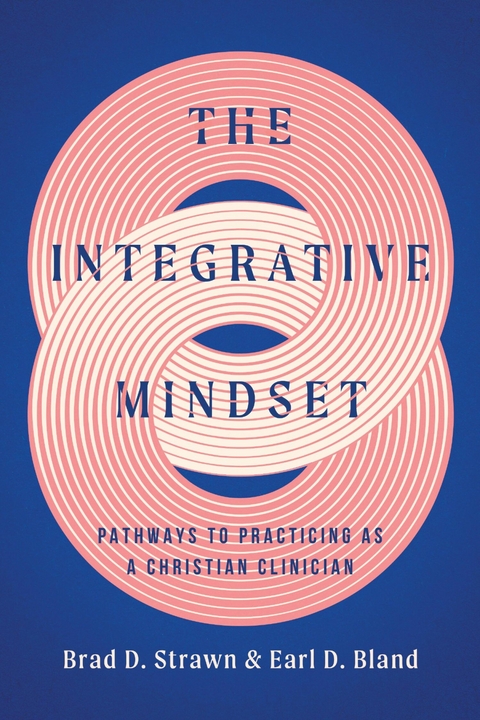
The Integrative Mindset (eBook)
192 Seiten
IVP Academic (Verlag)
978-1-5140-0221-6 (ISBN)
Brad D. Strawn (PhD, Fuller Theological Seminary) is the Evelyn and Frank Freed Professor of the Integration of Psychology and Theology at Fuller Theological Seminary, School of Psychology. He has post-doctoral training in psychoanalysis and is a licensed psychologist.He is coauthor (with Warren S. Brown) of The Physical Nature of Christian Life: Neuroscience, Psychology and the Church (2012, Cambridge) and coeditor of Wesleyan Theology and Social Science: The Dance of Practical Divinity and Discovery (Cambridge). Strawn has also published widely on psychology, psychoanalysis and Wesleyan theology.
Brad D. Strawn (PhD, Fuller Theological Seminary) is the Evelyn and Frank Freed Professor of the Integration of Psychology and Theology at Fuller Theological Seminary, School of Psychology. He has post-doctoral training in psychoanalysis and is a licensed psychologist.He is coauthor (with Warren S. Brown) of The Physical Nature of Christian Life: Neuroscience, Psychology and the Church (2012, Cambridge) and coeditor of Wesleyan Theology and Social Science: The Dance of Practical Divinity and Discovery (Cambridge). Strawn has also published widely on psychology, psychoanalysis and Wesleyan theology. Earl D. Bland (PsyD, Illinois School of Professional Psychology; PsyD, Institute of Contemporary Psychoanalysis, Los Angeles) is a clinical psychologist, psychoanalyst, professor of psychology at Biola University's Rosemead School of Psychology, and faculty member at the Institute of Contemporary Psychoanalysis, Los Angeles. He has authored numerous articles and is coeditor of Christianity and Psychoanalysis.
1
Emergence Matters
Illuminating the Integrative Moment
It’s the first session with a brand-new client. Paperwork has been filled out, introductions have been made, you and the client have both sat down on comfortable furniture, and now you’ve invited the client to explain what has brought them to see you today. But instead of answering your question, they turn and ask, “You’re religious, right?”
What do you say? Why is the client asking this? What exactly are they asking? Is this a trap, a defense, an attack, a plea for attachment and solidarity, or something else entirely? How do you incorporate this into therapeutic work? Is talking about religion even okay in therapy? What if the client wants to say more about their faith or is interested in yours? What if they want to talk about what their faith has to do with their psychological issues? Is this a moment of integration of psychology and theology, and if so, what do you do?
Over the years we have had the privilege of conducting and supervising therapy with countless clients who professed religious faith. So, over the years we have heard lots of stories. We have worked with deeply religious clients who said they were afraid to come to therapy because they were told by their Christian friends and pastors that psychology was dangerous and should be avoided. We’ve heard these same believers say that instead of coming to counseling they were told that they should have more faith and pray harder. Yet somehow, when all their religious resources disappointed them, they found their way to our offices. On the other end of the spectrum, we have had religious clients come to us saying that if we even mentioned God or the Bible, they would find another therapist. We’ve even had nonreligious clients say that they had come to see us because even though they were not religious, they thought that maybe there was something spiritual in the world that they might benefit from thinking more about.
We have also had the honor of training students of faith to become psychologists or counselors who were authentically intent in their desire to bring together religion/spirituality with their psychological knowledge. From these students we have also heard stories. Students have told us that they love psychology and love their faith, but they just can’t get their mind around how to put these two into meaningful conversation, especially in practical ways they can apply in their clinical work. We have had students wonder whether they are truly integrating their faith into their practice if they are not talking about God or Scripture or engaging in some practice of faith. We have had students (and peers) who were so afraid of integrating faith poorly that they consciously (and unconsciously) avoided the subject altogether, even when the client practically brought it up. We’ve had students who prayed with a client as soon as the client asked for it and others who adamantly refused, saying, “I’m a psychologist, not a pastor.” We’ve even had students who, while not afraid to ask clients about their personal sex life, finances, or their culture, were terrified to bring up the issue of religion or spirituality, saying, “It’s just so personal.”
In general, we find that the idea of integration is attractive and desired by our students and colleagues, but the actual embodiment of an integrative clinical posture has been somewhat illusive. We especially find this with our students from various non-White cultures, who often remark that the writing, research, and theorizing around the integration of psychology and theology is primarily White, patriarchal, and of a Reformed theological persuasion.
So, while integration, a term we will define below, has been around for at least fifty years, there is still much confusion about what it is, how to define it, and, for the focus of this book, how to engage it in clinical practice. Our desire is to make the clinical experience of integration more accessible and applicable to everyday work with clients. We specifically want to address the gap so many Christian therapists and counselors encounter when they attempt to bridge the theory or idea of integration and the real-world clinical relationships.
We begin by drawing a parallel with a phrase that our good friend and early integrator John Carter was fond of saying. John would often say that Christians were interested in “thinking Christian thoughts,” but they should be more concerned with “thinking Christianly.” We believe too that many Christian therapists are interested in “integrative thoughts” (e.g., models, formulas, manuals), but we want to challenge integrators to “think integratively.” Semantically, an adverb always modifies another word and usually answers a question such as “How?” If one is thinking Christianly, Christianly is modifying the verb thinking, and therefore we can expect that there is some process to how one is thinking. In thinking integratively, integratively modifies thinking and also suggests a process or a how. Importantly, when we say thinking in this context, we are not referring to an abstract intellectual process, although clearly that is an element of what we are considering. Rather, because all thinking is embodied, we recognize that thinking is a deeply affective experience. Consequently, integrative practice involves the total you—thoughts, feelings, emotional states, and bodily sensations. This book is our attempt to offer a process of how to think integratively, or perhaps how to be integrative, and why it matters. This process will include five domains (the matters that make integration matter): hermeneutics, tradition, ethics, self-development, and resilience. But first let us return to integration itself.
A BRIEF HISTORY OF INTEGRATION TOLD IN FIVE WAVES
While there is an entire literature on interdisciplinary work, some of which we will touch on in later chapters, our focus is on the integration of psychology and theology. In 1953 psychologist Fritz Kunkel first used the term integration to describe interdisciplinary activity between psychology and theology. While Kunkel was a major pioneer in the fledgling integration movement, the pastoral psychology movement grabbed hold of the phrase and begin to popularize it (Vande Kemp, 1996). Over time, integration has come to mean many things.
Since the fifties the term integration has been used in diverse ways, including (but not limited to) the integration of psychology and Christianity, psychology and religion, psychology and theology (faith and practice, belief and life), psychology and Christian faith, psychology and spirituality, and even psychotherapy and spirituality (Strawn, 2016).
For much of its history, the project to find a satisfactory outcome to the meeting of modern psychology and Christianity has been consumed with developing models of engagement that provide a scaffold or framework for the actual work of integration. This endeavor has produced a remarkable number of diverse and thought-provoking books and journal articles, so much so that some have labeled integration a distinct field of study within the field of clinical psychology (Vande Kemp, 1996). At the risk of gross oversimplification, perhaps we can think broadly of five waves of discourse that characterize this historical conversation—the apologetic wave, the modeling wave, the applied/empirical validation wave, the spiritual formation wave, and the clinical integrative wave (Bland & Strawn, 2024; Strawn, et al., 2018).
Wave one: Apologetic. In the early days of integration, specifically in Christian evangelical and mainline circles, the conversations generally consisted of justifications regarding why such a dialogue might be useful and even compatible with Christian faith. Because the discipline of psychology largely developed within non-Christian institutions and universities, more conservative and evangelical expressions of Christianity were wary of the development of healing methods that addressed people’s thoughts, motivations, and behavior—their hearts, if you will—absent a clear reference to the beliefs and practices of Christianity. Many were suspicious of and even hostile to the supposed godlessness of psychoanalysis, behaviorism, or existential/humanistic theories. In response to the gap, early work conducted by faculty at Fuller School of Psychology and Rosemead School of Psychology argued persuasively that psychology and Christian faith didn’t have to be strange bedfellows but could be allies in both understanding human nature and partnering in the healing and restoration of human difficulties. Although the apologetic wave was largely aimed at Christians, both lay and academic, there were some justifications of religion and spirituality to the secular world of psychological science as well.
Wave two: Modeling. While wave one was largely successful in the broadly Christian world, by the mid- to late 1980s and into the mid-1990s, this discussion expanded beyond defending a conversation between psychology and Christianity to one of providing various models of how this might be accomplished. Early thinkers such as Paul Clement, Newt Malony, and Richard Gorsuch (Malony & Vande Kemp, 1995), as well as John Carter and Bruce Narramore (1979), among others, developed models of integration. While these were all helpful, they were primarily models with a view from a distance in that they...
| Erscheint lt. Verlag | 5.8.2025 |
|---|---|
| Reihe/Serie | Christian Association for Psychological Studies Books |
| Verlagsort | Lisle |
| Sprache | englisch |
| Themenwelt | Geisteswissenschaften ► Psychologie |
| Religion / Theologie ► Christentum ► Kirchengeschichte | |
| Medizin / Pharmazie ► Medizinische Fachgebiete ► Psychiatrie / Psychotherapie | |
| Schlagworte | Bible • Biblical • Case study • Counselor • Development • Emergent • ethics • Faith • Foundation • hermeneutics • Integration • Mental Health • Model • Nonlinear • Professor • Psychology • resiliency • Scripture • Student • System • Teacher • Textbook • Therapeutic • Therapist • Tradition |
| ISBN-10 | 1-5140-0221-3 / 1514002213 |
| ISBN-13 | 978-1-5140-0221-6 / 9781514002216 |
| Informationen gemäß Produktsicherheitsverordnung (GPSR) | |
| Haben Sie eine Frage zum Produkt? |
 EPUB (Wasserzeichen)
DRM: Digitales Wasserzeichen
Dieses eBook enthält ein digitales Wasserzeichen und ist damit für Sie personalisiert. Bei einer missbräuchlichen Weitergabe des eBooks an Dritte ist eine Rückverfolgung an die Quelle möglich.
Dateiformat: EPUB (Electronic Publication)
EPUB ist ein offener Standard für eBooks und eignet sich besonders zur Darstellung von Belletristik und Sachbüchern. Der Fließtext wird dynamisch an die Display- und Schriftgröße angepasst. Auch für mobile Lesegeräte ist EPUB daher gut geeignet.
Systemvoraussetzungen:
PC/Mac: Mit einem PC oder Mac können Sie dieses eBook lesen. Sie benötigen dafür die kostenlose Software Adobe Digital Editions.
eReader: Dieses eBook kann mit (fast) allen eBook-Readern gelesen werden. Mit dem amazon-Kindle ist es aber nicht kompatibel.
Smartphone/Tablet: Egal ob Apple oder Android, dieses eBook können Sie lesen. Sie benötigen dafür eine kostenlose App.
Geräteliste und zusätzliche Hinweise
Buying eBooks from abroad
For tax law reasons we can sell eBooks just within Germany and Switzerland. Regrettably we cannot fulfill eBook-orders from other countries.
aus dem Bereich