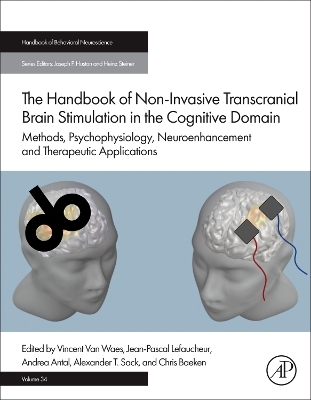
The Handbook of Non-Invasive Transcranial Brain Stimulation in the Cognitive Domain
Academic Press Inc (Verlag)
978-0-443-26602-7 (ISBN)
This handbook offers an unparalleled gateway to the dynamic and rapidly advancing field of neuromodulation and serves as an essential resource for researchers, clinicians, students, and policymakers.
Vincent Van Waes graduated from the University of Lille, France, with a Master degree in Cognitive Science. He earned in 2008 the PhD degree in Neuroscience from the University of Lille, France, in collaboration with the Sapienza University of Roma, Italy (European Label). Following postdoctoral work at the Department of Cellular and Molecular Pharmacology of the Chicago Medical School, North Chicago, USA, he joined in 2010 the University of Bourgogne-Franche Comté, France as a Research Assistant Professor (Maître de Conférences) in the Laboratory of Integrative and Clinical Neuroscience and was appointed Full Professor in 2017. Jean-Pascal Lefaucheur is a university Professor and Hospital Practitioner at CH Henri Mondor. His interest is in developing innovative therapeutic strategies, both pharmacological and neurostimulation-based, that could correct neurological disorders. Andrea Antal graduated from Attal Jozsef University of Szeged, Hungary, in Biology. She earned her PhD in 1998 in Biological Sciences from the University of Szeged, Hungary. She has an extensive background in research and training in the fields of neurology and clinical neurophysiology. Beginning in 2001, she has had a pivotal role in establishing and coordinating the activities of the visual laboratory, and later the pain laboratory in Göttingen. She is the head of the Non-Invasive Brain Stimulation (NBS Lab) laboratory at the University Medical Center Göttingen, Germany an experienced researcher in the field of cortical plasticity and brain stimulation, with a H-Index of 70. Alexander T. Sack graduated from Frankfurt University, Germany with a Master of Science in Psychology (2000) and PhD in Natural Sciences (2003). He completed several international postdoctoral and academic research positions before being appointed as Professor of Brain Stimulation and Applied Cognitive Neuroscience at the Faculty of Psychology & Neuroscience, Maastricht University, The Netherlands in 2011. As the Principal Investigator of the research section “Brain Stimulation and Cognition at the Maastricht Brain Imaging Centre, his research focuses on the neurobiological and psychological principles underlying attention, learning, memory, and cognitive control; combining various brain research techniques, ranging from psychophysics and eye-tracking, to functional Magnetic Resonance Imaging (fMRI), Electroencephalography (EEG), and Noninvasive Brain Stimulation (NIBS). His group pioneered the development of simultaneously implemented TMS-fMRI-EEG during cognitive behavior, allowing to apply brain-stimulation while recording the individual brain network (fMRI) and oscillation (EEG) responses of cognitively engaged participants. This multimodal brain stimulation approach allows to investigate the neural network dynamics underlying human cognition in healthy volunteers and to translate these findings into clinical applications for treating various neurological and neuropsychiatric brain disorders. Chris Baeken is currently a professor at the University of Ghent. He also works as a psychiatrist specializing in the neurobiological field of Affective Disorders.
Part 1: Methods
1.The principles and methods of noninvasive transcranial brain stimulation
2.How to design a NIBS study in the cognitive domain: Common pitfalls and recommendations
Part 2: Preclinic — psychophysiology
Section A: Animals
3.Use of tDCS, rTMS, and TUS rodents: Contributions to understanding the neurobiological mechanisms involved
4.Use of tDCS, rTMS, and TUS in non-human primates: Contributions to understanding the neurobiological mechanisms involved
5.tDCS to treat psychiatric disorders: Insights from animal studies
6.tDCS to treat neurological disorders: Insights from animal studies
7.Implication of glial cells in the effects of tDCS in mice
8.Accelerated rTMS in the canine species
Section B: Healthy
9.Noninvasive transcranial brain stimulation for the study of perception and attention
10.Noninvasive transcranial brain stimulation for the study of decision-making
11.Noninvasive transcranial brain stimulation for the study of memory
12.Optimizing learning with transcranial electrical stimulation
13.Noninvasive transcranial brain stimulation for the study of speech and language
14.Noninvasive transcranial brain stimulation to promote executive functions
Part 3: Therapeutic applications (cognition)
15.Noninvasive transcranial brain stimulation to treat attention disorders (ADHD)
16.Noninvasive transcranial brain stimulation to treat autism spectrum disorders
17.Noninvasive transcranial brain stimulation to treat addiction
18.rTMS to treat mood/PTSD
19.tES in mood and stress-related disorders
20.Noninvasive transcranial brain stimulation to treat anxiety disorders and obsessive compulsive and related disorder
21.Noninvasive transcranial brain stimulation to treat schizophrenia
22.Noninvasive transcranial brain stimulation to treat cognitive aspects of other psychiatric diseases
23.Noninvasive transcranial brain stimulation to treat visuospatial neglect
24.Noninvasive transcranial brain stimulation for language rehabilitation
25.Noninvasive transcranial brain stimulation to treat mild cognitive impairment & dementia
26.Noninvasive transcranial brain stimulation to treat cognitive aspects of traumatic brain injury
27.Noninvasive transcranial brain stimulation to treat cognitive aspects of multiple sclerosis
28.Noninvasive transcranial brain stimulation to treat fatigue in chronic diseases
29.Noninvasive transcranial brain stimulation to treat cognitive aspects of chronic pain syndromes
30.Noninvasive transcranial brain stimulation to treat cognitive aspects of other neurological diseases
Part 4: Ethics/regulation
31.Ethics/regulation
Index
| Erscheinungsdatum | 13.12.2025 |
|---|---|
| Reihe/Serie | Handbook of Behavioral Neuroscience |
| Verlagsort | San Diego |
| Sprache | englisch |
| Maße | 216 x 276 mm |
| Gewicht | 450 g |
| Themenwelt | Geisteswissenschaften ► Psychologie ► Biopsychologie / Neurowissenschaften |
| Medizin / Pharmazie ► Medizinische Fachgebiete ► Neurologie | |
| Medizin / Pharmazie ► Medizinische Fachgebiete ► Psychiatrie / Psychotherapie | |
| Naturwissenschaften ► Biologie ► Humanbiologie | |
| Naturwissenschaften ► Biologie ► Zoologie | |
| ISBN-10 | 0-443-26602-6 / 0443266026 |
| ISBN-13 | 978-0-443-26602-7 / 9780443266027 |
| Zustand | Neuware |
| Informationen gemäß Produktsicherheitsverordnung (GPSR) | |
| Haben Sie eine Frage zum Produkt? |
aus dem Bereich