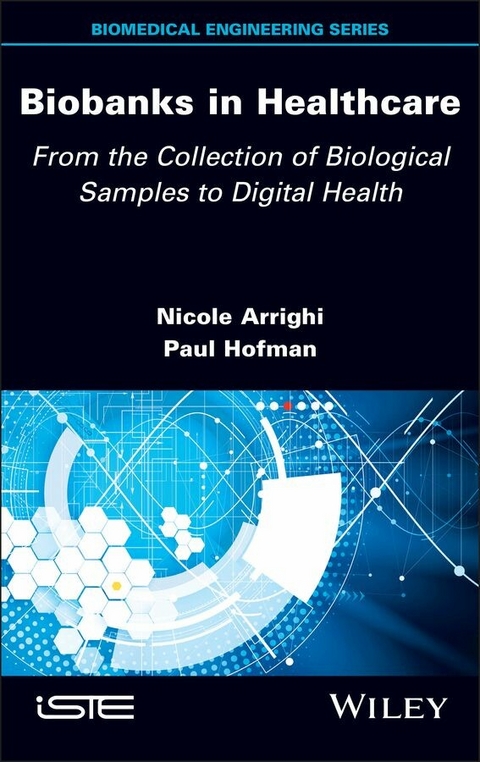
Biobanks in Healthcare (eBook)
239 Seiten
Wiley-Iste (Verlag)
978-1-394-33271-7 (ISBN)
Introduction
Biobanks in 2022: Why and How?
Research is based on several foundations: fundamental concepts, cellular and animal models, validation of discoveries obtained in laboratories through a “translational” approach and then, depending on the sector of interest, clinical or applied research or research carried out in silico using databases. Depending on the research topics, it is necessary to achieve a continuum between the discovery of new cellular mechanisms and an application in the living world, whether it is the plant, microbial or animal and human world.
One of the unavoidable links between basic research and its various applications is the use of different biological resources, whether they come from plants, microbes, animals or healthy or sick human beings [ALD 19, VAU 19]. From time immemorial, researchers have needed to analyze these different biological resources to validate their hypotheses or observations made with cellular models. Several purposes have progressively emerged, such as better understanding of developmental biology or of the mechanisms of cell death, growth or transformation. One of the most successful examples of the use of biological resources is the discovery of biomarkers of human diseases, which can be biomarkers for diagnostic, prognostic or predictive purposes in a therapeutic response [BAR 20, HEW 11]. While the these biological resources were initially used in a poorly controlled manner and without any real established rules, several reflection policies have gradually led to the establishment of a controlled and rigorous operation. Thus, the notion of a collection was born, associated with the need to control use and the necessary storage spaces. In recent decades, these different collections have been associated with the creation of biological resource centers (BRCs), still called “biobanks” today, the structuring of which has been progressive, and they have become essential “tools” in the world of research [WAT 19].
Biobanks have evolved in recent years and are now professionalized and complex structures whose operation is subject to national and international regulations. These biobanks can function as secure storage areas for biological collections (called “biorepositories”), making samples available for research projects. They can also be organized as Expert Centers, and thus both offer services to researchers (thanks to the existence of technical platforms) and enable scientific collaboration (thanks to unique knowledge). Biobanks can also develop their own research projects on specific topics, in particular on the control, management and use of biological samples, essentially with the aim of optimizing their operations and their service offer [WAS 18a].
Biobanks and collection policy have evolved over time. A typical example is the evolution of biobanks collecting patient samples. At first, many samples were accumulated and frozen, in particular tumor samples. The question of the quality of these thousands of stored samples then arose. Indeed, the discovery and/or validation of the different markers proved to be totally dependent on the reproducibility of the analyses on perfectly preserved samples. Finally, the need to acquire more and more associated or targeted data modified the functioning of biobanks by requiring the development of multiple and complex databases. Indeed, one of the key points associated with making biological samples available for research projects is now the need to associate very precise and relevant data with them. The world of biobanking has therefore evolved progressively over the last few decades, with this field becoming a medical specialty in its own right. Thus, schematically, the activity of biobanks has passed through several stages, from the “biobank 1.0” (massive collection activity often without any preconceived ideas and based on “quantitative” data) to the “biobank 2.0” (where the quality of samples is considered crucial along with the implementation of the control of the parameters of the pre-analytical phase), and finally the “biobank 3.0” (integrating several imperatives, in particular the controlled management of clinicobiological data, the anticipation of requests and the control of the business model) [DOU 17, ELL 15, LIN 20, SIM 14]. Thus, the creation and construction of a biobank-type structure must nowadays meet strict requirements, in particular associated with a collection strategy and planning of the use of stored samples [BAI 16, HOF 13].
The diversity of expertise required to generate the data associated with the samples, their integration and their analysis necessitate a rethinking of the organization and structuring of biobanks in order to address the services of specialists in different fields, notably medical, biological, imaging, statistics, bioinformatics and mathematics. This change must concern, at the national or international level, biobanks involved in the collection, integration and analysis of complex data. The concept of next generation biobanks (NGBs) is gradually emerging. An NGB must be able to combine huge databases hosting phenotypic, behavioral, familial, imaging, omics, radiomics and biological data from different centers. Operating an NGB requires overcoming several challenges, the first of which is that of computing infrastructures capable of processing tetrabits, pentabits and exabits. In addition, a suite of appropriate analysis methods and algorithms must be developed. Moreover, these NGBs are now accompanied by a paradigm shift from the analysis of data from a large number of patients to the analysis of a large volume of data from a single subject (“Big Data” vs. “Fat Data”). A crucial aspect for biobanks is their sustainability, taking into account the fact that the business model of these structures is often fragile [RAO 19, VAU 11]. Indeed, the operation of a biobank today requires a dedicated and qualified staff, a secure and expensive infrastructure and equipment that must be renewed regularly in order to maintain the quality of the collections.
There are more and more biobanks throughout the world and the number of collections that can be made available to researchers is increasing, which may lead to a gradual decrease in demand for certain biobanks due to competition. In this context, in order to be competitive, a biobank must make organizational and strategic choices. It is difficult to maintain a high level of expertise in several fields of activity, and focusing on a limited number of pathologies certainly makes it possible to concentrate on the completeness of the collections and to associate complete clinical and biological data, the latter becoming increasingly complex.
An essential point is to obtain the signed consent of patients to use their sample for research purposes. This key point must be associated with an internal process specific to each biobank, which must be perfectly mastered and conducted in consultation with the clinical services. The external visibility of a biobank and its recognition are increased when the partners of a biobank have access to different forms of expertise (e.g. histological diagnosis performed by senior pathologists in the field of pathology concerned; expertise in molecular biology and accessible genomic databases). Focusing on one or a few pathologies also makes it possible to associate, for the same patients, diversified collections of tissues (fixed and frozen) and biofluids (plasma, sera, buffy coat, whole blood, urine, other fluids, etc.). Clinical data and in particular the follow-up of patients according to the different successive treatments or the collection of events (progression, metastasis, death) can be more easily integrated into the biological databases [WAT 17]. In this context, it is often easier to join a national or international network of experts in the same field.
Certification or accreditation of the biobank according to national or international standards is also essential to the robustness of its operation and the quality of the service provided. A competitive biobank must also develop innovative projects, particularly in relation to the pharmaceutical and biotechnology industries. Different projects can allow for the transfer of the results of the innovation thus acquired to clinical practice, after a validation phase carried out with biological samples. Thus, the visibility of a biobank vis-à-vis different partners and/or applicants for biological samples can benefit from the implementation of performance indicators that must be adapted to the structure concerned and its ambitions [HOF 13].
Several challenges are emerging in the near future for biobanks, and these structures must meet a certain number of common objectives. For example, data from different databases or documents (pathological anatomy, molecular biology, imaging, clinical and therapeutic data) have to be gathered (or used) in a single accessible source. It will also be necessary to integrate, store and process complex and often very heterogeneous data volumes. One of the challenges is the sharing and access to information, which must be secure and based on perfectly de-identified data. This access could be envisaged for external partners wishing to know the available samples and the associated complex data. In view of these rapid developments and a change in the activities related to the biobanking profession, it is therefore crucial to continue or develop...
| Erscheint lt. Verlag | 22.10.2024 |
|---|---|
| Reihe/Serie | ISTE Invoiced |
| Sprache | englisch |
| Themenwelt | Medizin / Pharmazie ► Gesundheitsfachberufe |
| Medizin / Pharmazie ► Medizinische Fachgebiete | |
| Schlagworte | Biobanks • biological drugs • Biomarkers • Biotechnologies • Digital Health • Healthcare • Medical Research • molecular classifications |
| ISBN-10 | 1-394-33271-8 / 1394332718 |
| ISBN-13 | 978-1-394-33271-7 / 9781394332717 |
| Informationen gemäß Produktsicherheitsverordnung (GPSR) | |
| Haben Sie eine Frage zum Produkt? |
 EPUB (Adobe DRM)
Kopierschutz: Adobe-DRM
Adobe-DRM ist ein Kopierschutz, der das eBook vor Mißbrauch schützen soll. Dabei wird das eBook bereits beim Download auf Ihre persönliche Adobe-ID autorisiert. Lesen können Sie das eBook dann nur auf den Geräten, welche ebenfalls auf Ihre Adobe-ID registriert sind.
Details zum Adobe-DRM
Dateiformat: EPUB (Electronic Publication)
EPUB ist ein offener Standard für eBooks und eignet sich besonders zur Darstellung von Belletristik und Sachbüchern. Der Fließtext wird dynamisch an die Display- und Schriftgröße angepasst. Auch für mobile Lesegeräte ist EPUB daher gut geeignet.
Systemvoraussetzungen:
PC/Mac: Mit einem PC oder Mac können Sie dieses eBook lesen. Sie benötigen eine
eReader: Dieses eBook kann mit (fast) allen eBook-Readern gelesen werden. Mit dem amazon-Kindle ist es aber nicht kompatibel.
Smartphone/Tablet: Egal ob Apple oder Android, dieses eBook können Sie lesen. Sie benötigen eine
Geräteliste und zusätzliche Hinweise
Buying eBooks from abroad
For tax law reasons we can sell eBooks just within Germany and Switzerland. Regrettably we cannot fulfill eBook-orders from other countries.
aus dem Bereich