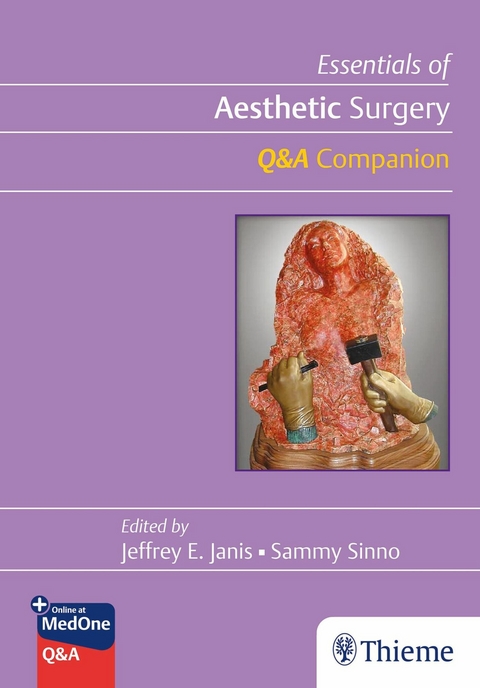
Essentials of Aesthetic Surgery Q&A Companion (eBook)
524 Seiten
Georg Thieme Verlag KG
978-1-63853-669-7 (ISBN)
1 The Aesthetic Surgery Patient
Sammy Sinno, Jeremie Oliver Piña
See Essentials of Aesthetic Surgery, pp. 3–12
1.1 Questions
DEMOGRAPHICS AND STATISTICS
1. Approximately what percentage of aesthetic surgery patients undergo multiple procedures (either simultaneously or consecutively)?
A. 20%.
B. 32%.
C. 57%.
D. 71%.
E. 95%.
DEMOGRAPHICS AND STATISTICS
2. In evaluating a patient's candidacy for aesthetic surgical procedures, which of the following should weigh most heavily on the decision to pursue surgery?
A. Age <20.
B. Age >60.
C. History of prior aesthetic surgical procedures.
D. Body habitus.
E. Overall health.
DEMOGRAPHICS AND STATISTICS
3. Which of the following has been positively correlated with greater patient satisfaction, shorter recovery times, and less postoperative pain?
A. Desire to change appearance in order to advance in career.
B. Desire to salvage a romantic relationship.
C. Consultation with at least four other aesthetic surgeons.
D. A high level of internal motivation for change.
E. History of multiple aesthetic surgical procedures.
DEMOGRAPHICS AND STATISTICS
4. Which of the following scenarios depicts a “red flag” for undergoing an aesthetic surgical procedure?
A. The patient keeps referring to wanting to look like their 20-year-old self.
B. The patient has been planning a particular aesthetic procedure only for a few weeks.
C. The patient is currently being treated for multiple psychiatric illnesses and/or has a history of several psychiatric hospital admissions.
D. The patient has an anatomic flaw that is visible to the surgeon but not the patient.
E. The patient has an anatomic flaw but is not terribly preoccupied by it.
DEMOGRAPHICS AND STATISTICS
5. Under which circumstance should an aesthetic surgeon agree to operate on a patient with body dysmorphic disorder?
A. The patient is overly concerned with the appearance of only one anatomical region.
B. The physical flaw the patient perceives is significantly disrupting the daily life of the patient.
C. The symptoms of body dysmorphic disorder are accompanied by an eating disorder, and the patient feels the aesthetic procedure would alleviate the associated symptoms.
D. The patient does not want to obsess over the physical flaw any longer.
E. Aesthetic surgery is not indicated in patients with active body dysmorphic disorder.
DEMOGRAPHICS AND STATISTICS
6. Which of the following is an indication for an aesthetic surgeon to refuse to proceed with surgery?
A. The patient is currently taking a selective serotonin receptor inhibitor (SSRI).
B. The patient has a history of major depressive disorder.
C. The patient shows signs of neuroticism.
D. The patient was under the impression that aesthetic surgery did not produce postoperative scars.
E. The surgeon feels persistently uneasy about the patient or the procedure.
DEMOGRAPHICS AND STATISTICS
7. Considering the emotional response of the “healing curve,” at which postoperative time point would you expect the patient to be most critical, nit-picky, scared, impatient, or complaining?
A. Day 1.
B. Week 2.
C. Week 4.
D. Week 8.
E. Week 12.
DEMOGRAPHICS AND STATISTICS
8. Which of the following is considered an essential adjunct to any facial rejuvenation procedure?
A. Following a strict low-carb diet.
B. Exercising five times per week.
C. Losing 10 pounds prior to the operation.
D. A consistent skin care regimen.
E. Physical therapy.
DEMOGRAPHICS AND STATISTICS
9. Which of the timeframes listed below is the most appropriate to undergo a revision procedure following primary rhinoplasty?
A. At least 3 months.
B. Between 3 and 6 months.
C. At least 6 months.
D. At least 12 months.
E. At least 18 months.
1.2 Answers
DEMOGRAPHICS AND STATISTICS
1. Approximately what percentage of aesthetic surgery patients undergo multiple procedures (either simultaneously or consecutively)?
C. 57%.
Approximately 57% of aesthetic surgery patients have multiple procedures performed. Specifically, 44% of patients who have a cosmetic procedure will return for another one and 57% of patients have multiple procedures performed simultaneously. ▶ 1
Reference
-
Plastic Surgery Statistics Report. American Society of Plastic Surgeons. Available at https://www.plasticsurgery.org/documents/News/Statistics/2020/plastic-surgery-statistics-full-report-2020.pdf
DEMOGRAPHICS AND STATISTICS
2. In evaluating a patient's candidacy for aesthetic surgical procedures, which of the following should weigh most heavily on the decision to pursue surgery?
E. Overall health.
As part of the preoperative evaluation for aesthetic surgery candidacy, baseline health, comorbidities, tobacco use, prior surgeries, and prior pregnancies are fully discussed. Surgical risk is often dependent upon general health at consultation, as well as the specific desired procedure. As a general rule, health criteria for aesthetic surgery should be at least as stringent as those for reconstructive cases given the strictly elective nature of aesthetic cases. Thus, aesthetic surgery may be deemed inappropriate for unhealthy patients as well as those with a high risk of post- or intraoperative complications. Age should not be considered a significant determinant of aesthetic surgical candidacy. Rather, overall health should be the primary factor to consider in evaluating any patient's candidacy to undergo aesthetic surgery. ▶ 1
Reference
-
Gorney M. Recognition and management of the patient unsuitable for aesthetic surgery. Plast Reconstr Surg 2010;126:2268
DEMOGRAPHICS AND STATISTICS
3. Which of the following has been positively correlated with greater patient satisfaction, shorter recovery times, and less postoperative pain?
D. A high level of internal motivation for change.
Both internal and external motives can be driving patients’ desire for aesthetic surgical procedures. Intensity of motivation has been shown to positively correlate with satisfaction and shorter recovery, while negatively correlating with postoperative pain. Patients with primarily internal motives tend to be greater surgical candidates overall, while patients with substantial external motives (e.g., desire to change appearance to salvage a romantic relationship, satisfy a relative, advance in their career, etc.) tend to display greater dissatisfaction with aesthetic surgical results. ▶ 1, ▶ 2 These patients may be pressured into undergoing surgery, thus demonstrating less motivation, often predicating a more difficult postoperative course.
References
-
Ferraro GA, Rossano F, D’Andrea F. Self-perception and self-esteem of patients seeking cosmetic surgery. Aesthetic Plast Surg 2005;29:184
-
Nahai F. Evaluating the cosmetic patient on antidepressants. Aesthet Surg J 2014;34:326
DEMOGRAPHICS AND STATISTICS
4. Which of the following scenarios depicts a “red flag” for undergoing an aesthetic surgical procedure?
C. The patient is currently being treated for multiple psychiatric illnesses and/or has a history of several psychiatric hospital admissions.
Psychological indicators are important for the aesthetic surgeon to consider when evaluating a patient's surgical candidacy. A thorough evaluation of a patient's motivation and...
| Erscheint lt. Verlag | 4.12.2024 |
|---|---|
| Sprache | englisch |
| Themenwelt | Medizinische Fachgebiete ► Chirurgie ► Ästhetische und Plastische Chirurgie |
| Schlagworte | Body contouring • breast surgery • Clinical pearls • Compact • Companion • facial surgery • learning tool • Medicolegal considerations • Plastic Surgery • Q&A • Skin Care |
| ISBN-10 | 1-63853-669-4 / 1638536694 |
| ISBN-13 | 978-1-63853-669-7 / 9781638536697 |
| Informationen gemäß Produktsicherheitsverordnung (GPSR) | |
| Haben Sie eine Frage zum Produkt? |
 EPUB (Wasserzeichen)
DRM: Digitales Wasserzeichen
Dieses eBook enthält ein digitales Wasserzeichen und ist damit für Sie personalisiert. Bei einer missbräuchlichen Weitergabe des eBooks an Dritte ist eine Rückverfolgung an die Quelle möglich.
Dateiformat: EPUB (Electronic Publication)
EPUB ist ein offener Standard für eBooks und eignet sich besonders zur Darstellung von Belletristik und Sachbüchern. Der Fließtext wird dynamisch an die Display- und Schriftgröße angepasst. Auch für mobile Lesegeräte ist EPUB daher gut geeignet.
Systemvoraussetzungen:
PC/Mac: Mit einem PC oder Mac können Sie dieses eBook lesen. Sie benötigen dafür die kostenlose Software Adobe Digital Editions.
eReader: Dieses eBook kann mit (fast) allen eBook-Readern gelesen werden. Mit dem amazon-Kindle ist es aber nicht kompatibel.
Smartphone/Tablet: Egal ob Apple oder Android, dieses eBook können Sie lesen. Sie benötigen dafür eine kostenlose App.
Geräteliste und zusätzliche Hinweise
Buying eBooks from abroad
For tax law reasons we can sell eBooks just within Germany and Switzerland. Regrettably we cannot fulfill eBook-orders from other countries.
aus dem Bereich