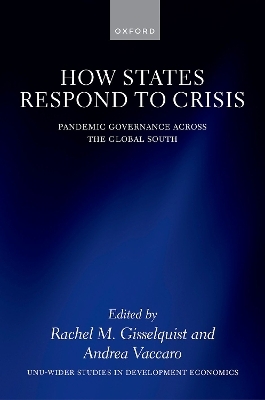
How States Respond to Crisis
Oxford University Press (Verlag)
978-0-19-890720-6 (ISBN)
This is an open access title available under the terms of a CC BY-NC-SA 3.0 IGO licence. It is free to read at Oxford Academic and is offered as a free PDF download from OUP and selected open access locations.
We expect the state to matter in times of crisis, for more 'capable' or 'stronger' states to better provide for and protect their populations. But how is it, precisely, that the quality of the state matters? This volume speaks to this question through comparative study of how diverse states in the Global South responded to the COVID-19 pandemic, the largest global crisis in recent memory.
Bringing together insights from quantitative cross-country analysis and detailed country case studies, How States Respond to Crisis analyses the ways in which the quality of the state - in terms of its capacity, authority, and legitimacy - affected pandemic governance and health outcomes. Overall, while the significance of state capacity to deliver public services in effective pandemic response is clear, so too is striking variation among states lacking 'strong' capacity. State legitimacy and authority shed light on this variation, linked in particular to the degree to which governments' responses were evidence-based versus politically driven, and the tenor of citizen compliance with and government enforcement of public health regulations.
Seven case study chapters authored by leading scholars of each country provide deep and specific insight into these relationships in Bolivia, Ghana, Nicaragua, Peru, the Philippines, Tanzania, and Vietnam. Extending beyond a literature on the state based heavily on study of Global North contexts, this volume sheds new light on the nature of the state and its role in crisis response and development.
Rachel M. Gisselquist is Professor in Governance and Development, and Director of the Governance and Social Development Resource Centre (GSDRC), University of Birmingham (UK). She is also a non-resident senior research fellow with UNU-WIDER, where she was based 2011-2024. Previously, she was a research director at Harvard University, where she co-authored the first several editions of the Ibrahim Index of African Governance, now a standard reference on governance. Her research examines issues of inequality, ethnic politics, state-building, foreign aid, governance, and democracy. She holds a PhD in Political Science from the Massachusetts Institute of Technology and an MPP from Harvard. Andrea Vaccaro is a postdoctoral research fellow at the Blavatnik School of Government, University of Oxford, and an associate member of St Antony's College. Previously, he was a visiting researcher at UNU-WIDER and a postdoctoral researcher at the University of Insubria. His research interests lie at the crossroads between comparative politics and global development. Recently, he has worked on the interplay between the state, political regimes, and development, as well as international aid, COVID-19 responses, and measurement and indicators. He received his PhD from Sapienza University of Rome.
List of Figures
List of Tables
List of Abbreviations
List of Contributors
Part l Introduction
1: Rachel M. Gisselquist;Andrea Vaccaro: What COVID-19 Can Tell Us about the State: A Global Look at the First Year of the Pandemic
Part II Sub-Saharan Africa
2: Kofi Takyi Asante: Harnessing Residual Capacity: Ghana's Struggle against Health System Constraints in the COVID-19 Response
3: Amy S. Patterson: The Effects of Limited Capacity, Ideational Legitimacy, and Weak Authority on the Tanzanian State Response to COVID-19
Part III Asia
4: Julio C. Teehankee: Pandemic Populism amid Weak State Capacity in the Philippines
5: Duc Anh Dang;Anh Tran: Local Governance and COVID-19's Health Impact: Evidence from Vietnam
Part IV Latin America
6: Calla Hummel;V. Ximena Velasco Guachalla;Jami Nelson-Nuñez; Carew Boulding: Decentralization, State Capacity, and Inequality: Explaining COVID-19 Outcomes in Bolivia
7: Camila Gianella: The Devasting Effects of the COVID-19 Pandemic on Peru: The Undermining Role of Vertical Health Policies in Health Systems
8: Mateo Jarquín: Nicaragua's Puzzling Pandemic Response
| Erscheinungsdatum | 14.05.2025 |
|---|---|
| Reihe/Serie | WIDER Studies in Development Economics |
| Zusatzinfo | 35 figures and tables |
| Verlagsort | Oxford |
| Sprache | englisch |
| Maße | 165 x 240 mm |
| Gewicht | 508 g |
| Themenwelt | Medizin / Pharmazie ► Gesundheitswesen |
| Wirtschaft ► Volkswirtschaftslehre ► Wirtschaftspolitik | |
| ISBN-10 | 0-19-890720-6 / 0198907206 |
| ISBN-13 | 978-0-19-890720-6 / 9780198907206 |
| Zustand | Neuware |
| Informationen gemäß Produktsicherheitsverordnung (GPSR) | |
| Haben Sie eine Frage zum Produkt? |
aus dem Bereich