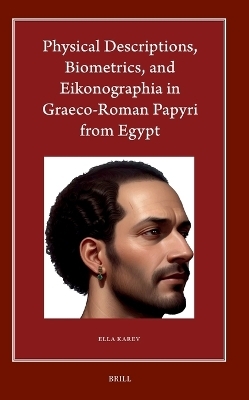
Physical Descriptions, Biometrics, and Eikonographia in Graeco-Roman Papyri from Egypt
Brill (Verlag)
978-90-04-54480-2 (ISBN)
In modern life, an identity document bearing a photograph is an indispensable feature. Yet this connection between physical appearance and legal identity is not as modern as it may seem. In Graeco-Roman Egypt, Greek texts also bore “lexical photographs”: standardised, detailed physical descriptions (eikones) of individuals including height, skin colour, hair texture, the shape of the nose and face, and other identifiers like body modifications and disabilities. For the first time, this book collects the nearly 4000 extant eikones and their role in society, bringing the images of real individuals to life within the everyday biometric system in which they acted, worked, and relied upon for identification.
Ella Karev, Ph.D. (2022), University of Chicago, is a Senior Lecturer in Egyptology at Tel Aviv University. She is a social and economic historian of Egypt whose research focuses on enslavement as well as Greek, Aramaic, Coptic, and Demotic papyrology.
Preface and Acknowledgements
List of Tables
Abbreviations
1 Introduction
1.1 Introduction
1.2 Scope
1.3 A brief note on terminology
1.4 The corpus of texts
1.5 Previous scholarship
1.6 Eikones in Demotic and Latin
1.7 Eikones outside of Egypt
1.8 Outline
1.9 Abbreviations and conventions
2 Identity verification, biometrics, and documentality
2.1 Biometrics, identity, and eikones
2.2 Biometrics and anthropometry
2.3 Documentality
2.4 The role of social trust
2.5 Conclusions and implications
3 Descriptive eikones
3.1 The Ptolemaic period: detailed physical description
3.2 Characteristics in the Ptolemaic eikōn
3.3 Absent characteristics and perception of physical traits
3.4 Comparison with artistic evidence
3.5 Demotic eikones
3.6 Conclusions
4 Oulai
4.1 The Roman period: identification by oulē
4.2 The format of the oulē-eikōn
4.3 Why not a scar?
4.4 Location of oulai on the body
4.5 Moles
4.6 “Unmarked” and “well-Marked”
4.7 Descriptive eikones in the Roman period
4.8 Conclusions: oulē as “identifier”
5 Impairments and disabilities
5.1 Impairment as identification
5.2 Types, frequency, and distribution of impairments
5.3 Distribution by Occupation and Gender
5.4 Impairments absent from the eikones
5.5 Impairment as an oulē
5.6 Comparison with artistic depictions and physical remains
5.7 Implications of impairments in the eikones
6 Ethnonyms, ethnicity, and race
6.1 The inclusion of ethnonyms in the eikones
6.2 Ethnonyms, geonyms, and “legal ethnic designations”
6.3 Ethnonyms of unenslaved persons
6.4 Ethnonyms of enslaved persons
6.5 Skin colour, race, and ethnicity
6.6 Conclusions
7 Enslaved persons
7.1 Enslaved persons in the corpus of eikones
7.2 Terminology
7.3 Characteristics of the eikones of enslaved persons
7.4 Enslaved eikones and social alienation
7.5 Typology of enslaved eikones
7.6 Distribution of texts by type
7.7 Conclusions
8 Conclusions
8.1 Findings
8.2 Ptolemaic descriptive eikones in contrast with Roman oulē-eikones
8.3 The eikones as a biometric system of documentary identification
8.4 Descriptions of enslaved persons
8.5 Observations on impairments
8.6 Race and ethnicity
8.7 Conclusions and future research
Appendix
Bibliography
Index
| Erscheinungsdatum | 06.11.2024 |
|---|---|
| Reihe/Serie | Harvard Egyptological Studies ; 24 |
| Verlagsort | Leiden |
| Sprache | englisch |
| Maße | 155 x 235 mm |
| Gewicht | 554 g |
| Themenwelt | Geisteswissenschaften ► Archäologie |
| Geschichte ► Allgemeine Geschichte ► Altertum / Antike | |
| Studium ► Querschnittsbereiche ► Geschichte / Ethik der Medizin | |
| ISBN-10 | 90-04-54480-1 / 9004544801 |
| ISBN-13 | 978-90-04-54480-2 / 9789004544802 |
| Zustand | Neuware |
| Informationen gemäß Produktsicherheitsverordnung (GPSR) | |
| Haben Sie eine Frage zum Produkt? |
aus dem Bereich