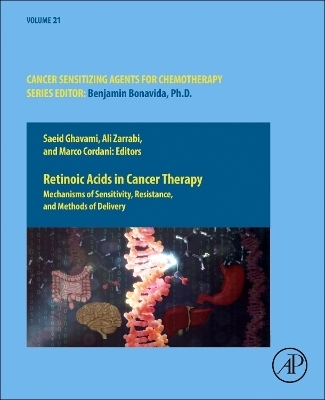
Retinoic Acids in Cancer Therapy
Academic Press Inc (Verlag)
978-0-443-22305-1 (ISBN)
- Noch nicht erschienen (ca. März 2026)
- Versandkostenfrei
- Auch auf Rechnung
- Artikel merken
Across 15 chapters, it describes the molecular structure and biological properties of ATRA, explains mechanisms of resistance, and defines ATRA’s efficacy in seven cancer types. It concludes with chapters on ATRA and cancer stem cell biology, strategies to improve treatment, future therapeutic perspectives, and delivery methods to reduce toxicity and enhance anticancer efficacy.
Each chapter includes Learning Objectives and a “What We Learn” section, making the book highly accessible for undergraduate, graduate trainees, scientists, physicians, and biotech companies. Adding simple, attractive schemes and informative tables makes it ideal for all interested in the current status of Retinoic Acids in Cancer Therapy. This book serves as a valuable resource for health professionals, scientists, researchers, clinical practitioners, and all those seeking to broaden their knowledge and develop new drugs or therapeutic strategies to improve ATRA’s efficacy in the treatment of resistant cancers.
Dr. Ghavami completed his undergraduate training MSc and PhD in clinical biochemistry. He is a cancer biologist and his research focusses on the importance of cross talk of three key cellular stress [apoptosis, autophagy and unfolded protein response (UPR)] in regulation of chemotherapy response in cancer cells including Glioblastoma, Rhabdomyosarcoma and non-small cell lung adenocarcinoma. Dr. Ghavami is currently honorary professor and co-founder of Autophagy Research Centre at Shiraz University of Medical Science and Tehran University of Medical Sciences, honorary professor at Katowice School of Technology, Poland. He is associate editor of BBA-Mol Basis of Disease, Molecular Neurobiology, BB Reports and IJMS. Ali Zarrabi is an Associate Professor and Principal Investigator in the Faculty of Engineering and Natural Sciences, at Istinye University, in Turkey. He holds a bachelor's degree in Chemical Engineering from Isfahan University of Technology, a master's degree in Chemical Engineering from Sharif University of Technology, and a PhD in Nanobiotechnology from Sharif University of Technology. His group works at the interface of supramolecular chemistry, bioengineering, and medicine to develop approaches for simultaneous diagnosis and treatment of diseases. He has been active as a faculty member for more than 12 years. His current research interests include nanomaterials, nanotheranostics, novel wound dressing and skin patches, and translational nanomedicine. Developing wearable biosensors and diagnostic patches has recently been considered in Zarrabi Lab. Marco Cordani obtained his Ph.D. at the University of Verona, working on the implication of mutated p53 proteins in metabolism and autophagy. Later, he has performed two postdoctoral stays, one at Universidad Autónoma de Madrid (2017) and another at the IMDEA Nanociencia (2018-2020), working on novel nanomedicine and gene editing strategies to counteract cancer. Currently, Postdoctoral Researcher at the University “Claude Bernard Lyon 1, characterizing the involvement of dependence receptors in cell death and metabolism.
1. Molecular structure and biological properties of all-trans retinoic acid
2. Emerging frontiers in drug development of all-trans retinoic acid and its derivatives
3. Cellular and molecular determinants of all trans retinoic acid sensitivity in different cancers
4. Apoptosis, autophagy, and unfolded protein response and their impact on all-trans retinoic acid induced toxicity in cancer cells
5. Mechanisms of resistance to all-trans retinoic acid and use of multi-target-directed ligand to fight against resistance
6. Nanocarrier systems for targeted delivery of all-trans retinoic acid: design and mechanisms
7. Advanced delivery systems for all-trans retinoic acid: challenges and opportunities in pharmacokinetics and bioavailability
8. Mechanisms of sensitivity, resistance, and methods of delivery
9. Efficiency of all-trans retinoic acid on gastric cancer
10. All-trans retinoic acid and its role in glioblastoma therapy
11. All-trans retinoic acid and vitamin A in neurodegeneration: from oncology to neuroprotection
12. Efficiency of all-trans retinoic acid in liver cancer
13. Efficiency of all-trans retinoic acid on colon cancer
14. Retinoic acids in head and neck cancer therapy: mechanisms of sensitivity, resistance, and methods of delivery
15. Role of artificial intelligence and machine learning in predicting all-trans retinoic acid treatment outcomes
| Erscheint lt. Verlag | 2.3.2026 |
|---|---|
| Reihe/Serie | Cancer Sensitizing Agents for Chemotherapy |
| Verlagsort | San Diego |
| Sprache | englisch |
| Maße | 191 x 235 mm |
| Gewicht | 450 g |
| Themenwelt | Medizin / Pharmazie ► Medizinische Fachgebiete ► Onkologie |
| Medizin / Pharmazie ► Medizinische Fachgebiete ► Pharmakologie / Pharmakotherapie | |
| Naturwissenschaften ► Biologie | |
| ISBN-10 | 0-443-22305-X / 044322305X |
| ISBN-13 | 978-0-443-22305-1 / 9780443223051 |
| Zustand | Neuware |
| Informationen gemäß Produktsicherheitsverordnung (GPSR) | |
| Haben Sie eine Frage zum Produkt? |
aus dem Bereich