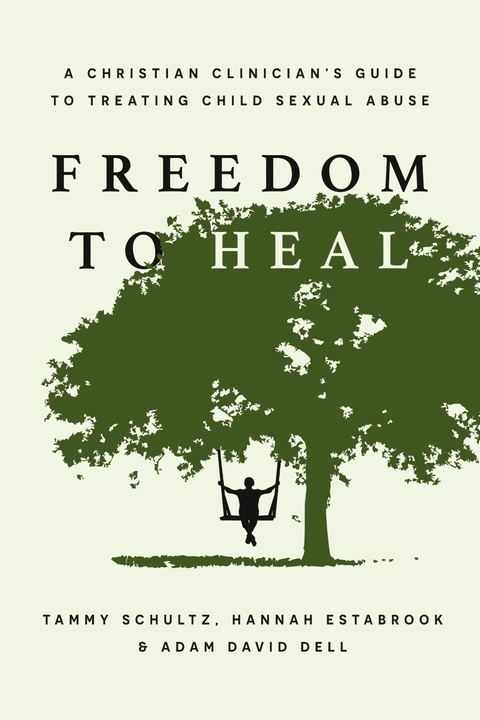
Freedom to Heal (eBook)
272 Seiten
IVP Academic (Verlag)
978-1-5140-0752-5 (ISBN)
Tammy Schultz (PhD, Indiana State University) is professor of clinical mental health counseling and co-coordinator of the Trauma Certificate Program at Wheaton College. She is a licensed counselor and has coauthored numerous articles on trauma healing and other topics.
Tammy Schultz (PhD, Indiana State University) is professor of clinical mental health counseling and co-coordinator of the Trauma Certificate Program at Wheaton College. She is a licensed counselor and has coauthored numerous articles on trauma healing and other topics. Adam David Dell (PsyD, Indiana State University) is board certified in clinical psychology, lectures nationwide, and provides therapy in hospitals and private practice. He is a veteran of the US Air Force, where he served as an active duty psychologist, and previous director of emotional well-being services at the Notre Dame Wellness Center. Hannah Estabrook (MA, Grace College) is a mental health clinician with a focus on supporting individuals who have transitioned from the sex trade. She is the cofounder of Sanctuary Night, a pioneering harm reduction drop-in center for marginalized women.
Introduction
Just as every survivor has a story, Freedom to Heal: A Christian Clinician’s Guide to Treating Child Sexual Abuse was also birthed in narrative. Years ago, Hannah and Tammy traveled to South Korea to speak at a sexual abuse conference. At the end of the conference, a poised and elegant woman lingered, waiting to talk with us. With hesitation, she looked around to ensure that no one could hear, and then, with her gaze fastened to the floor, she spoke in a hushed tone. A trusted and much-loved leader in her church had sexually violated her when she was a teenager. With the aid of a trusted translator, she explained that she would never confront this loved elder because this would bring dishonor to the church. During that week, we were deluged with many more sad stories of child sexual abuse (CSA) experienced by Korean women attending the conference.
After the conference, on our flight from South Korea to Germany, Hannah scribbled a downpour of ideas in a soft, red leather journal as we talked, dreamed, and prayed. The writing journey of the first edition of this text on CSA commenced. Specifically, the primary purpose of this text would be to serve as a trusted roadmap for clinicians and caregivers walking alongside adult survivors of CSA.
Under the broader umbrella of sexual trauma, there are two groups: adult survivors of CSA and adult survivors of sexual assault (ASA). There are overlapping mental health effects and neurobiological outcomes for both groups. However, there are also distinctions (Rowland et al., 2024). In our efforts to complete a distinctively Christian and clinical guide, we elected to focus singularly on adult survivors of CSA to narrow the focus and make this project attainable. Indeed, more research is needed on the topic of ASA. Moreover, many individuals who experience CSA often also later experience ASA (Rowland et al., 2024).
In 2022, we invited Adam to join us in the significant revision of this book. Adam served as an active-duty psychologist with the United States Air Force. In his military career, he accumulated training and real-world experience in offering numerous empirically supported therapies for military members and civilians who survived childhood and adulthood traumas. We asked him to coauthor based on his clinical and teaching experience concerning CSA survivors, his personal, powerful story of CSA that he regularly shares with military and civilian audiences, and because we love and admire Adam.
Mental health research, clinical experience, and spiritual integration deeply matter to many faith-based clinicians as they journey with CSA survivors. Thus, we discuss the integration of theology, mental health approaches, and Christian-accommodated practices throughout this edition. We begin with the sullied story of an Israelite princess who was raped. The threads of her narrative are woven into each chapter. Years ago, when we first read Tamar’s story in 2 Samuel, we were undone by how God so astutely understood and described the ways abuse impacted every aspect of her being. Without an excess of words, Scripture reveals that he sees and understands the imprint of sexual violation that crosses culture and class. We also include Tamar’s story as an invitation to clients and clinicians to contend with the God who permits such violence.
We decided to also draw chapter portions from the reservoir of our own stories. The bittersweet waters we have swallowed remind us that this text was set in motion long before we met. We are three individuals born in different generations, growing up in other countries, each impacted by CSA in our lives. Coincidence? Hardly. As children with tiny hands and hearts, we each emerged from the rubble of CSA, tragically primed for the work God prepared for us to embark on. It would be paramount to share sips of God’s grace poured out in our lives with our readers.
Still, despite all our combined experiences, personal opinions alone would be insufficient, as we intend this to be substantially a research-based endeavor for veteran clinicians, counselors in training, and other caregivers who bear witness to stories of individuals who have been sexually violated. With the increased global attention on CSA, there has been a more comprehensive, empirical focus on CSA. Thus, we have sifted through the rivers of research, panning for gold. In this second edition, we have intentionally incorporated evidence-based interventions into each chapter with greater emphasis on practical and clinical considerations as we walk in the direction of hope and healing. We have also provided more hope-imbued perspectives and interventions focusing on flourishing.
While we hold evidence-based approaches in high regard, we also acknowledge their limitations. There are times when manualized approaches offer the illusion of certainty. We understand that well-being is not a simple equation of three steps or stages. Therefore, the goal of healing in this edition extends beyond the cessation of symptoms. It is about thriving, about being freed up to love others and to love God. We firmly believe that those marred by tragedy can also be destined for triumph.
Almost two decades have passed between Hannah’s and my (Tammy) plane ride from South Korea and the gift of Adam joining the writing of this second edition. We have journeyed through forests of gloom and heard one more story about a famous Christian leader molesting a trusting teenager. The #MeToo and #ChurchToo movements that occurred have increased the onslaught of abuse stories shared by survivors worldwide. We have met with many more brave survivors who have entrusted their stories to each of us, which has continued to inform us and, at times, move us to tears.
Hannah has worked in varied settings where she journeyed primarily with survivors of sex trafficking. She is a well-known speaker in sex trafficking leadership circles across Ohio and is connected with municipal and state elected officials and influential leaders in the Ohio faith and clinical communities. She regularly responds to requests from clinicians and clergy alike concerning resources to better understand sexual trauma and care for survivors. Adam worked in military and civilian settings, including hospitals, private practice, integrated behavioral health, and multidisciplinary settings over the past twenty years. He is trained and experienced in offering the following therapies for survivors of CSA: prolonged exposure (PE), concurrent treatment of PTSD and substance use disorders using prolonged exposure (COPE), Cognitive Processing Therapy (CPT), Eye Movement Desensitization and Reprocessing (EMDR), and Written Exposure Therapy (WET). My therapy work (Tammy) with survivors has continued over many decades in community mental health centers, private practice, and college counseling centers. As the co-coordinator of the trauma certificate program at Wheaton College, I have also learned from numerous brave conference attendees and students who have shared their stories with me over the years. Moreover, each chapter of this book has been read by students in my Wheaton College Introduction to Trauma class. It has been such a privilege to hear from these dear students and make revisions based on their wise feedback prior to sending it off to our publisher.
Freedom to Heal is designed to be a go-to resource for faith-based therapists, medical professionals, clinicians in training, pastoral counselors, foster parents, teachers, and student life professionals on university campuses hungry for theologically informed principles and evidence-based approaches to use with adult survivors of CSA. The reader will find additional clinical resources at the end of each chapter and in the “Children’s Corner,” where we share children’s books that focus on a theme from the chapter for children (and adults) to grasp. Sometimes complexities are more aptly understood when spoken in the language of children.
A FEW CAVEATS
No two alike. During a deposition, a defense attorney asked me (Tammy) why my client, who had experienced years of abuse by a trusted caregiver, did not exhibit every posttraumatic stress disorder (PTSD) symptomatology. His question reflected a one-size-fits-all perspective. People who are sexually abused do not react in carbon-copy ways. They are a heterogeneous group. This means no two survivors are exactly alike. Diversity of abuse ensures diversity of aftermath effects of abuse. As psychiatrist Frank Putnam (2003, p. 269) explained,
Childhood sexual abuse is a complex life experience. . . . This diversity alone ensures that there will be a range of outcomes. . . . Thus sexually abused children constitute a very heterogeneous group with many degrees of abuse about whom few simple generalizations hold.
A review of research on CSA reveals significant consistency among trauma clinicians and researchers regarding the most common negative aftereffects. Yet differences are apparent as well. The age of the victim; the severity of abuse; the nature of the relationship with the perpetrator; the response of caregivers and significant others; personality factors; support system; relationship with God; family dynamics; use of force, aggression and grooming; number of perpetrators; culture; and other types of trauma experience all contribute to differing symptoms, dissimilar collages. In addition, specific symptoms may dominate at one point along the journey, while other effects may preside during a different phase. More recently, the attention to survivors’ uniqueness...
| Erscheint lt. Verlag | 18.3.2025 |
|---|---|
| Reihe/Serie | Christian Association for Psychological Studies Books |
| Verlagsort | Lisle |
| Sprache | englisch |
| Themenwelt | Geisteswissenschaften ► Psychologie |
| Religion / Theologie ► Christentum ► Kirchengeschichte | |
| Medizin / Pharmazie ► Medizinische Fachgebiete ► Psychiatrie / Psychotherapie | |
| Schlagworte | childhood sexual abuse • christian counselor • Christian psychologist • Christian therapist • Clinical psychology • Human Trafficking • Incest • Justice • #metoo • Prostitution • Rape • Sexual Abuse • sexual abuse survivor • sexual harassment • sexual misconduct • Sex Work • Trauma |
| ISBN-10 | 1-5140-0752-5 / 1514007525 |
| ISBN-13 | 978-1-5140-0752-5 / 9781514007525 |
| Informationen gemäß Produktsicherheitsverordnung (GPSR) | |
| Haben Sie eine Frage zum Produkt? |
 EPUB (Wasserzeichen)
DRM: Digitales Wasserzeichen
Dieses eBook enthält ein digitales Wasserzeichen und ist damit für Sie personalisiert. Bei einer missbräuchlichen Weitergabe des eBooks an Dritte ist eine Rückverfolgung an die Quelle möglich.
Dateiformat: EPUB (Electronic Publication)
EPUB ist ein offener Standard für eBooks und eignet sich besonders zur Darstellung von Belletristik und Sachbüchern. Der Fließtext wird dynamisch an die Display- und Schriftgröße angepasst. Auch für mobile Lesegeräte ist EPUB daher gut geeignet.
Systemvoraussetzungen:
PC/Mac: Mit einem PC oder Mac können Sie dieses eBook lesen. Sie benötigen dafür die kostenlose Software Adobe Digital Editions.
eReader: Dieses eBook kann mit (fast) allen eBook-Readern gelesen werden. Mit dem amazon-Kindle ist es aber nicht kompatibel.
Smartphone/Tablet: Egal ob Apple oder Android, dieses eBook können Sie lesen. Sie benötigen dafür eine kostenlose App.
Geräteliste und zusätzliche Hinweise
Buying eBooks from abroad
For tax law reasons we can sell eBooks just within Germany and Switzerland. Regrettably we cannot fulfill eBook-orders from other countries.
aus dem Bereich