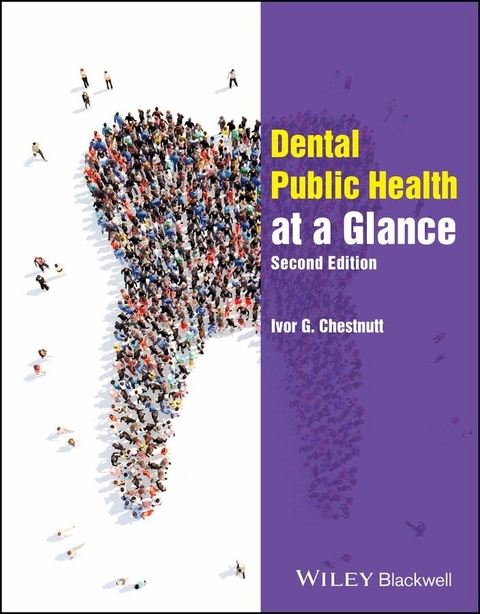
Dental Public Health at a Glance (eBook)
440 Seiten
John Wiley & Sons (Verlag)
978-1-394-18430-9 (ISBN)
The market-leading at a Glance series is popular among healthcare students and newly qualified practitioners, for its concise and simple approach and excellent illustrations.
Each bite-sized chapter is covered in a double-page spread with clear, easy-to-follow diagrams, supported by succinct explanatory text.
Covering a wide range of topics, books in the at a Glance series are ideal as introductory texts for teaching, learning and revision, and are useful throughout university and beyond.
Everything you need to know about Dental Public Health... at a Glance!
The essential reference covering the field of dental public health
Dental Public Health at a Glance, presents a rich introduction to dental and oral health issues in communities and populations. Offering comprehensive coverage of the field, each topic is richly illustrated and presented in an easy-to-comprehend two-page spread. The essential facts are clearly summarized and accompanied by tables, illustrations, and diagrams.
This revised and updated Second Edition presents a variety of updates, including the importance of population perspective on healthcare organization and delivery due to COVID-19 and other pandemics and the role to be played by dental services in contributing to the environmental agenda. It also addresses a number of revisions to important policy documents such as the Scientific Advisory Committee on Nutrition's report on feeding 1-5 year olds, emerging views on behavior change, and the increasing prominence of the Behavior Change Wheel.
Written by a widely published dental academic with more than 25 years of experience in the field, Dental Public Health includes information on:
- Principles of measuring and recording oral health and the epidemiology of dental caries, periodontal diseases, and oral cancer
- Study design, case reports, cohort studies, randomized controlled trials, and split-mouth and crossover studies in evidence based dentistry
- Strategies for the delivery of fluoride in the prevention of dental caries, covering toothpaste, water fluoridation, and community fluoride schemes and fissure sealant programs
- Societal factors influencing dental care including migration, race, and ethnicity
- Considerations for a career in dental public health
Offering new revisions throughout all essential areas and case studies to enable enhanced understanding of concepts, Dental Public Health at a Glance is a must-have introductory textbook and revision guide for dentistry and dental hygiene and therapy students.
The Author
Ivor G. Chestnutt, BDS, MPH, PhD, FDS(DPH)RCSEd, FDS RCSEng, FDS RCPSGlas, FFPH, DDPH RCS ENG FHEA is Professor and Honorary Consultant in Dental Public Health at the School of Dentistry, Cardiff University in the UK. Ivor is also registered as a Specialist in Dental Public Health with the General Dental Council.
The market leading at a Glance series is popular among healthcare students and newly qualified practitioners, for its concise and simple approach and excellent illustrations. Each bite sized chapter is covered in a double page spread with clear, easy to follow diagrams, supported by succinct explanatory text. Covering a wide range of topics, books in the at a Glance series are ideal as introductory texts for teaching, learning and revision, and are useful throughout university and beyond. Everything you need to know about Dental Public Health at a Glance! The essential reference covering the field of dental public health Dental Public Health at a Glance, presents a rich introduction to dental and oral health issues in communities and populations. Offering comprehensive coverage of the field, each topic is richly illustrated and presented in an easy-to-comprehend two-page spread. The essential facts are clearly summarized and accompanied by tables, illustrations, and diagrams. This revised and updated Second Edition presents a variety of updates, including the importance of population perspective on healthcare organization and delivery due to COVID-19 and other pandemics and the role to be played by dental services in contributing to the environmental agenda. It also addresses a number of revisions to important policy documents such as the Scientific Advisory Committee on Nutrition s report on feeding 1-5 year olds, emerging views on behavior change, and the increasing prominence of the Behavior Change Wheel. Written by a widely published dental academic with more than 25 years of experience in the field, Dental Public Health includes information on: Principles of measuring and recording oral health and the epidemiology of dental caries, periodontal diseases, and oral cancer Study design, case reports, cohort studies, randomized controlled trials, and split-mouth and crossover studies in evidence based dentistry Strategies for the delivery of fluoride in the prevention of dental caries, covering toothpaste, water fluoridation, and community fluoride schemes and fissure sealant programs Societal factors influencing dental care including migration, race, and ethnicity Considerations for a career in dental public health Offering new revisions throughout all essential areas and case studies to enable enhanced understanding of concepts, Dental Public Health at a Glance is a must-have introductory textbook and revision guide for dentistry and dental hygiene and therapy students.
4
Principles of measuring and recording oral disease and oral health
Table 4.1 Common dental indices and the conditions they measure
| Index | Condition measured |
|---|
| DMFT/dmft (decayed, missing and filled) | Dental caries |
| ICDAS – International Caries Detection and Assessment System | Dental caries |
| Significant caries index (based on DMFT/dmft) | Dental caries |
| Root caries index | Root caries |
| Community Periodontal Index of Treatment Need (CPITN) – Basic Periodontal Examination (BPE) | Periodontal disease |
| Plaque index | Dental plaque |
| Modified gingival index | Gingivitis |
| IOTN (Index of Orthodontic Treatment Need) | Orthodontic treatment need |
| PAR (Peer Assessment Rating) | Orthodontic treatment outcome |
| Erosion index | Erosion/non‐carious tooth surface loss |
| Dean’s index | Fluorosis |
| Modified DDE | Developmental defects of enamel |
Table 4.2 Interpretation of the strength of agreement determined by kappa (κ) statistic
| Value of κ | Strength of agreement |
|---|
| 1.00–0.81 | Very good |
| 0.80–0.61 | Good |
| 0.60–0.41 | Moderate |
| 0.40–0.21 | Fair |
| <0.20 | Poor |
Table 4.3 Reasons for measuring and recording oral disease
| At an INDIVIDUAL level | At a POPULATION level |
|---|
| Clinical management |
| To aid diagnosis | To record the prevalence of disease in a population |
| To aid treatment | To aid understanding of the aetiology of diseases |
| To measure individual treatment need | To provide an indication of population treatment need |
| To measure individual treatment outcome | To evaluate the effectiveness of public health programmes |
| Research (e.g. in clinical trials) |
| To test the effect of new treatments or products |
Table 4.4 Oral Health Impact Profile 14 (OHIP 14)
Source: Slade (1997)/John Wiley & Sons.
| Dimension | Question – How often in the last 12 months |
|---|
| Functional limitation | Have you had trouble pronouncing any words because of problems with your mouth teeth or dentures? |
| Have you felt that your sense of taste has worsened because of problems with your mouth teeth or dentures? |
| Physical pain | Have you had painful aching in your mouth? |
| Have you found it uncomfortable to eat any foods because of problems with your teeth, mouth or dentures? |
| Psychological discomfort | Have you been self‐conscious because of your teeth, mouth or dentures? |
| Have you felt tense because of problems with your mouth teeth or dentures? |
| Physical disability | Has your diet been unsatisfactory because of problems with your mouth teeth or dentures? |
| Have you had to interrupt meals because of problems with your mouth teeth or dentures? |
| Psychological disability | Have you found it difficult to relax because of problems with your mouth teeth or dentures? |
| Have you been a bit embarrassed because of problems with your mouth teeth or dentures? |
| Social disability | Have you been a bit irritable with other people because of problems with your mouth teeth or dentures? |
| Have you had difficulty doing your usual jobs because of problems with your mouth teeth or dentures? |
| Handicap | Have you felt that life in general was less satisfying because of problems with your mouth teeth or dentures? |
| Have you been totally unable to function because of problems with your mouth teeth or dentures? |
Responses on a 5‐point scale coded 0 = never, 1 = hardly ever, 2 = occasionally, 3 = fairly often, 4 = very often.
What is a dental index?
To record the presence, extent and severity of dental disease in a consistent manner, a suitable method is required. Such recording systems are termed dental indices (singular: dental index). Over the years, numerous dental indices have been developed, and standardised ways of recording most dental conditions and pathologies exist. Examples of commonly used dental indices are shown in Table 4.1.
The properties of an ideal dental index
An ideal dental index should have the following features:
- Simple: The index should be simple to understand and easy to learn. This is important if large numbers of clinicians are to be taught how to use the index consistently. It should also be simple to administer. An index that takes a long time to record reduces the efficiency of collecting data in epidemiological surveys, where clinicians need to record a large amount of data in a short period of time.
- Objective: There should be as little scope as possible for subjective interpretation on the part of the examining clinician. This limits the chances of different clinicians recording different levels of disease when examining identical clinical conditions.
- Clear‐cut categories: The division between categories or codes used within an index should be clear. It is also helpful if these categories relate to distinct stages of the clinical condition being measured. If these distinct stages are associated to different treatment needs, then it is possible to construct an index that not only measures the presence of a disease, but can also give an indication of treatment needs Common examples include the community periodontal index of treatment need (CPITN) and the index of orthodontic treatment need (IOTN).
- Valid: The index must measure what it is intended to measure. For example, an index designed to measure early dental decay (white spots) must not be confused by developmental hypoplasia (which can also appear as a white/demineralised spot).
- Reliable: Each time the index is used, it should record the same outcome (provided the disease remains the same). This relates to the properties of the index.
- Reproducible: Each time the index is used, it should record the same outcome, either when two different examiners use the index to measure the same condition (inter‐examiner reproducibility) or when the same examiner measures the condition on two different occasions (intra‐examiner reproducibility). This is provided, of course, that the condition being measured has not changed between examinations. The degree of agreement between or within examiners is measured statistically using the Kappa statistic (κ). This is a more robust measure than simply calculating the percentage agreement between examiners, as κ takes into account agreement that has occurred by chance. The Kappa statistic is reported as a value between 0 and 1 and is interpreted as shown in Table 4.2.
- Quantifiable: It is an advantage if the output of a dental index is amenable to statistical analysis.
- Sensitive: An ideal index should be able to detect and record small changes in levels of disease.
- Reversible: A good index should respond to improvements in the measured dental condition.
- Future risk: It is an advantage if a dental index can give an indication of the future risk of disease.
Few dental indices meet all of these ideal characteristics.
Why is it necessary to measure and record dental disease?
Measuring dental diseases can be viewed from two perspectives: in the context of measuring disease either in an individual in a clinical context or in an individual as part of a population group. The reasons for measuring in these contexts are described in Table 4.3.
Many dental indices were initially developed for use in research studies (e.g. plaque and gingivitis indices) and...
| Erscheint lt. Verlag | 23.5.2024 |
|---|---|
| Reihe/Serie | At a Glance (Dentistry) | At a Glance (Dentistry) |
| Sprache | englisch |
| Themenwelt | Medizin / Pharmazie ► Allgemeines / Lexika |
| Medizin / Pharmazie ► Zahnmedizin | |
| Schlagworte | Berufspraxis i. d. Zahnmedizin • Community Dentistry & Public Health • community fluoride schemes • delivery of fluoride • dental care • dental caries • Dental Hygiene & Therapy • Dental Professional Practice • dentistry • Evidence Based Dentistry • fissure sealant programs • fluoride toothpaste • Oral Cancer • oral disease • Oral health • periodontal diseases • Public Health • Water fluoridation • Zahnheilkunde • Zahnheilkunde u. Gesundheitswesen • Zahnmedizin • Zahn- u. Mundhygiene u. Therapie |
| ISBN-10 | 1-394-18430-1 / 1394184301 |
| ISBN-13 | 978-1-394-18430-9 / 9781394184309 |
| Informationen gemäß Produktsicherheitsverordnung (GPSR) | |
| Haben Sie eine Frage zum Produkt? |
 EPUB (Adobe DRM)
Kopierschutz: Adobe-DRM
Adobe-DRM ist ein Kopierschutz, der das eBook vor Mißbrauch schützen soll. Dabei wird das eBook bereits beim Download auf Ihre persönliche Adobe-ID autorisiert. Lesen können Sie das eBook dann nur auf den Geräten, welche ebenfalls auf Ihre Adobe-ID registriert sind.
Details zum Adobe-DRM
Dateiformat: EPUB (Electronic Publication)
EPUB ist ein offener Standard für eBooks und eignet sich besonders zur Darstellung von Belletristik und Sachbüchern. Der Fließtext wird dynamisch an die Display- und Schriftgröße angepasst. Auch für mobile Lesegeräte ist EPUB daher gut geeignet.
Systemvoraussetzungen:
PC/Mac: Mit einem PC oder Mac können Sie dieses eBook lesen. Sie benötigen eine
eReader: Dieses eBook kann mit (fast) allen eBook-Readern gelesen werden. Mit dem amazon-Kindle ist es aber nicht kompatibel.
Smartphone/Tablet: Egal ob Apple oder Android, dieses eBook können Sie lesen. Sie benötigen eine
Geräteliste und zusätzliche Hinweise
Buying eBooks from abroad
For tax law reasons we can sell eBooks just within Germany and Switzerland. Regrettably we cannot fulfill eBook-orders from other countries.
aus dem Bereich