


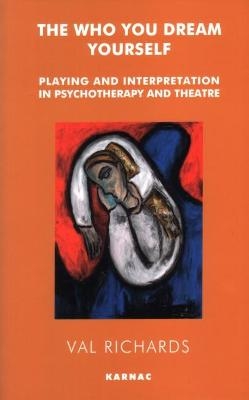
The Who You Dream Yourself
Playing and Interpretation in Psychotherapy and Theatre
Seiten
2005
Karnac Books (Verlag)
978-1-85575-313-6 (ISBN)
Karnac Books (Verlag)
978-1-85575-313-6 (ISBN)
The motif of time and space runs as a continual thread through this book, which examines the relationship between psychotherapy and the theatre as underpinned by Winnicott's writings.
'At the time of beginning my own therapy, I was teaching drama and theatre studies and become fascinated by the analogies between theatre and therapy, especially by how these set-apart space-times affect the behaviour of meaning-making and the seeming immensity of the therapist's power.'...as a trainee psychotherapist, discovering the writings of Winnicott, I realised that his theory of transitional phenomena and his vision of "playing"...provided a theoretical underpinning to the bond between theatre and therapy, bringing together the three parts of this book.'- From the IntroductionThe motif of time and space runs as a continual thread through this book, which examines the relationship between psychotherapy and the theatre as underpinned by Winnicott's writings. Richards supplements her theories with Jung's ideas on self, the writings of Lacan and the prose, drama and poetry of Yeats - an unusual blend between diverse and often opposing schools of thought.The book itself is divided into three parts. Part One focuses on the workings of language, space and meaning-making in the settings of infancy, therapy and theatre. Part Two looks at the "struggle between masks", which is used as a metaphor for self and the representation of self. Richards considers how the phenomenon of theatrical "forced masks and free masks" serves as an analogy for the range of positions inadequately covered by the True and False Self dichotomy of Winnicitt. Part Three looks at signs and times by showing that space and linear time are one and indivisible: disturbance in one means disturbance in the other. The point is illustrated with an in-depth examination of Yeat's Purgatory. Elsewhere in the book, case studies are used to illustrate formulations.This book is highly recommended for analysts, therapists and trainees, in particular child and Winnicottian therapists, and anyone with an interest in the role of theatre plays in the wider world.
'At the time of beginning my own therapy, I was teaching drama and theatre studies and become fascinated by the analogies between theatre and therapy, especially by how these set-apart space-times affect the behaviour of meaning-making and the seeming immensity of the therapist's power.'...as a trainee psychotherapist, discovering the writings of Winnicott, I realised that his theory of transitional phenomena and his vision of "playing"...provided a theoretical underpinning to the bond between theatre and therapy, bringing together the three parts of this book.'- From the IntroductionThe motif of time and space runs as a continual thread through this book, which examines the relationship between psychotherapy and the theatre as underpinned by Winnicott's writings. Richards supplements her theories with Jung's ideas on self, the writings of Lacan and the prose, drama and poetry of Yeats - an unusual blend between diverse and often opposing schools of thought.The book itself is divided into three parts. Part One focuses on the workings of language, space and meaning-making in the settings of infancy, therapy and theatre. Part Two looks at the "struggle between masks", which is used as a metaphor for self and the representation of self. Richards considers how the phenomenon of theatrical "forced masks and free masks" serves as an analogy for the range of positions inadequately covered by the True and False Self dichotomy of Winnicitt. Part Three looks at signs and times by showing that space and linear time are one and indivisible: disturbance in one means disturbance in the other. The point is illustrated with an in-depth examination of Yeat's Purgatory. Elsewhere in the book, case studies are used to illustrate formulations.This book is highly recommended for analysts, therapists and trainees, in particular child and Winnicottian therapists, and anyone with an interest in the role of theatre plays in the wider world.
Val Richards
Preface , Introduction , Signs and Spaces , Language, space, and meaning-making , The genesis of meaning-making , A time and a place for playing: transitional phenomena , “An act apart”: meaning-making in theatre and therapy , Analytic interpretation: games and playing , Interpretation and playing: freedom of association , No-space: psychotic meaning-making and regression , The Struggle between Masks , The mask of language , Forced masks and free masks , Child’s play: show and hide , The search for free masks , Signs and Times , Time, fantasy, and imagination , “A dead, living murdered man!” , This year , … Next year … , Sometime: the past and the future perfect , Never , The who you dream yourself
| Verlagsort | London |
|---|---|
| Sprache | englisch |
| Maße | 147 x 230 mm |
| Themenwelt | Medizin / Pharmazie ► Medizinische Fachgebiete ► Psychiatrie / Psychotherapie |
| ISBN-10 | 1-85575-313-8 / 1855753138 |
| ISBN-13 | 978-1-85575-313-6 / 9781855753136 |
| Zustand | Neuware |
| Informationen gemäß Produktsicherheitsverordnung (GPSR) | |
| Haben Sie eine Frage zum Produkt? |
Mehr entdecken
aus dem Bereich



aus dem Bereich
Zwischen Normvariante, Persönlichkeitsstörung und …
Buch | Softcover (2022)
Kohlhammer (Verlag)
CHF 49,95
Menschen mit psychischer Erkrankung wirksam unterstützen
Buch | Hardcover (2023)
Psychiatrie Verlag
CHF 48,95


