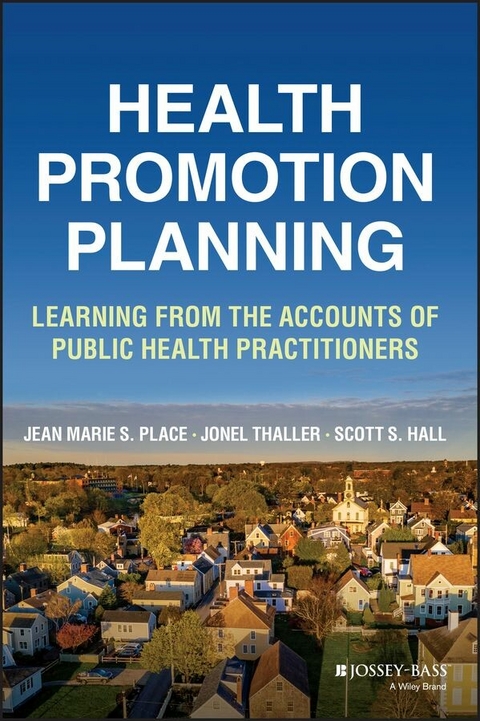
Health Promotion Planning (eBook)
322 Seiten
John Wiley & Sons (Verlag)
978-1-119-68620-0 (ISBN)
'I find this book to be an invaluable resource, offering a comprehensive guide for assessing and addressing public health issues. Its unique blend of theoretical insights and real-world narratives provides a nuanced understanding of interventions in practical contexts. This book is an essential tool for both current and aspiring professionals in the public health sector.'
-DANE MINNICK, Indiana Division of Mental Health and Addiction
Real stories, real solutions-a unique textbook that embeds definitions and descriptions of program planning principles within the story of one town grappling with the opioid crisis
In Health Promotion Planning: Learning from the Accounts of Public Health Practitioners, you will embark on a journey through the heart of a small midwestern city, where a community grapples with the daunting challenges of the opioid epidemic. The book uses narratives in a creative and engaging way, weaving together the real-life accounts of over 100 public health practitioners.
As you follow the saga of the town, you will see program planning principles in action. Through the intricacies of substance use and opioid-related challenges, this book sheds light on the interconnected efforts of diverse programs, including needs assessment, health education curriculum, health communication campaigns, environmental change strategies, peer support initiatives, and community organizing.
Students and practitioners will uncover the principles and processes of building health promotion programs. Discussion questions and activities at the end of each chapter stimulate reflection and exploration, offering a valuable resource for instructors and individual learners.
Health Promotion Planning is a powerful glimpse into public health practice, inspiring future generations to take up the mantle in addressing societal challenges. Learners will witness health promotion in action as they follow the compelling stories inside-where lessons are learned, lives are changed, and hope emerges from the frontlines of a devastating epidemic.
Jean Marie S. Place is Associate Professor of Health Science at Ball State University. Her research and teaching areas include women's health, maternal and child health, substance abuse and global health. She received her Doctorate in Health Promotion, Education, & Behavior from the University of South Carolina. Her community-based research focuses on addressing root causes of substance use disorder such as adverse childhood experiences and trauma.
Jonel Thaller earned a Master's and Doctoral degree in Social Work from Arizona State University. She is currently an Associate Professor of Social Work at Ball State University where she teaches coursework related to program evaluation and human behavior in the social environment. She also supervises social work students in community-based practicums within public health organizations and works closely with several prevention, treatment, and recovery programs that address substance use disorders.
Scott S. Hall is a professor of family science in the department of Early Childhood, Youth, and Family Studies at Ball State University. He earned a Masters degree in Marriage and Family Therapy at the University of Nebraska-Lincoln and a Doctorate degree in Family Studies at Purdue University. He has taught various courses related to program planning, including grant writing and research methods, family stressors and crisis, and family relations, and has been involved with community-based programs related to foster care, suicide, and substance use disorders.
Jean Marie S. Place is Associate Professor of Health Science at Ball State University. Her research and teaching areas include women's health, maternal and child health, substance abuse and global health. She received her Doctorate in Health Promotion, Education, & Behavior from the University of South Carolina. Her community-based research focuses on addressing root causes of substance use disorder such as adverse childhood experiences and trauma. Jonel Thaller earned a Master's and Doctoral degree in Social Work from Arizona State University. She is currently an Associate Professor of Social Work at Ball State University where she teaches coursework related to program evaluation and human behavior in the social environment. She also supervises social work students in community-based practicums within public health organizations and works closely with several prevention, treatment, and recovery programs that address substance use disorders. Scott S. Hall is a professor of family science in the department of Early Childhood, Youth, and Family Studies at Ball State University. He earned a Masters degree in Marriage and Family Therapy at the University of Nebraska-Lincoln and a Doctorate degree in Family Studies at Purdue University. He has taught various courses related to program planning, including grant writing and research methods, family stressors and crisis, and family relations, and has been involved with community-based programs related to foster care, suicide, and substance use disorders.
Note to Instructors ix
Foreword xi
Acknowledgments xiii
Introduction 1
One: Community Health Needs Assessment: Collecting Data to Inform Interventions 17
Two: Fatality Review Board: Identifying Risk Factors for Poor Health Outcomes 30
Three: Maternal Treatment Program: Using Consumer Analysis to Target a Specific Segment of the Population 44
Four: Recovery Ride and Rally: Event Planning and Process Improvement 60
Five: Red Ribbon Week: Raising Support to Change Community Norms 74
Six: The Wise Program: Social Marketing Strategies to Promote Health Education Interventions 88
Seven: Peer-run Warmline: Managing and Evaluating a Health Communication Program 103
Eight: An Interprofessional Symposium: Recruiting Planning Committee Members and Setting Measurable Goals and Objectives 120
Nine: Recovery Café: Building an Environmental Change Strategy for Positive Health Outcomes 133
Ten: Grassroots Community Organizing: Assessing Readiness for Change 149
Eleven: Trauma-informed Care: Creating Health Communication Campaigns for Public Awareness 165
Twelve: Working with External Vendors: Knowing What to Look for 178
Thirteen: Working with Volunteers: Learning Management Skills 184
Fourteen: Working Across Institutions: Sharing Knowledge on Substance Use Disorders 192
Index 200
CHAPTER 1
COMMUNITY HEALTH NEEDS ASSESSMENT: COLLECTING DATA TO INFORM INTERVENTIONS
In this chapter, we highlight how a formalized needs assessment provides a systematic way to gather and analyze data to begin to solve community problems. Program planning is more effective when the needs and voices of community members, and not merely the goals of administrators and practitioners, are incorporated into the process.
Flynn Mosi, Director of Community Outreach for a large nonprofit area hospital, was sitting comfortably in a polo shirt, smiling generously across the table. He was talking about the hospital’s ongoing community health needs assessment. Flynn loved that conducting a needs assessment was part of his job. Specifically, he explained, he loved being part of connecting the hospital to his home town in a way that improved the overall health of the community. Additionally, his efforts ensured that the hospital would maintain its tax‐exempt status, as each nonprofit area hospital was required to conduct an assessment every three years.
Flynn explained that the purpose of a community health needs assessment was to identify community health needs and inform the planning and development of an implementation strategy to address these needs. In his county, community health needs could include high rates of diabetes, accidents, or behavioral health issues, among many other health problems. They could also include barriers to care, such as lack of accessibility, availability, or affordability of services. The Patient Protection and Affordable Care Act, or “Obamacare,” was behind the push to assess and plan for community health needs in Flynn’s region. It required that Flynn and his team collect a wide range of data, compare the relative importance of multiple health problems, and set priorities to address the top needs in the community. Flynn flashed a smile and excitedly shared that the needs assessment process would take place in three phases: (1) data collection, (2) data analysis, and (3) intervention planning.
FOCUS GROUPS AS A MEANS OF DATA COLLECTION
Flynn and his team began the needs assessment process by conducting focus groups to learn about the community's health needs. They were in the process of conducting three focus groups at different times and on different days of the week within a two‐month period. The people first invited to participate were change agents in the community, rich with connections to the wider population. Attendees included directors of nonprofits, public health practitioners, neighborhood association leaders, healthcare providers, outreach specialists, business owners, and case workers.
Focus groups, or group interviews, are a research method used to elicit people’s opinions, feelings, beliefs, insights, attitudes, and perspectives on a selected topic. Focus groups are qualitative in nature, meaning a facilitator uses a guide to ask open‐ended questions to a small group (usually between 7 and 10 people) to learn what group members think about the topic. In a needs assessment, focus groups can be used to identify a variety of needs in a community.
Some focus groups use purposive sampling, which involves recruiting people who meet certain criteria, such as those who share a similar life experience or demographic background. Results from focus group discussions with specific populations can be compared to find similarities and differences among groups.
A skilled moderator who can create a comfortable atmosphere and elicit responses to questions is necessary for conducting a focus group. A co‐moderator can also help by drawing attention to group dynamics that the lead moderator might overlook. With participants’ consent, focus groups should be audio‐recorded so that data can be transcribed to written text to facilitate analysis.
Remember that results emerging from focus groups might not be generalizable to other groups because of purposive sampling where participants are selected based on certain characteristics or criteria.
Flynn described a practical matter in forming the focus groups, that of making sure the groups were neither too big nor too small. He had learned to keep each group between 12 and 15 people. He explained why: “In a focus group of 30 people, 20 of the people never get to talk, so you’re not hearing from a large portion of people. But, if groups are too small, one person feels like they can take center stage. They’ll begin to drive the whole meeting and dominate the discussion. That’s not good either.” He continued, “For these reasons, I’ve found that 12–15 people is a pretty good size, and everybody gets a chance to talk.” Flynn planned to use purposive sampling to recruit professionals to attend the first focus group. Later in the month, he would invite members of the lay public to attend a second focus group.
On a hot day in April, Flynn spoke with 15 attendees over video conference to learn more about what they see as the most pressing health issues in the community. The goal of the group was to consider multiple health challenges, and debate and reflect on which ones were most important, which ones were changeable, and which should be the focus of community change efforts. From this effort, he anticipated a short list of more urgent issues would emerge and become visible from the dozens of health problems that existed in the community.
To get the meeting started, Flynn encouraged everyone to briefly introduce themselves. Then, he promptly outlined how the focus group would proceed. First, he would share recent health statistics – secondary data from federal‐, state‐, and county‐level surveys – to paint a picture of the community’s health needs. Then he would ask for feedback and reflections on the data shared.
Secondary data is data already collected by someone else for a different purpose and made available for the public to access through online datasets. It includes existing data generated from large government institutions, healthcare facilities, or other data collection organizations, and available in books, on websites, or in journal articles or other publications.
Primary data is information collected firsthand, generally via survey, questionnaire, qualitative interview, or focus group.
The secondary data presented to focus group participants in the video conference included demographics of the county (e.g. age ranges, education levels, ethnicity), health status among residents, and factors that influence health status. The data were pulled from the Robert Wood Johnson County Health Rankings, the state Department of Health, US census track data, as well as other state, federal, and foundation sources. Data on the county included the following:
- The percent of residents with a disability was higher than state and national averages.
- Poverty rates for residents were above the state and national averages. Poverty rates for Black and Hispanic (or Latino) residents were generally above the poverty rate of White residents.
- Unemployment rates were above state and national averages.
- The percentage of people uninsured was above the national average.
- Crime rates were below state averages.
- Rates of mortality for diabetes in the county were significantly higher than state averages.
- The county had overall cancer mortality and lung cancer mortality rates that exceeded state averages.
- Rates of women who smoked during pregnancy were more than 50% higher than the state average.
- Several census tracts in the county were designated as food deserts.
- The percent of children in poverty in the county was 22.2%.
Flynn explained why he started the focus group by presenting secondary data. “I had to encourage participants to talk about what data points stood out as well as what was notably absent in the reporting.” Secondary data can only say so much, and Flynn intended that the focus group discussion would fill in any data gaps to better understand the needs of the population. Thus, while secondary data was used to launch the focus group, the discussion would become a new source of primary data about the health of the community, with participants providing feedback on whether the statistics shared reflected the true needs of their community. What things stood out in the statistical picture? What was not presented that should have been?
As the focus group proceeded, Flynn asked open‐ended questions to deepen the conversation and prompt the attendees to further consider community needs. He asked the following questions: What needs are you personally seeing? What do people in our community struggle with? What do we need to focus on to help people in our community? These questions were variations of the core question of a needs assessment: What are the needs of the target population? In this case, the target population was referring to residents of the county.
Within the focus group, one attendee suggested lack of access to healthy foods was a problem, and another noted community issues with financial literacy. Others rallied around mental health issues and shared stories to emphasize their point. “Lack of birth control,” another small cohort insisted. Addiction and substance misuse was mentioned again and again, including addiction to prescription pain killers, and everyone agreed COVID‐19 exacerbated health...
| Erscheint lt. Verlag | 8.4.2024 |
|---|---|
| Sprache | englisch |
| Themenwelt | Medizin / Pharmazie ► Allgemeines / Lexika |
| Sozialwissenschaften ► Politik / Verwaltung | |
| Schlagworte | Allg. Public Health • community based health • Gesundheits- u. Sozialwesen • Gesundheitsvorsorge • Health & Social Care • health program planning • Health Promotion • health promotion book • health promotion program • health promotion textbook • Program evaluation • Public Health • Public Health General • Public health planning • public health programs • public health textbook |
| ISBN-10 | 1-119-68620-2 / 1119686202 |
| ISBN-13 | 978-1-119-68620-0 / 9781119686200 |
| Informationen gemäß Produktsicherheitsverordnung (GPSR) | |
| Haben Sie eine Frage zum Produkt? |
 EPUB (Adobe DRM)
Kopierschutz: Adobe-DRM
Adobe-DRM ist ein Kopierschutz, der das eBook vor Mißbrauch schützen soll. Dabei wird das eBook bereits beim Download auf Ihre persönliche Adobe-ID autorisiert. Lesen können Sie das eBook dann nur auf den Geräten, welche ebenfalls auf Ihre Adobe-ID registriert sind.
Details zum Adobe-DRM
Dateiformat: EPUB (Electronic Publication)
EPUB ist ein offener Standard für eBooks und eignet sich besonders zur Darstellung von Belletristik und Sachbüchern. Der Fließtext wird dynamisch an die Display- und Schriftgröße angepasst. Auch für mobile Lesegeräte ist EPUB daher gut geeignet.
Systemvoraussetzungen:
PC/Mac: Mit einem PC oder Mac können Sie dieses eBook lesen. Sie benötigen eine
eReader: Dieses eBook kann mit (fast) allen eBook-Readern gelesen werden. Mit dem amazon-Kindle ist es aber nicht kompatibel.
Smartphone/Tablet: Egal ob Apple oder Android, dieses eBook können Sie lesen. Sie benötigen eine
Geräteliste und zusätzliche Hinweise
Buying eBooks from abroad
For tax law reasons we can sell eBooks just within Germany and Switzerland. Regrettably we cannot fulfill eBook-orders from other countries.
aus dem Bereich