


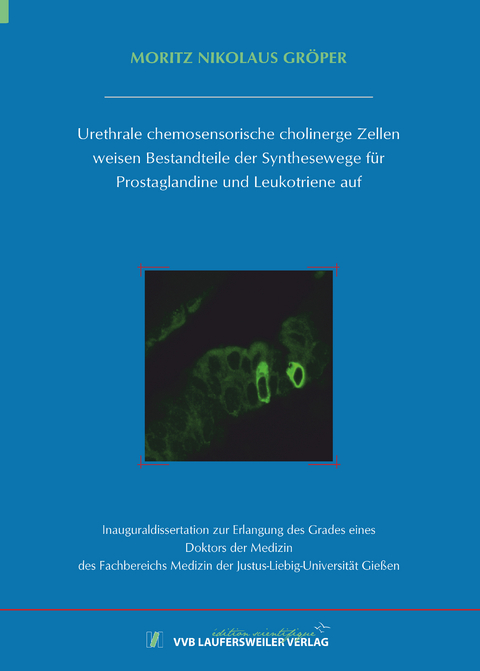
Urethrale chemosensorische cholinerge Zellen weisen Bestandteile der Synthesewege für Prostaglandine und Leukotriene auf
Seiten
2024
VVB Laufersweiler Verlag
978-3-8359-7177-6 (ISBN)
VVB Laufersweiler Verlag
978-3-8359-7177-6 (ISBN)
UCCC fungieren als Wächter am Eingang des Urogenitaltraktes und initiieren bei Wahrnehmung potenziell schädlicher Substanzen mittels der kanonischen Geschmackskaskade (u.a. α-Gustducin, PLCβ2 und TRPM5) Schutzmaßnahmen. Für die Entwicklung von UCCC ist der Transkriptionsfaktor Pou2f3 essenziell. CCC der Trachea und im gastrointestinalen Trakt weisen die vollständigen Synthesewege für Prostaglandine und Leukotriene auf. Relevante Proteine sind hierbei FLAP für die Cysteinyl-Leukotriensynthese und Cox-1 für die Prostaglandinsynthese. Hier wurde geprüft, ob auch UCCC die Bestandteile der Prostaglandin- und Leukotriensynthesewege aufweisen. Dazu wurden Expressionsanalysen an der Urethra der Maus mittels NGS-Daten und RT-PCR durchgeführt. Das Vorkommen der Proteine FLAP, ChAT und der Bestandteile der Bittergeschmackstransduktion sowie von Cox-1, ChAT und FLAP in UCCC wurde immunhistochemisch an C57BL/6Rj- und ChAT-eGFP-Mäusen untersucht. Eine immunhistochemische Abgrenzung zur neuroendokrinen Zelle erfolgte an Pou2f3-/--Tieren, denen UCCC fehlen. Dabei wurden Antikörper-Markierungen gegen Serotonin als Marker für neuroendokrine Zellen und FLAP durchgeführt. In Überständen explantierter Urethren von Pou2f3-/-- und C57BL/6Rj-Mäusen wurde mittels Cysteinyl-Leukotrien-ELISA die Cysteinyl-Leukotrien-Konzentration nach Stimulation mit dem Bitterstoff Denatonium gemessen, um eine mögliche durch UCCC vermittelte Cysteinyl-Leukotrien-Freisetzung zu untersuchen.
Serotonin-immunreaktive neuroendokrine Zellen zeigten in Pou2f3-/-- und C57BL/6Rj-Tieren keine FLAP+-Markierung. In der Urethra zeigte sich in den NGS-Daten und der RT-PCR mRNA-Expression von für die Prostaglandin- und Leukotriensynthese relevanten Proteinen wie FLAP und Cox-1. Immunhistochemisch ließen sich im urethralen Epithel von ChAT-eGFP-Tieren FLAP+-Zellen finden. ChAT+/FLAP+-Zellen zeigten die typische, keulenförmige UCCC-Morphologie, ChAT-/FLAP+-Zellen hingegen nicht. Darüber hinaus ließen sich in der Lamina propria FLAP+-Zellen nachweisen, die am ehesten Immunzellen sind. In ChAT-eGFP-Tieren waren ChAT und FLAP zu 63% bei Weibchen und zu 49% bei Männchen bei typischer UCCC-Morphologie kolokalisiert. Nur 40% bei Weibchen bzw. 35% bei Männchen der (Ad-)Villin+-Zellen waren auch FLAP+. 53,9% der α-Gust+-Zellen, 71% der PLCβ2+-Zellen bei Männchen und Weibchen sowie 53% bei Weibchen und 63% bei Männchen der TRPM5+-Zellen waren in C57BL/6Rj-Tieren FLAP+. ChAT und Cox-1 waren zu 59% bei Weibchen und 62% bei Männchen, Cox-1 und FLAP zu 68% bei Weibchen und 92% bei Männchen kolokalisiert. FLAP+-Zellen in Pou2f3-/--Tieren zeigten keine typische UCCC-Morphologie und waren Cox-1-. Die Stimulation explantierter Urethren mit Denatonium ergab von einem Basiswert im Überstand über 5000 pg/ml ausgehend keinen signifikanten Anstieg der Cysteinyl-Leukotrien-Konzentration. Im Vergleich zu anderen Organen (wie z.B. der Gallenblase) stellt dies einen deutlich erhöhten Wert dar. Die Überdeckung UCCC-vermittelter Leukotrienfreisetzung durch andere Quellen, z.B. Immunzellen, scheint möglich. In Untersuchungen an Geweben von menschlichen Körperspendern ließen sich keine Markierungen mit charakteristischen CCC-Markern und FLAP zeigen.
In dieser Arbeit wurden zwei UCCC-Phänotypen dokumentiert: UCCC-Typ 1 weisen neben klassischen Bürstenzellmarkern wie ChAT und den Bestandteilen der Geschmackstransduktion auch die Anteile der Eicosanoidsynthese wie FLAP und Cox-1 auf. UCCC-Typ 1 waren am häufigsten vertreten. UCCC-Typ 2 zeigten nur ChAT und Bestandteilen der Geschmackstransduktion. Durch UCCC freigesetzte Eicosanoide könnten in der Urethra bei einer durch UCCC vermittelten neurogenen Entzündung oder einer durch UCCC vermittelten Kontraktion der Harnröhre nach Kontakt mit Pathogenen eine Rolle spielen. Die spezifische Funktion aus UCCC freigesetzter Prostaglandine bzw. Leukotriene verbleibt weiterhin unklar und bedarf weiterer Untersuchungen. UCCC act as sentinels at the entrance of the urogenital tract and initiate protective measures upon perception of potentially harmful substances through of the canonical taste cascade (including α-gustducin, PLCβ2 and TRPM5). The transcription factor Pou2f3 is essential for the development of UCCC. CCC of the trachea and the gastrointestinal tract express the complete synthetic pathways for prostaglandins and leukotrienes. Relevant proteins here are FLAP for cysteinyl-leukotriene synthesis and Cox-1 for prostaglandin synthesis. Here, we asked whether UCCC also express the components of prostaglandin and leukotriene synthesis pathways. Expression analyses were carried out on murine urethra using NGS-data and RT-PCR. The presence of the proteins FLAP, ChAT and of the components of the taste transduction cascade as well as of Cox-1, ChAT and FLAP in UCCC was investigated by immunohistochemistry in C57BL/6Rj- and ChAT-eGFP mice. Immunohistochemical differentiation from neuroendocrine cells was carried out using a genetically modified mouse strain in which the transcription factor Pou2f3, a central developmental factor of UCCC, was deleted. Labelling with antibodies against serotonin as a marker for neuroendocrine cells and FLAP was performed. In supernatants of explanted urethrae from Pou2f3-/-- and C57BL/6Rj-mice, cysteinyl-leukotriene concentration was measured by ELISA after stimulation with the bitter substance denatonium to investigate a possible UCCC-mediated cysteinyl-leukotriene release.
Serotonin-immunoreactive neuroendocrine cells showed no FLAP+ labelling in Pou2f3-/-- and C57BL/6Rj-animals. In the urethra, NGS-data and RT-PCR showed mRNA expression of proteins relevant for prostaglandin and leukotriene synthesis, such as FLAP and Cox-1. Immunohistochemically, FLAP+-cells could be found in the urethral epithelium of ChAT-eGFP-mice. ChAT+/FLAP+-cells showed the typical club-shaped UCCC morphology, whereas ChAT-/FLAP+-cells did not. In addition, FLAP+-cells, which are most likely immune cells, could be detected in the lamina propria. In ChAT-eGFP-mice, ChAT and FLAP were colocalised in 63% of cells in females and 49% of cells in males with typical UCCC morphology. Only 40% of cells in females and 35% of cells in males of (Ad-)Villin+-cells were also FLAP+. 53.9% of α-Gust+-cells, 71% of PLCβ2+-cells in males and females, and 53% in females and 63% in males of TRPM5+-cells were FLAP+ in C57BL/6Rj-mice. ChAT and Cox-1 were colocalised in 59% of cells in females and 62% of cells in males, Cox-1 and FLAP were colocalised in 68% of cells in females and 92% of cells in males. FLAP+-cells in Pou2f3-/--mice did not show typical UCCC morphology and were Cox-1-.
Stimulation of explanted urethras with denatonium did not result in a significant increase in cysteinyl-leukotriene concentration from a baseline value in the supernatant above 5000 pg/ml. Compared to other organs (such as the gallbladder), this represents a markedly elevated value. A masking of UCCC-mediated leukotriene release by other sources, e.g. immune cells, seems possible. In studies on tissues from human body donors, no labelling with characteristic CCC markers and FLAP could be shown.
This study identified two UCCC phenotypes: UCCC type 1 exhibit the components of eicosanoid synthesis such as FLAP and Cox-1 in addition to classical brush cell markers such as ChAT and the components of the taste transduction cascade. UCCC type 1 were more abundant. UCCC type 2 showed only ChAT and components of taste transduction. UCCC-released eicosanoids could play a role in the urethra in UCCC-mediated neurogenic inflammation or UCCC-mediated contraction of the urethra after contact with pathogens. The specific function of prostaglandins or leukotrienes released from UCCC remains unclear and requires further investigation.
Serotonin-immunreaktive neuroendokrine Zellen zeigten in Pou2f3-/-- und C57BL/6Rj-Tieren keine FLAP+-Markierung. In der Urethra zeigte sich in den NGS-Daten und der RT-PCR mRNA-Expression von für die Prostaglandin- und Leukotriensynthese relevanten Proteinen wie FLAP und Cox-1. Immunhistochemisch ließen sich im urethralen Epithel von ChAT-eGFP-Tieren FLAP+-Zellen finden. ChAT+/FLAP+-Zellen zeigten die typische, keulenförmige UCCC-Morphologie, ChAT-/FLAP+-Zellen hingegen nicht. Darüber hinaus ließen sich in der Lamina propria FLAP+-Zellen nachweisen, die am ehesten Immunzellen sind. In ChAT-eGFP-Tieren waren ChAT und FLAP zu 63% bei Weibchen und zu 49% bei Männchen bei typischer UCCC-Morphologie kolokalisiert. Nur 40% bei Weibchen bzw. 35% bei Männchen der (Ad-)Villin+-Zellen waren auch FLAP+. 53,9% der α-Gust+-Zellen, 71% der PLCβ2+-Zellen bei Männchen und Weibchen sowie 53% bei Weibchen und 63% bei Männchen der TRPM5+-Zellen waren in C57BL/6Rj-Tieren FLAP+. ChAT und Cox-1 waren zu 59% bei Weibchen und 62% bei Männchen, Cox-1 und FLAP zu 68% bei Weibchen und 92% bei Männchen kolokalisiert. FLAP+-Zellen in Pou2f3-/--Tieren zeigten keine typische UCCC-Morphologie und waren Cox-1-. Die Stimulation explantierter Urethren mit Denatonium ergab von einem Basiswert im Überstand über 5000 pg/ml ausgehend keinen signifikanten Anstieg der Cysteinyl-Leukotrien-Konzentration. Im Vergleich zu anderen Organen (wie z.B. der Gallenblase) stellt dies einen deutlich erhöhten Wert dar. Die Überdeckung UCCC-vermittelter Leukotrienfreisetzung durch andere Quellen, z.B. Immunzellen, scheint möglich. In Untersuchungen an Geweben von menschlichen Körperspendern ließen sich keine Markierungen mit charakteristischen CCC-Markern und FLAP zeigen.
In dieser Arbeit wurden zwei UCCC-Phänotypen dokumentiert: UCCC-Typ 1 weisen neben klassischen Bürstenzellmarkern wie ChAT und den Bestandteilen der Geschmackstransduktion auch die Anteile der Eicosanoidsynthese wie FLAP und Cox-1 auf. UCCC-Typ 1 waren am häufigsten vertreten. UCCC-Typ 2 zeigten nur ChAT und Bestandteilen der Geschmackstransduktion. Durch UCCC freigesetzte Eicosanoide könnten in der Urethra bei einer durch UCCC vermittelten neurogenen Entzündung oder einer durch UCCC vermittelten Kontraktion der Harnröhre nach Kontakt mit Pathogenen eine Rolle spielen. Die spezifische Funktion aus UCCC freigesetzter Prostaglandine bzw. Leukotriene verbleibt weiterhin unklar und bedarf weiterer Untersuchungen. UCCC act as sentinels at the entrance of the urogenital tract and initiate protective measures upon perception of potentially harmful substances through of the canonical taste cascade (including α-gustducin, PLCβ2 and TRPM5). The transcription factor Pou2f3 is essential for the development of UCCC. CCC of the trachea and the gastrointestinal tract express the complete synthetic pathways for prostaglandins and leukotrienes. Relevant proteins here are FLAP for cysteinyl-leukotriene synthesis and Cox-1 for prostaglandin synthesis. Here, we asked whether UCCC also express the components of prostaglandin and leukotriene synthesis pathways. Expression analyses were carried out on murine urethra using NGS-data and RT-PCR. The presence of the proteins FLAP, ChAT and of the components of the taste transduction cascade as well as of Cox-1, ChAT and FLAP in UCCC was investigated by immunohistochemistry in C57BL/6Rj- and ChAT-eGFP mice. Immunohistochemical differentiation from neuroendocrine cells was carried out using a genetically modified mouse strain in which the transcription factor Pou2f3, a central developmental factor of UCCC, was deleted. Labelling with antibodies against serotonin as a marker for neuroendocrine cells and FLAP was performed. In supernatants of explanted urethrae from Pou2f3-/-- and C57BL/6Rj-mice, cysteinyl-leukotriene concentration was measured by ELISA after stimulation with the bitter substance denatonium to investigate a possible UCCC-mediated cysteinyl-leukotriene release.
Serotonin-immunoreactive neuroendocrine cells showed no FLAP+ labelling in Pou2f3-/-- and C57BL/6Rj-animals. In the urethra, NGS-data and RT-PCR showed mRNA expression of proteins relevant for prostaglandin and leukotriene synthesis, such as FLAP and Cox-1. Immunohistochemically, FLAP+-cells could be found in the urethral epithelium of ChAT-eGFP-mice. ChAT+/FLAP+-cells showed the typical club-shaped UCCC morphology, whereas ChAT-/FLAP+-cells did not. In addition, FLAP+-cells, which are most likely immune cells, could be detected in the lamina propria. In ChAT-eGFP-mice, ChAT and FLAP were colocalised in 63% of cells in females and 49% of cells in males with typical UCCC morphology. Only 40% of cells in females and 35% of cells in males of (Ad-)Villin+-cells were also FLAP+. 53.9% of α-Gust+-cells, 71% of PLCβ2+-cells in males and females, and 53% in females and 63% in males of TRPM5+-cells were FLAP+ in C57BL/6Rj-mice. ChAT and Cox-1 were colocalised in 59% of cells in females and 62% of cells in males, Cox-1 and FLAP were colocalised in 68% of cells in females and 92% of cells in males. FLAP+-cells in Pou2f3-/--mice did not show typical UCCC morphology and were Cox-1-.
Stimulation of explanted urethras with denatonium did not result in a significant increase in cysteinyl-leukotriene concentration from a baseline value in the supernatant above 5000 pg/ml. Compared to other organs (such as the gallbladder), this represents a markedly elevated value. A masking of UCCC-mediated leukotriene release by other sources, e.g. immune cells, seems possible. In studies on tissues from human body donors, no labelling with characteristic CCC markers and FLAP could be shown.
This study identified two UCCC phenotypes: UCCC type 1 exhibit the components of eicosanoid synthesis such as FLAP and Cox-1 in addition to classical brush cell markers such as ChAT and the components of the taste transduction cascade. UCCC type 1 were more abundant. UCCC type 2 showed only ChAT and components of taste transduction. UCCC-released eicosanoids could play a role in the urethra in UCCC-mediated neurogenic inflammation or UCCC-mediated contraction of the urethra after contact with pathogens. The specific function of prostaglandins or leukotrienes released from UCCC remains unclear and requires further investigation.
| Erscheinungsdatum | 20.03.2024 |
|---|---|
| Reihe/Serie | Edition Scientifique |
| Verlagsort | Gießen |
| Sprache | deutsch |
| Maße | 148 x 210 mm |
| Gewicht | 220 g |
| Themenwelt | Medizin / Pharmazie |
| Schlagworte | Cysteinyl-Leukotriensynthese • kanonischen Geschmackskaskade • Prostaglandine und Leukotriene • UCCC • Urogenitaltrakt |
| ISBN-10 | 3-8359-7177-8 / 3835971778 |
| ISBN-13 | 978-3-8359-7177-6 / 9783835971776 |
| Zustand | Neuware |
| Informationen gemäß Produktsicherheitsverordnung (GPSR) | |
| Haben Sie eine Frage zum Produkt? |
Mehr entdecken
aus dem Bereich

aus dem Bereich
Buch | Hardcover (2024)
Referenz-Verlag
CHF 79,95


