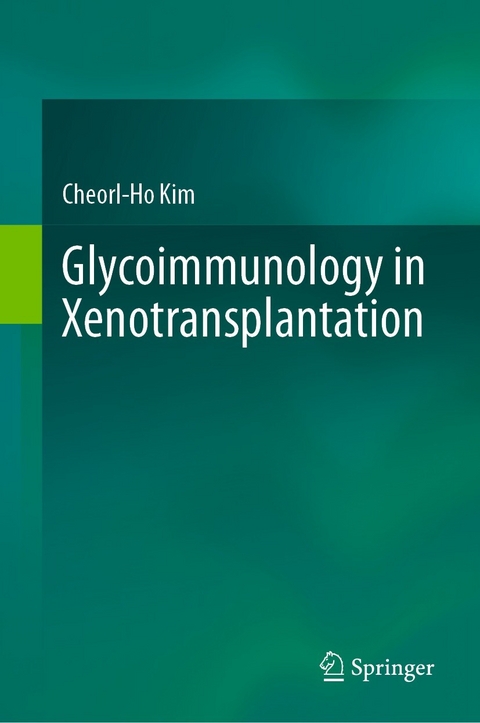
Glycoimmunology in Xenotransplantation (eBook)
365 Seiten
Springer Nature Singapore (Verlag)
978-981-99-7691-1 (ISBN)
This book describes general glycobiology in emphasizing the structures, biosynthesis, glycosylation and distribution of the glycans and xenogenic glycoantigens in eukaryotic cells of mammals including mouse, swine, chimpanzee and human. In the middle, I have focused on topics in xenotransplantation glycobiology and expand descriptions of allogenic and xenoantigenic transplantation to open the dawn in insights into the origin of life. One of the biological diversity, named species diversity, is a phenomenon environmentally adapted from the evolutionary process for long period. The distinct structures of glycans discriminate each organism and are the essential molecular basis of the discrimination and difference between the organisms, giving an incompatibility between the different species. Diversity and variations in carbohydrate chain structures between family, species, kingdoms and domains mark the global pattern and signs of immune self- and non-self recognition. In human, diversity in ABH blood group antigens is observed in human family and this type pattern distinguishes individuals from a pan-family to non-dividable unit of the family. Blood transfusion and organ transplantation are impossible even in the allogenic cross between humans if carbohydrates are ignored. This explains how and how human beings are a lonely existence. ABH-related antibodies induce hemolysis or hyperacute or allograft rejection due to incompatible graft property even between the same species. The incompatibility is an immunologic rejection when the recipient host receives the tissues or organs from the different species of donors, as well-known in pig-to-human xenotransplantation. The immunologic incompatibility between the donor pigs and the recipient human are based on the evolutionary distance between pigs and humans. This distance allows a xenograft rejection between the 2 mammals. Modification or deletion of the specific gene locus for immune rejection on genome of donor animalsdisrupts the immunological recognition ligands of the donor organs, consequently preventing the immune rejection of the human recipient and xenograft rejection. This book helps undergraduate and graduate students, researcher and professors who are involved in the glycobiology and xenoantigenic biology with recent advances in the xenotransplantation basic and clinic.
This book describes general glycobiology in emphasizing the structures, biosynthesis, glycosylation and distribution of the glycans and xenogenic glycoantigens in eukaryotic cells of mammals including mouse, swine, chimpanzee and human. In the middle, I have focused on topics in xenotransplantation glycobiology and expand descriptions of allogenic and xenoantigenic transplantation to open the dawn in insights into the origin of life. One of the biological diversity, named species diversity, is a phenomenon environmentally adapted from the evolutionary process for long period. The distinct structures of glycans discriminate each organism and are the essential molecular basis of the discrimination and difference between the organisms, giving an incompatibility between the different species. Diversity and variations in carbohydrate chain structures between family, species, kingdoms and domains mark the global pattern and signs of immune self- and non-self recognition. In human, diversity in ABH blood group antigens is observed in human family and this type pattern distinguishes individuals from a pan-family to non-dividable unit of the family. Blood transfusion and organ transplantation are impossible even in the allogenic cross between humans if carbohydrates are ignored. This explains how and how human beings are a lonely existence. ABH-related antibodies induce hemolysis or hyperacute or allograft rejection due to incompatible graft property even between the same species. The incompatibility is an immunologic rejection when the recipient host receives the tissues or organs from the different species of donors, as well-known in pig-to-human xenotransplantation. The immunologic incompatibility between the donor pigs and the recipient human are based on the evolutionary distance between pigs and humans. This distance allows a xenograft rejection between the 2 mammals. Modification or deletion of the specific gene locus for immune rejection on genome of donor animalsdisrupts the immunological recognition ligands of the donor organs, consequently preventing the immune rejection of the human recipient and xenograft rejection. This book helps undergraduate and graduate students, researcher and professors who are involved in the glycobiology and xenoantigenic biology with recent advances in the xenotransplantation basic and clinic.
| Erscheint lt. Verlag | 20.2.2024 |
|---|---|
| Zusatzinfo | XX, 365 p. 1 illus. |
| Sprache | englisch |
| Themenwelt | Studium ► 2. Studienabschnitt (Klinik) ► Humangenetik |
| Studium ► Querschnittsbereiche ► Infektiologie / Immunologie | |
| Naturwissenschaften ► Biologie ► Genetik / Molekularbiologie | |
| Schlagworte | biological diversity • carbohydrate antigen • ER/Golgi apparatus • glycan-based Evolution • Swine (pig) KO strain • Xenotransplantation |
| ISBN-10 | 981-99-7691-X / 981997691X |
| ISBN-13 | 978-981-99-7691-1 / 9789819976911 |
| Informationen gemäß Produktsicherheitsverordnung (GPSR) | |
| Haben Sie eine Frage zum Produkt? |
 PDF (Wasserzeichen)
DRM: Digitales Wasserzeichen
Dieses eBook enthält ein digitales Wasserzeichen und ist damit für Sie personalisiert. Bei einer missbräuchlichen Weitergabe des eBooks an Dritte ist eine Rückverfolgung an die Quelle möglich.
Dateiformat: PDF (Portable Document Format)
Mit einem festen Seitenlayout eignet sich die PDF besonders für Fachbücher mit Spalten, Tabellen und Abbildungen. Eine PDF kann auf fast allen Geräten angezeigt werden, ist aber für kleine Displays (Smartphone, eReader) nur eingeschränkt geeignet.
Systemvoraussetzungen:
PC/Mac: Mit einem PC oder Mac können Sie dieses eBook lesen. Sie benötigen dafür einen PDF-Viewer - z.B. den Adobe Reader oder Adobe Digital Editions.
eReader: Dieses eBook kann mit (fast) allen eBook-Readern gelesen werden. Mit dem amazon-Kindle ist es aber nicht kompatibel.
Smartphone/Tablet: Egal ob Apple oder Android, dieses eBook können Sie lesen. Sie benötigen dafür einen PDF-Viewer - z.B. die kostenlose Adobe Digital Editions-App.
Buying eBooks from abroad
For tax law reasons we can sell eBooks just within Germany and Switzerland. Regrettably we cannot fulfill eBook-orders from other countries.
aus dem Bereich